
Testing is over. The tire smoke has cleared, and the teams are packing for Melbourne. While the headlines are full of technical gossip, the stopwatch doesn’t lie. In this F1 pre-season testing analysis, we try to strip away the “sandbagging” and look at the long-run simulations from Bahrain to see who truly holds the upper hand.
Which team has the best race pace after Pre-season testing?
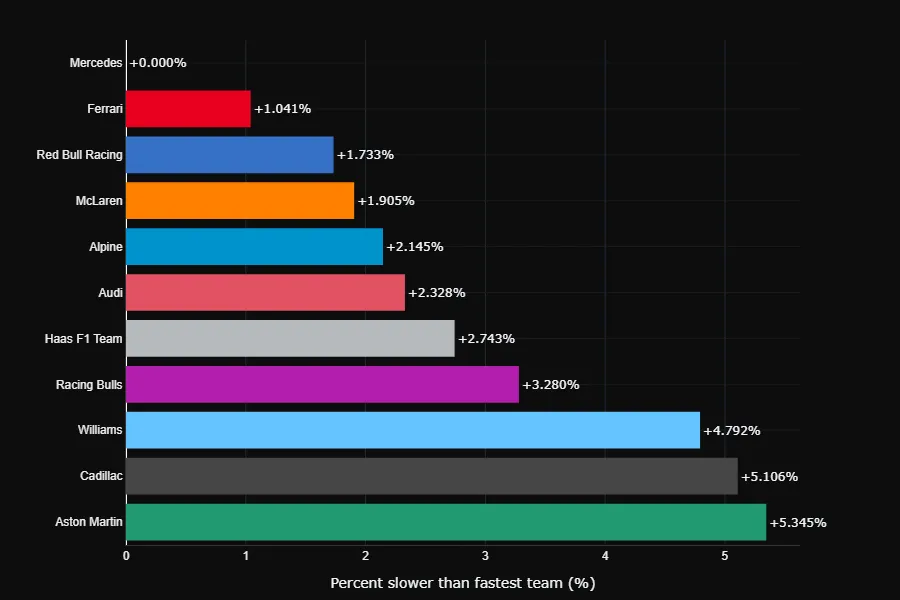
To find indication of the true race pace, we have filtered the data to only include stints of 8 laps or more. While a 20-lap simulation is the gold standard, these shorter long-runs still reveal critical patterns in pace which are essential for any F1 pre-season testing analysis. For each stint the median pace has been withdraven, afterwards a weighted pace is created based on stint-lenght. This makes shorter stints have a lower weight for ther overall pace picture. This approach also has it drawsback, however I believe it is more consistent than just taking the fastest lap and comparing sectors.
Mercedes: In a League of Their Own?
In the last post, Mercedes were catching up. However the tables have turned. There is no question that Mercedes are currently the top team in their testing, most of their longer stints had much better pace, compared to the other and they are currently in my believe in a league of their own, when looking at the data. However things may change in Q3 in Australia.
The Chasing Pack: Ferrari, Red Bull and Mclaren
They are closely followed by Ferrari who have been putting in the laps and showing great 1 stint pace, as well as best launch acceleration on the grid. Greatly followed are Red Bull Racing where Max Verstappen did an amazing 21 lap stint and I definitely believe we are not yet to leave them out of contention, but we will wait and have to see in Australia. They are followed by Mclaren who remains a threat matching some of the lower end of Mercedes pace, however on longer stints they fall back.
The midfield mystery: Alpine, Haas and Audi
While Alpine and Haas have shown reliable mileage, their median pace suggests they are stuck in no-man’s-land safe from the back, but too slow for the front. The real enigma is Audi. On paper, their pace matches Alpine, but the extreme variance in their lap times suggests they are still fighting inconsistency in the handling of the car which can be due to the energy management issues over longer stints. Meanwhile, Racing Bulls continue to prioritize extreme mileage over performance, likely stress-testing their 2026 engine.
Survival of the fittest: Williams, Cadillac and Aston Martin
At the back, Williams is surprisingly lagging behind their Mercedes-powered counterparts, however I believe they can make the required progress rather fast. For a premier entry, staying withing striking distance of established teams I am surprised by Caddilac. Finally Aston Martin, a total of 6 laps on Friday is not a test program it’s a crisis. Unless they have been hiding a massive performance update, Melbourne will be a painful wake-up call.
Is Energy Management in and Top Speed Out?
The paddock was left stunned when Charles Leclerc posted a blistering lap on Day 3, with just over a second clear of the Mercedes.
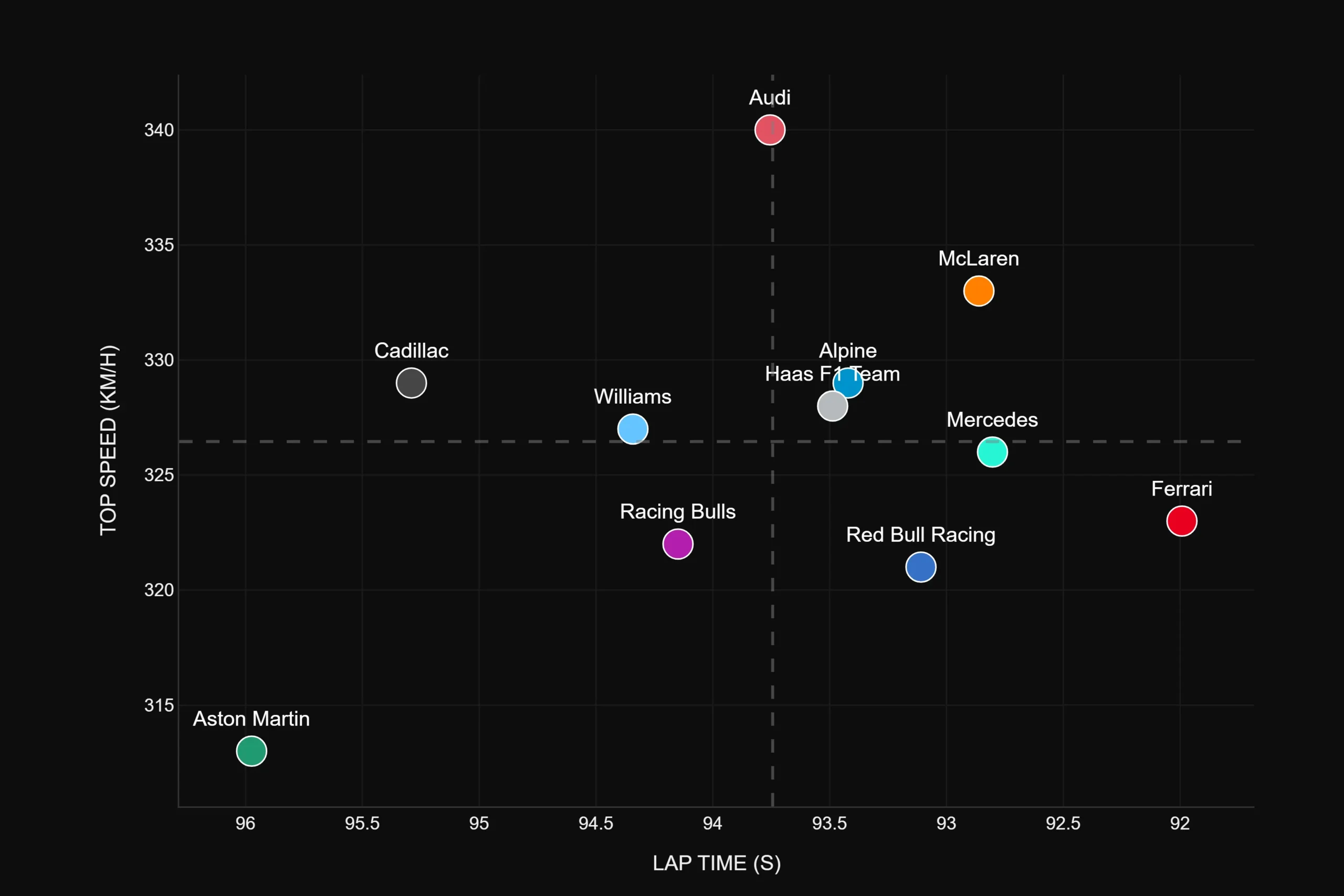
Despite holding the fastest lap by a significant margin, the Ferrari clocked the 4th lowest top speed in the Speed Traps. How does the fastest car on track end up being one of the slowest on the straights?
The answer lies in the 2026 Power Unit regulations. Ferrari appears to be prioritizing initial acceleration and energy harvesting over top-end velocity. By intentionally “clipping” (cutting electrical deployment) early on the straights, they conserve energy to ensure they have maximum torque available for every corner exit. This tactical trade-off suggests that in 2026, the battle for Pole Position won’t be won by the car with the least drag, but by the team with the smartest energy mapping and technical skills from the driver.
On the other hand Audi is able to retrieve the highest topspeed, however looking at the data they er losing significant time in Sector 2 compared to the other cars ahead of them indicating they are using more og the power on the straight sectors.
The Big Three Questions for Albert Park:
Qualifying Power: Can Ferrari translate their one-lap performance into a front-row lockout, or will they be challenged by the relentless efficiency of Mercedes and or the Red Bull power train?
Reliability Under Pressure: The 2026 Power Units have shown flashes of brilliance, but also moments of fragility. I will be keeping a close eye on the DNF potential for teams like Aston Martin and Audi. Furthermore, I’ll be tracking the different power unit groups—does one manufacturer’s architecture clearly outperform the others when it matters most?
Energy Management in the Race: Albert Park is notorious for its high-speed Sector 2. I’ll be watching for “clipping” and how each team approaches deployment on the long straights. Will they risk being a “sitting duck” for a chance at better acceleration out of the corners? It’s the ultimate tactical gamble.