
Oliver Bearman came to the Australia GP 2026 for the first time as an established driver, with a point to prove. Starting in P14 he was able to carve his way through the race ending up in P7. This was not done through strategy luck or safety car chaos, but through patience, tyre management and a calculated hunt that lasted the better part of the race.
While Mercedes and Ferrari were trading blows up front, a quieter battle was unfolding in the midfield between Bearman, Lindblad and Borteletto. The data tells you everything you need to know about how Bearman won it.
0.25 seconds a lap faster than Lindblad on identical strategy, never cracked. Never rushed it. This is that story.
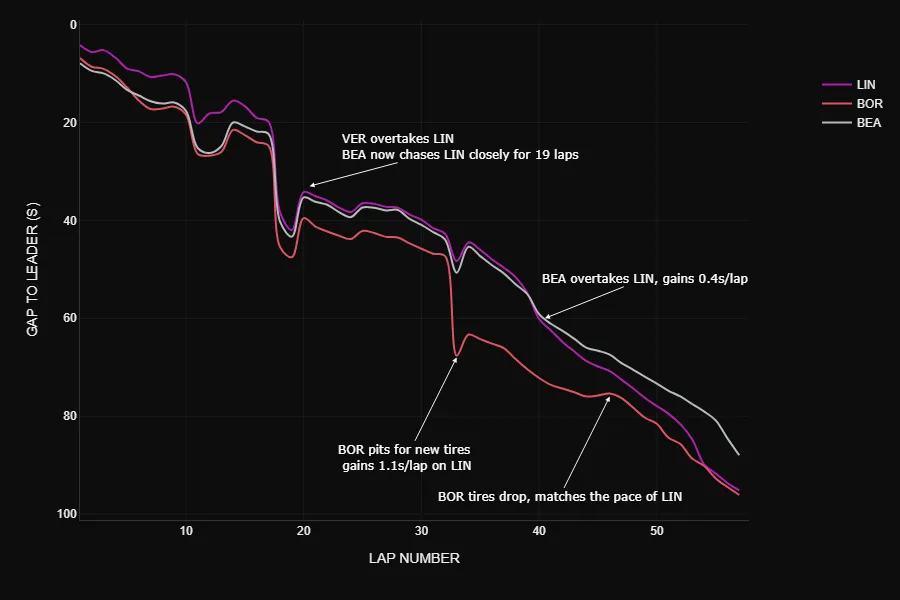
The chart below maps every lap of that battle. Keep it in mind as you read.
The chart tracks the gap to the race leader for each driver across all 58 laps. The further down the line moves, the further behind the leader they fall, so a steeper drop means faster relative pace. If a gap widens widens between two drivers is corresponds to gap in the track. The annotated moments mark the key events that shaped the midfield battle.
How the battle formed
All three started on the medium tyre – Bearman from P14, Borteletto from P11, Lindblad from P5. Before the first lap was done, the race had already reshuffled. Lawson botched his start, Piastri never made it to the grid, and Bearman had climbed two positions before the first corner of 2026 was done. Hulkenberg’s retirement handed him another place, and by lap 5 he had dispatched Borteletto too.
He was P11 and pointed at Lindblad who were five seconds up the road. The hunt was on.
How the battle unfolded
On lap 17 the gap was just around 4 seconds between the three cars, splitting them by 2 seconds each. They were all constantly posting times on the closest car. At this point it was clear for all three drivers, they were in a battle with each other.
At lap 18 all three pitted under the virtual safety car, swapping out worn mediums for a fresh set of hards. The picture changed dramatically in the pitlane. Bearman came out right behind Verstappen, who was chasing Lindblad, while Borteletto emerged 4 seconds behind, caught out behind Ocon and Gasly who had stayed out.
On the opening lap after the VSC Verstappen tried to pass Lindblad but couldn’t make it stick. That was Bearman’s opportunity. Haas knew they couldn’t compete with Verstappen or Norris, so they played it smart, sitting in cruise control behind the Lindblad and Verstappen fight, letting Lindblad burn his fresh tyres defending. When Verstappen finally made the move and cleared Lindblad, it became a straight fight between Lindblad and Bearman for the rest of the race.
For the next 19 laps Bearman sat within 1 to 1.5 seconds of Lindblad, waiting. He made his move at the start of lap 40 and simply outpaced him. Bearman showed pure maturity and patience, he never forced it. After the overtake Lindblad hit a cliff, his lap times dropping off significantly.
In the meantime Borteletto had been called in for a second stop after just 15 laps on his hards. Fresh tyres in hand, he began closing on both Bearman and Lindblad, but after only 13 laps his pace fell off a cliff too, and he never recovered enough to threaten Bearman.
With Lindblad’s tyres gone and Botoletto running out of time, Bearman had P7 secured. The final twist came at lap 54 when Borteletto crept back up to Lindblad, but Lindblad held him off to the flag.
The data behind the story
The above chart summarizes the race history, with lap indicators telling how it battles out between the drivers. The chart tells the story better than any lap time table could.
Even though Borteletto did a two stop and thus having on average fresher tires than Bearman, Bearman was able to deliver a race pace which was around 0.2 seconds faster. A more direct comparison can be made with Lindblad, who ran identical strategy as Bearman. Overall Lindblad was around 0.25 seconds slower than Bearman, most of the time is gained on the last 18 laps when Bearman cleared Lindblad where the gap between the accelerates to 0.2 seconds per lap.
This is based on all laps, not taking into account clean air time. If we had taken into account clean air it in this specific case would skew the analysis greatly, because Bearman spent most of his time on his fresh hards behind Lindblad, and thus only clean air laps was the last 17 laps in which the tires were worn out, so the sample is small.
The race history tells you what happened. The tyre degradation chart tells you why. Bearman’s degradation rate on the hard tyre was +0.078 seconds per lap nearly identical to Lindblad’s +0.082, but the gap to Bortoletto is where it gets interesting. At +0.117 seconds per lap, Bortoletto was degrading at almost 50% the rate of Bearman. That’s not a strategy call that’s a tyre that gave him no choice but to pit again. Audi has pace, but their tyre degradation held them back in Australia or maybe they though it was a mandatory 2 stopper.
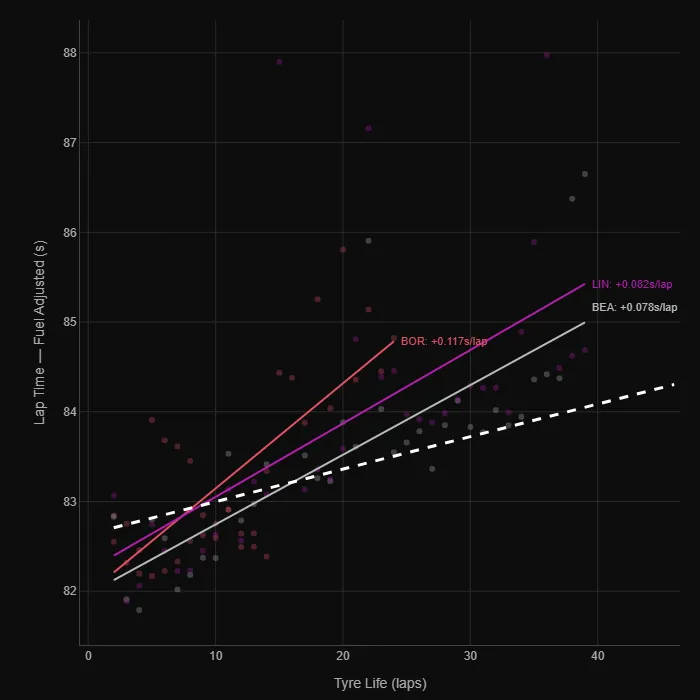
It is a masterclass in F1 tyre management from a driver only in his second season. Worth noticing too that Bearman showed no true drop in pace until lap 56 – long after the race was won.
It is worth noticing Bearman did not show any true drop in pace until lap 56, showing how great his focus and calmness for the tires were. I would love to do a direct comparison with Ocon, who followed the same exact same strategy. However Ocon was racing Gasly directly most of the race, which has led to a few situation on track and off track. Maybe in China a more direct comparison can be made.
Bearman came to Australia as an established driver with a point to prove. Forty laps of patience, one decisive move, and a tyre management performance that held up all the way to lap 56. Point proven.
Methodology
Data is sourced from the official F1 timing feed via the FastF1 Python library. Lap times are fuel-adjusted at 0.07 seconds per lap to account for decreasing fuel load. Safety car laps, VSC laps, and in and out laps are excluded.
Tyre degradation is calculated using linear regression on fuel-adjusted lap times against tyre life. The slope represents degradation rate in seconds per lap – steeper means faster drop-off.
Clean air is not accounted for in the pace comparison, as noted in the analysis.
If you like this content, come back for more!