
The Title Tracker
The standings tell you who is leading today, but they don’t reveal the true weight of the lead. A 50-point gap early in the season carries far less, than a 20-point gap in the final rounds.
To visualize the true state of the title race, we look beyond the current points. For every completed Grand Prix, we run simulations of the remaining calendar. This process translates current standings into actual win probabilities, illustrating exactly how many ‘paths to victory’ remain for each driver – and identifying the precise moment a championship dream becomes mathematically impossible or possible.
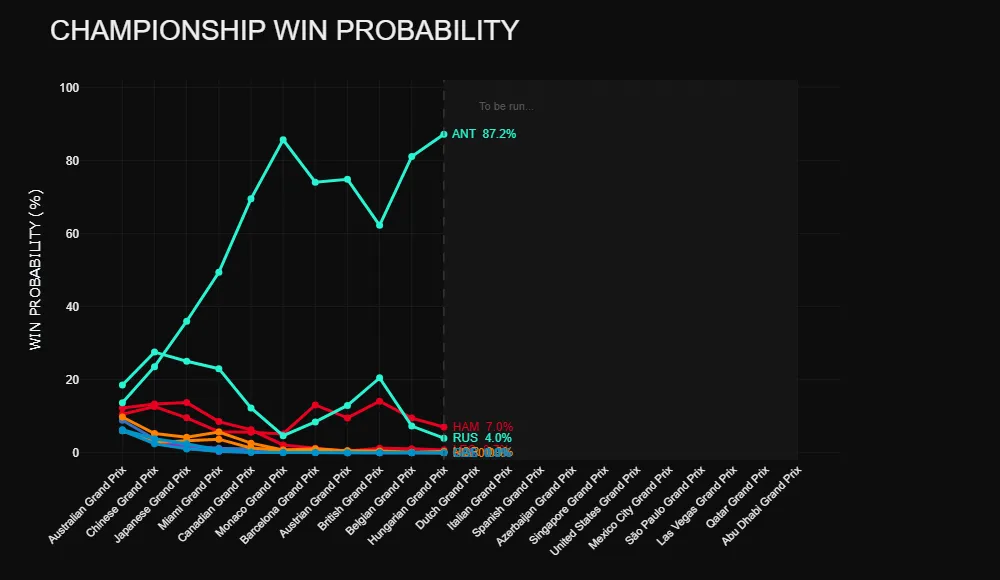
Note: Probabilities are updated after each race weekend. As the number of remaining races decreases, the weight of the standings increases, narrowing the paths to victory.
Update after Hungary
Kimi were despite the grid penalty able to finish ahead of the both Russel and Hamilton. Increasing his chances to win the championship. Russel had a bad start, while Hamilton also received a 5-sec penalty. Kimi now has a 50 point gap down to Hamilton in 2nd place. If Kimi reaches 70 points by Zandvoort he only needs to finish 2nd behind Hamilton for rest of the season and will still win WDC.
Update after Barcelona
Hamiltons first win with Ferrari, what a race and strategy. For once in a long time Ferrari were able to read the race and perform a perfect strategy, utilizing the undercut strenght in Barcelona. Hamilton went for a 3 stopper, while Russel went for a 2 stopper. In the end Hamilton was given a VSC which guranteed his win. In our latest piece comming up we investigate how much VSC had of an effect on the Hamilton win. Russel ended in second, saved by the Antonelli DNF. True title contenders currently are Antonelli, Russel and maybe Hamilton. The upgrades might have worked in Barcelona, however the real tests are still to come. Russel reduced the gap to Antonelli which is crucial if it becomes a two horse race.
Mclaren looked strong in racepace and was ready to pick up the pieces all weekend, if it stumbled between Ferrari and Mercedes.
Update after Monaco GP
The wonder bambino did it again. Antonelli locked in the frontrow and went on with it and delivered a amazing race. Creating a gap to a 7th time world champion in Monaco is not easy. Ferrari were clear favorites going into Monaco, but with Leclerc having issues in qualifying and Hamilton not putting right together the italian was able to start in the front. Monaco showed that Antonelli were something special, as Monaco is technical and more driver dependent to perform in. Which is why we have seen multiple pole qualifyings from cars, which were not in the front of the pack. The point lead is now 68 points. If Antonelli hits the 84 point mark after the Belgium GP, he would only need to finish 2nd behind Russel and still be champion. This is the curse of the two horse race, finishing outside the points as Russel has done in the last two GP’s can be devestating for his chances. If Russel really wants to get a go at this, he has to hope the other teams catch up to create some turbulence.
Talking of turbulence, Monaco delivered. Racing Bulls were able to get 15 points this weekend, which is quite a lot for a midfield team. Furthermore Aston Martin could be the real winners as they just got 1 point, which seperates them from 11th place, which now solely belongs to Cadillac. The amount of DNF’s in Monaco is exactly what we just wrote about in our latest piece. This is the opportunity for the midfield to gather points, which can be a deciding factor for their final constructor points. Having the car at the right track at the right point of time in the calender, can be crucial for constructors placement.
Update after Canada GP
This was Russel’s arena, some would say his best track on the calender and the gap to Antonelli became only larger. Antonelli and Russel both showed great pace in the upgraded mercedes car, which showed dominance across the whole weekend. The sprint race got fisty as Antonelli and Russel were battling it out on track and Antonelli did not seem to find a place around the position of Russel. Toto Wolf were surely looking away at some times. Going into the race day it was saturday all over again from the get go. For 30 laps it was cat an mouse between the two mercedes drivers. The team gave orders to stop the yo-yo and wait, because Verstappen was catching up. Just after that messeage to the team Russels car quit the race and turned on him by stopping by itself. Russel were emotional, which is understood. He lost unforgiving points, which in the end could be champion deciding points. This is the end game for Russel, he is against the wall. He showed pace in his arena, but not enough to make it clear it actually was his arena.
Antonelli is quite far ahead right now, and it is a true catchup game for Russel. It becomes difficult for George when Antonelli gets to a stage where he just needs to become 2nd in the races, which is what the numbers in model show he is approaching.
Verstappen had his best race of the season, finishing on the podium and battling with Hamilton for the whole race. Hamilton refused to use the sim in Maranello and ended up with a 2nd place. He showed great understanding of the car in all sessions and were quickest in the corners, however Canada once again showed Ferrari’s kryptonite, straight line speed. Leclerc on the other hand, he said it was his worst weekend in his career. He ended with a P4, he is probably thanking Russel, Norris and Piastri for that one. He did fend off Hadjar who were closing in on him.
Mclaren did a gamble on the intermediate, they did not split the strategy. The teams still suffers from telling their drivers what to do, they dont have a pecking order, so instead of splitting strategies they follow the same one. Just as they did in Qatar 2025, losing a lot of championship points.
In my view the big winner of Canda was Alpine, they scored massive points which keep them in the lead of the midfield. Both of them showed great pace and great racing.
Other good mentions:
- Alonso, showed great pace in the race however he had to retire due to seat issues.
- Bottas, ended his Sprint race as 11 on softs. Impressive and nice progress for Cadillac, must lift their spirits.
- Once again, Ocon was beaten by Bearman. Rumours stille flourish around his exit, but lets see…
Update after Miami GP
Kimi Antonelli won his third consecutive race from pole, he was able to fend off Lando Norris in an eventful 57-lap race. He has now hit the 100 points mark this season and leading russel by 20 points in the championship. As things stand now he is the clear favorite. However things can change rather quickly as both Mclaren drivers are making their apperance on the podium. Norris having a fantastic weekend, winning Sprint and qualifying in the top 3. While Piastri were able to gain the most from his position in the main grand prix.
Ferrari had a rough grandprix as Hamilton’s car was torn apart by Colapinto in the opening lap and thus had reduced pace for the remainder, while Leclerc had to fall back into a defending overcut and thus were not able to get to grabs of a podium. Leclerc faced a 20 second penalty from spinning on the final lap at Turn 3 and clipping the wall. He cut almost every corner to the flag and were thus dropped from a potential 4th position to an 8. Bad weekend for ferrari. Talking penalties
Verstappen had a great race, from the opening lap he spun and were on the backfoot the rest of the race. Redbull did a really early pitstop to try and get the undercut and go long on the hards from my point of view it was a genious strategic move as it put him right in the top again. Had it not been for the 5 sec penalty, he would have taken 4th position.
Another true winner of the weekend were Alpine being able to secure two Q3 spots, however due to a dramatic accidient between Liam Lawson and Gasly, Gasly had to retire as he went flying around in the air.
Update after Japan GP
A costly safety car, a chaotic mid-race reshuffle, and a Williams sandwich
Kimi Antonelli’s afternoon at Suzuka began the wrong way. A sluggish start dropped him down the order, and for a spell, the race looked like it might slip away entirely. But Formula 1 has a habit of rewriting the script, and at Suzuka, it did exactly that.
The turning point came courtesy of Ollie Bearman – a failed overtaking attempt on Colapinto sent the Haas into the barriers and brought out the Safety Car at the worst possible moment for the race leaders. George Russell and Oscar Piastri had just pitted. Antonelli had not. The timing was brutal for one side of the garage and a lifeline for the other.
Antonelli didn’t need asking twice. He nursed the gap, managed the restart, and drove it home with the composure of someone who knew the race had come to him. Sometimes you make your luck. Sometimes it arrives gift-wrapped.
Behind him, Russell spent the closing laps fighting off both Ferraris in a battle that was more war of attrition than outright pace. Charles Leclerc had enough left in the tank to complete the podium – a timely result for a Ferrari side that is known to be quick in the corners.
The subplot of the afternoon belonged to Pierre Gasly. The Alpine driver held off Max Verstappen for a points finish that felt genuinely significant – not because of what it means for Alpine, but because of what it says about Red Bull. The RB21 continues to look overweight and ill-at-ease, and Verstappen’s inability to pass a midfield car on a track that rewards raw laptime is the kind of detail that doesn’t go unnoticed in Milton Keynes.
Audi showed genuine pace and left Suzuka just outside the points, even if the podium remained out of reach. Progress is progress – and in the context of a manufacturer project still finding its feet, that matters.
For Colapinto, the race was a different kind of story. Boxed in by two Williams for much of the second stint, he couldn’t find a way out of the sandwich – a frustrating day that raises questions about team strategy as much as circuit position and a clear comparisons performance.
And Aston Martin? They opened the champagne. A car crossed the finish line. At this point in their season, that is genuinely the headline for them.
The methodology
What it is
To keep our analysis objective, we assume equal chances for a given position for each driver. This is the baseline.
- Mathematical Chaos: We feed the model the current standings and the remaining race calendar. In each of the simulations, the model ‘rolls the dice’ for every race. We assume a level playing field for each weekend to see how the points distribution itself protects or exposes the leaders.
- Pathfinding: By using this ‘Baseline,’ we reveal how many specific combinations of results actually lead to a title change. If a driver still wins the title in 90% of our random simulations, their lead isn’t just big-it’s statistically dominant.
What it is not
Performance Agnostic: The model doesn’t ‘know’ that the McLaren is fast in high-speed corners or that Ferrari has improved their tire deg. It only sees points and math. It evaluates the strength of the lead, not the speed of the car.
Probability, Not Prophecy: A 1% chance isn’t an impossibility—it’s a rarity. It means the driver requires a very specific, narrow set of circumstances to clinch the title.