
With the DNF of Russell and Norris, and a wrong gamble of the Mclaren the race in Canada had the just the right cocktail for the midfield teams, making it a point buffet. F1 midfield points are far more dependent on top-team failures than most fans realise.
The weekend swept away drivers as the race had 5 retirements, where two of those were Russel and Norris, furthermore Mclaren gambled wrong and had to pit early making it a race changing damage control rather than wins. For the mid teams, this made the race more critical as more points were up for grabs.
Alpine took double points and made it a step further up the order and is now in 5th place with 14 points down to Haas in 6th place. Races like Canada matter, especially in a new regulation year. When the cars are unpredictable, top teams fear chaos. Midfield teams indulge it.
On paper, the midfield only has two realistic positions for points, P9 and P10. The rest is occupied by the top teams. As a team in total you can get 3 points. However the world is not always ideal and sometimes teams and drivers make mistakes or have to retire due to car issues, as seen a lot in the start of 2026. Either way a missing top team car opens the door for points in the midfield.
If a midfield takes P8 and P9 instead of P9 and P10, they double their points that weekend to 6 points instead of 3. If a team is able to make both drivers finish in the points, a top team DNF can potentially mean a difference between P5 and P6 in the constructors.
As someone who has seen F1 for multiple years, we all know the midfield can be extremely messy due to closer performance, more traffic and often another level of experience between drivers. Having a great weekend as a midfield team combined with two drivers in the top teams not finishing, might be decisive.
Constructors placement for the midfield are just as if not more important than for the top teams. Things often change more quickly in the midfield compared to the big four, and in the midfield it can be more difficult to catch up on points if the team in front of you makes a big leap. Prize money is important for the midfield teams, however the real deal is in the PR value of the team and so sponsors. A P5-P7 team has more PR value and meaning more money for the team.
Methodology
In order to magnify the importance of these weekends we have looked at the historic seasons and tried to compute the part of points midfield teams have acquired from races where top-cars have DNF’ed and so opened the door for free extra points. In this piece this is defined as “race disruption” or disruption points when two or more top team cars experience a DNF. Top teams are based on the top 3 teams in the constructors championship standings at the end of the season. The definition by DNF is simple and cuts through the noise, and also makes it reusable over seasons.
Using this as a indicator we are able to analyze across season and races, how points were given for each team. In this piece we focus on P4-P10 standings. P4 and P3 are close to each other in some seasons, however the point advantage is more interesting for the midfield teams. In this piece data from 2021 to 2025 is used.
Analysis - The midfield game
Below is a chart highlighting the median amount of points from each constructor position over the last five seasons. Red points showcased when points were given in a race were 3 or more cars from a top team had a DNF, while orange showcased when there were only 2 cars.
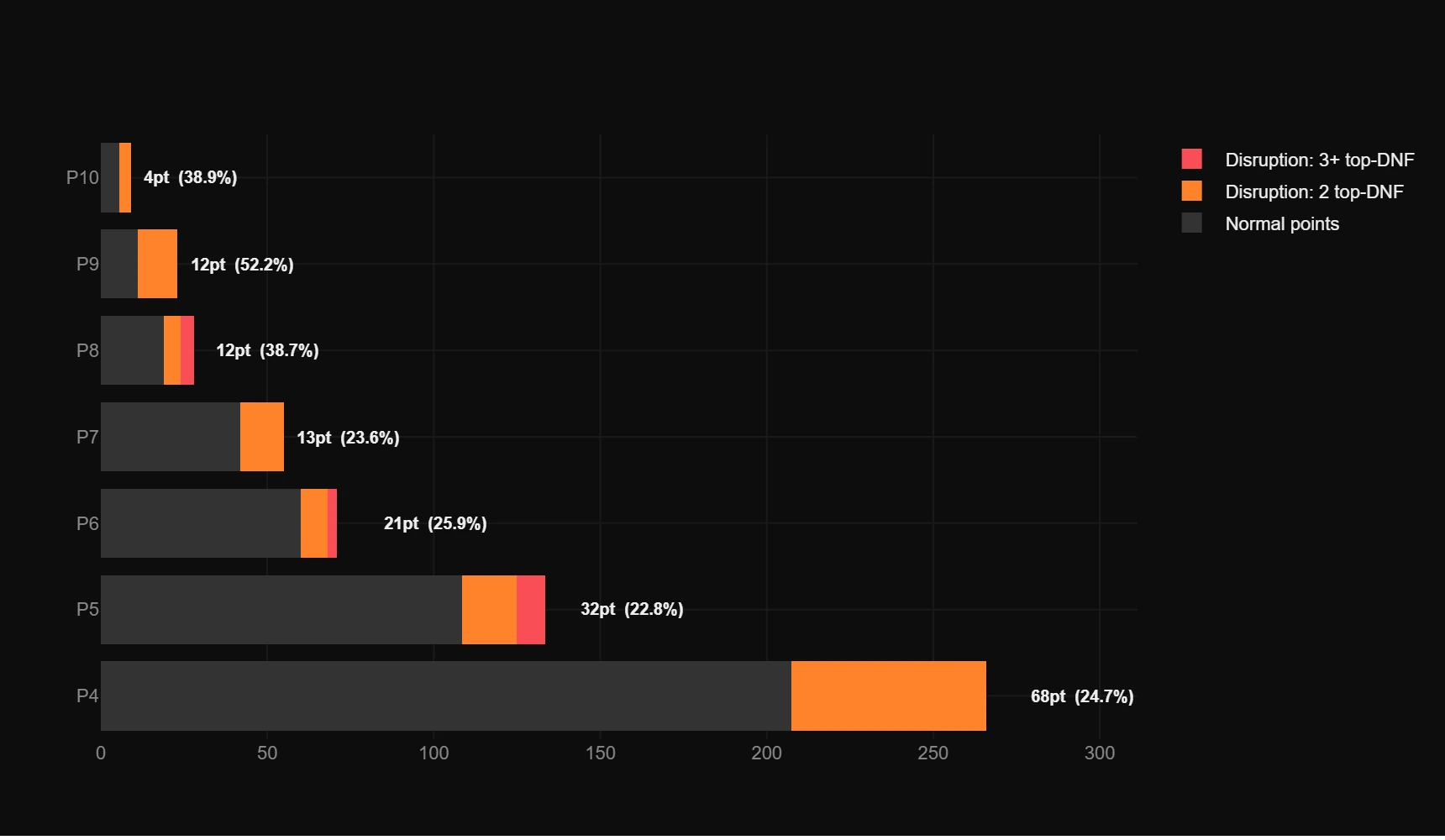
On average P9 teams earns more than half their points from disruptive races alone, meaning their placement in the championship between P10 and P9 is dependent on being in the right race at the right time for someone to have their car break down. P4 teams earn the most amount of points from disruptive races, which can seem obvious as they often will have the most in absolute points to gain from additional placement.
Else on average it is a quite a similar percentage the disruptions made of the total points for each placement in the constructors. However for each placement it is a substantial amount of the total points. If we went further, not showcased here, and also showed how many of the points were from races where just a single top car did not finish, then on average it would be around 50% for all placements.
However when looking at it from season to season it is clear that the lower placements in the championship are much more dependent on these disruptive races and are more likely to earn their 9th placement, based on points from those. As the placements approaches P4 the dependency narrows down to around 24%.
On the other hand using the median can flat out the drama between the teams. When looking at the seasons individually, the dependency becomes more pronounced, especially for the lower half of the field. In the following graph you can see each team, for each season and their placements while also showcasing how many of their points were made out of disruptive races.
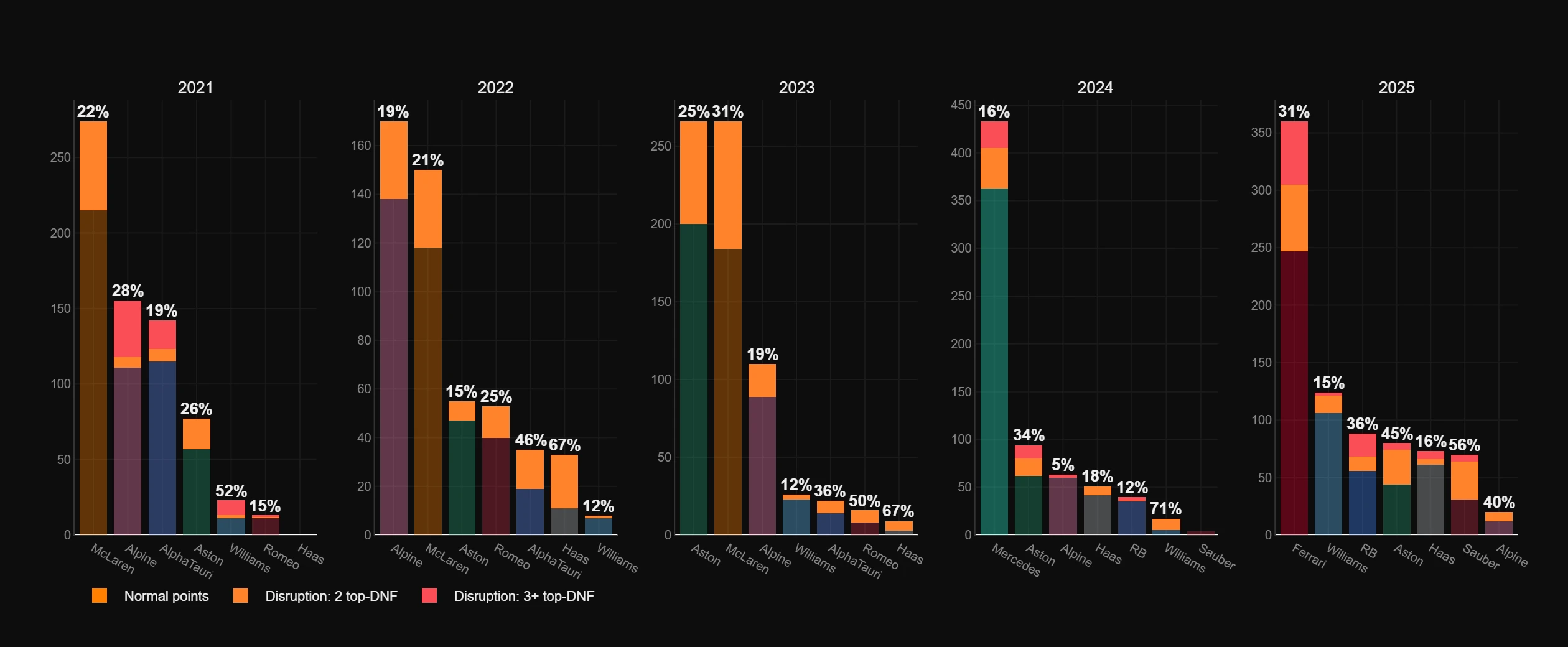
The chart is showcasing each team and how many points they got from disruptive races. When the orange/red bar crosses the points of another team, it means the disruptive points have been decisive.
We can see that in some seasons (2022 and 2023), disruptive points were as large as the points settling the places of P4 and P5, while in other seasons for those positions it did not matter. when the tumble down to P5-P7 it is clear the disruptive more often play a dominant role in the constructors placement, in both directions.
To break it down, we introduced a heatmap indicating when it actually mattered.
Three colors are introduced in the heatmap:
- Red: If the disruption points were removed, would have they been overtaken by the team below them?
- Yellow: If the disruption points were given to the team below them, would the have been overtaken by them?
- Green: In no scenario would they have been overtaken.
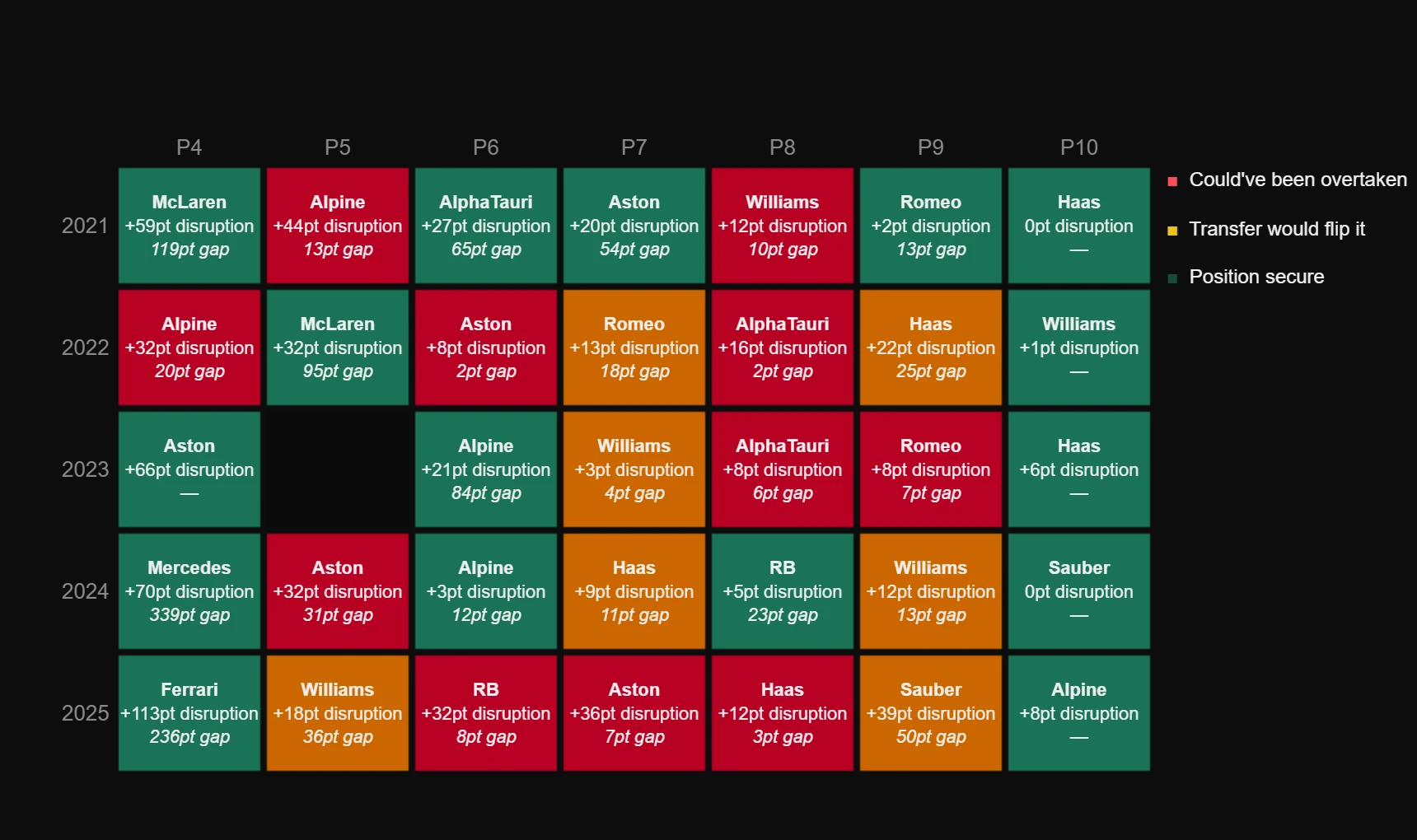
A quick look at the heatmap and two things are clear. 2025 was a close year between RB, Aston Martin and Haas. Making points from disruptive races important for the ending placements, the gap between the teams is 3 to 8 points. 2022, a new year with new regulation introducing empowered ground effect cars. I mean empowered, because the cars have always had some extend of ground effect, not their downforce were just more dependent on it. However it was a year with much disruption as well.
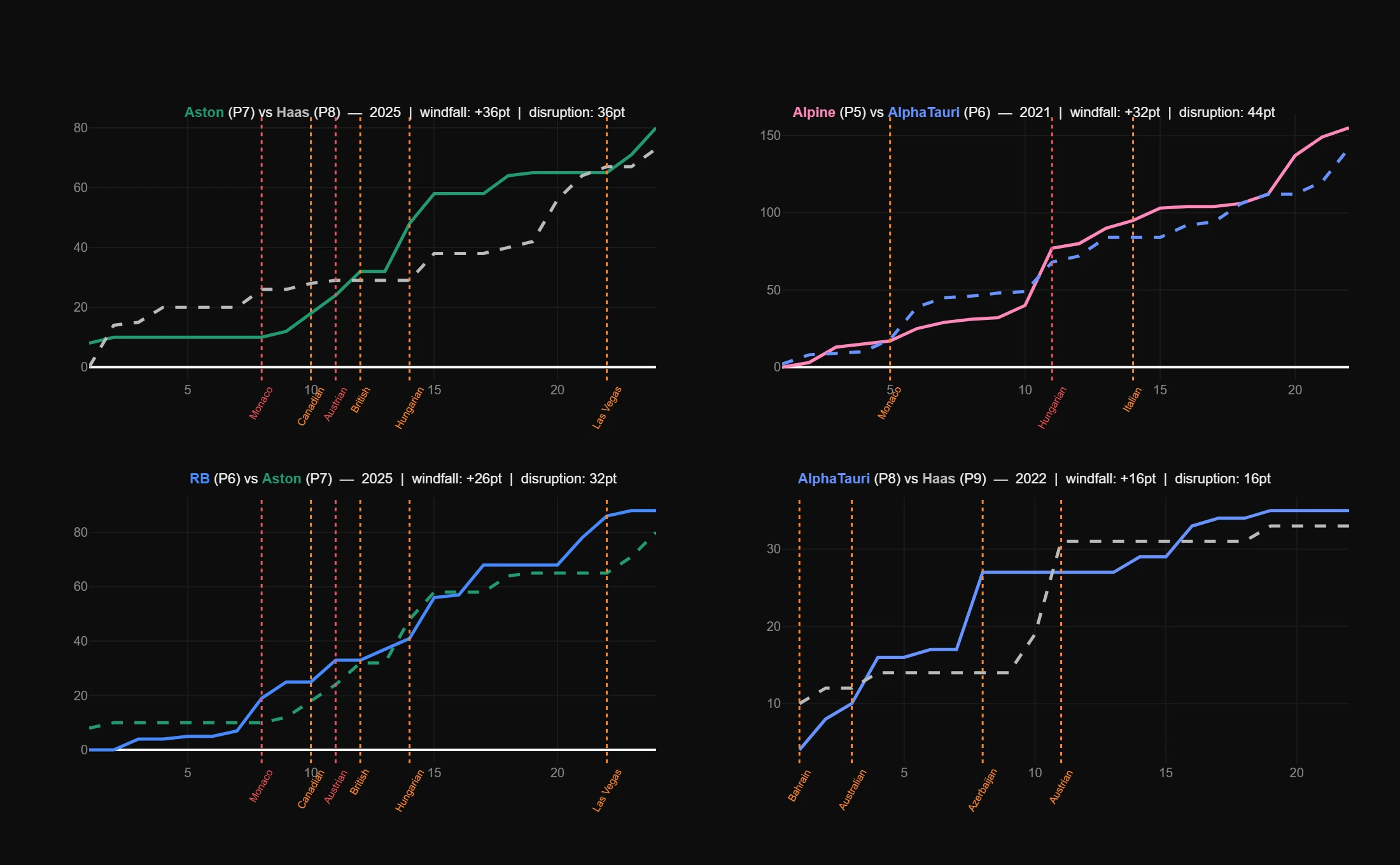
In the first part of the 2022 season AlphaTauri were ahead of Haas, they made the final jump in Azerbaijan where they got their drivers in a close top 10, a few races later in Austria Haas had the best race of the season and they got back on them and were in front until Alpha Tauri ground out points race by race to the end, scoring a P8 instead of P9. The same could be said in 2025 between Racing Bulls and Aston Martin, who in the end lost it all due to a great race from Racing Bulls in Las Vegas, which partly sealed the deal. This is ofcourse quite anecdotal, however more of these stories lie in the data, which is intended to be shown in the heat map.
Scenario snippet from the data
Below are showcased a few of the team battles across a disruptive season, where the disruptive points made a difference. The Alpha Tauri vs. Haas in 2022 really points to the importance of theese races for the midteams, and how some midfield teams will never see to become P5 if they dont capitalize on the DNFs of top teams.
Conclusion
Takeaways
What the above means for the sport. Disruptive races are real and measurable to some extent, as when top teams retire, midfield tems collect more points and it becomes harder for other midteams to catch up. P9 Is the most dependent on these points. Points for disruptive races do not always decide the WCC positions, however when it does it really does.
The dependency on DNF’s in the fight for points might also shape the strategycalls for the midteam and explain why they are more inclined to take bigger risks on when to pit, what tyres to put on and how to race.
A boring day at the top is a bad day for the midfield
The first few races in 2026 have been quite disruptive by any measure, much like we saw in 2022 when new regulation appeared on the cars. Nearly every race has seen a major DNF from the top teams, and Mclaren and Red Bull are still finding their feet. Currently Alpine and Haas have been the teams able to capitlise the most. Bearman delivered amazing results in Australia and China, while Alpine made the best of it bullying momentim through China, Japan, Miami and Canada.
However the window may already be closing. The cars are becoming more predictable, the top teams are more settling in as top teams and reliability is set to be improved. Which means the opportunities which have defined the opening rounds in 2026 will shrink. For the midfield, the race for constructors positions could already partly be won and lost in the early chaotic races. Missing them and you spend the rest of the season chasing.
Pingback: Monaco 2026 Analysis: The DNFs That Reshaped the Title - LAPTIME
Pingback: Aston Martin B-spec analysis - LAPTIME