
Bahrain Testing Round 1 - Which teams found stability
In Formula 1, testing is the ultimate exercise in deception. While the timesheets display raw speed, the true story of the 2026 grid is hidden in the telemetry of long-run consistency and energy recovery. Before any real action can happen, teams must ensure their aerodynamic platform is stable or, to put it bluntly, they need to make sure the door is locked and the seat is up before they can truly get to work and get some performance data.
After three days in Bahrain, the ‘glory runs’ are fading, and the data is starting to speak. From Cadillac’s surprising reliability to Aston Martin’s thermal struggles, we are stripping away the sandbagging to look at the ‘indicative consecutive high stint laps’— that separates the true contenders from those still searching for the light switch in a dark room
Stint Consistency - Why Mclaren are flying and Aston Martin is stalling
There are many ways to interpret lap counts. Many consecutive flying laps give indication of two things. First of all it indicates stability and reliability of the engine and the team. Secondly it provides valuable indication of whether the team maybe have reached a stable aerodynamic platform which is somewhat aligned with their simulations, or the other way around, which creates a fundament for further testing.
The short stints are ultimately for changing setups and getting the driver up to speed with the new Power Units in 2026. Below is a figure, showing the amount of flying laps for each teams where the stint is above 8 laps. Consecutive laps are important, they force the driver to manage the battery which in 2026 seem to be the alpha omega, making drivers the manipulators of electricity.
Consecutive flying laps where the stint is at least 8 laps long
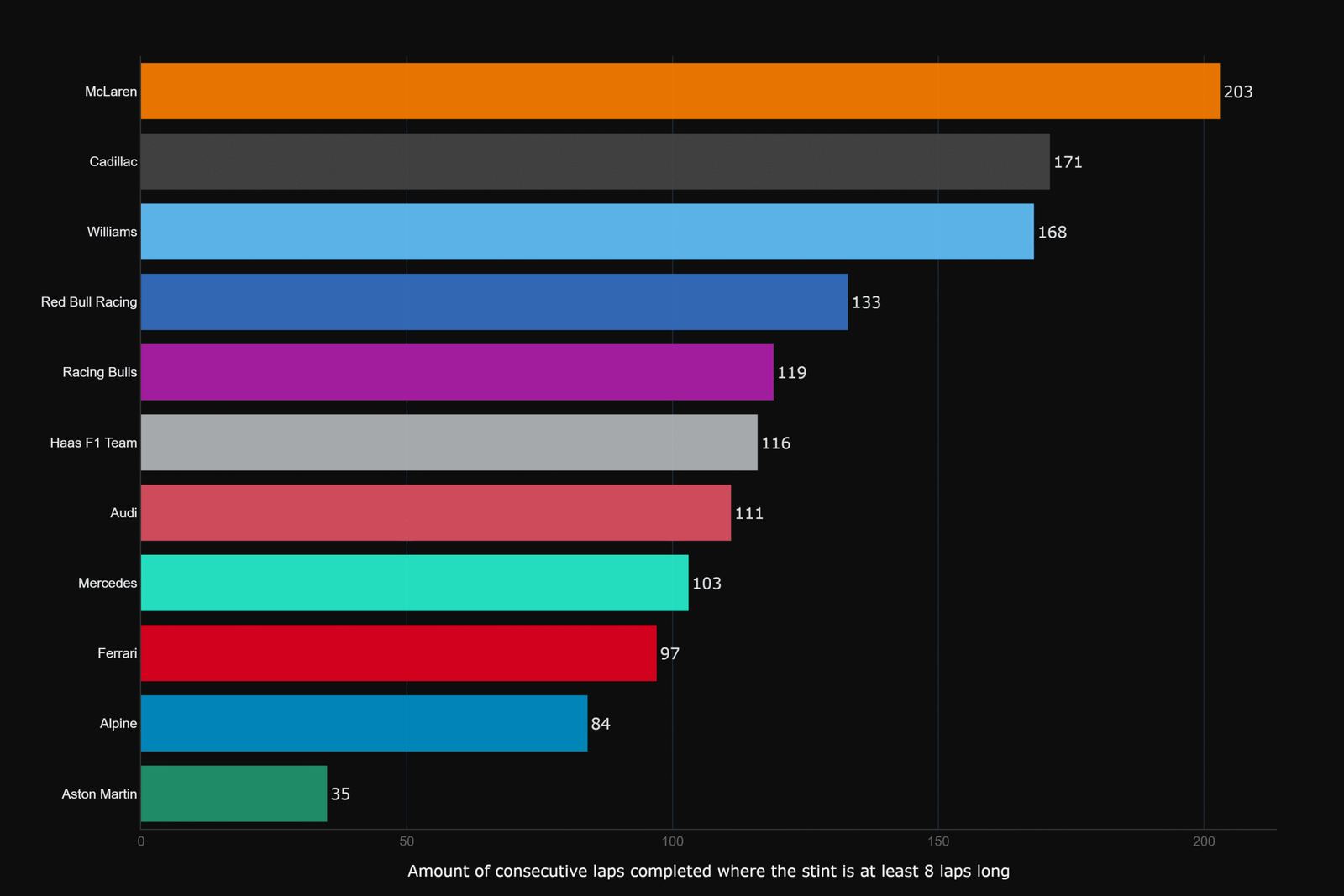
Two things are clear, one is McLaren, Williams and McLaren are leading in consecutive laps, with long race stints. Secondly Aston Martin are strugglgin with their car, it is clear in any way. The total amount of laps is low compared to the rest of the grid and so are their consecutive flying laps. They are currently quite far behind, they do not have a great understanding of the car or are not happy with the performance of it.
Various sources report that it seems like they have a RPM issue related to the cooling of the engine, which might not have showed up in Barcelona, forcing them to lower their RPM and thus power. Williams were not ready for the “shakedown” in Barcelona which in some regards make them a kind of an anomaly in this data, since they are in the need for long run data to adjust the car.
However Cadillac are going strong with 171 flying laps, which is quite remarkable, at least showing a reliable engine to some regard which is positive as a new manufacturer going into formula 1.
Stint Performance
Looking at the general stint picture from Bahrain Testing we can also get some indicative intel on how the teams are stacking up against each other. There are limits to how much sandbagging which can occur over all the hours of testing.
Last year on the final day of testing in the afternoon, Norris did a long stint of 24 laps with the fastest pace on hard tires, which made it clear they were in a different ball-game with their tyre wear. Hard tires are considered the slowest tires and thus made it quite impressive and made the paddock looking baffled.
Looking at the long run stints from Bahrain Testing it is possible with some confidence to set the following groups:
Frontrunners
It is very hard to set the top teams apart, and they are very close to one another and with inception for sandbagging everything is unsure. However Ferrari delivered some quite long stints throughout the testing where both LEC and HAM showed overall good pace on 26 laps and 17 laps. Redbull did a lot of 10-lap stints with great pace and high consistency from Max Verstappen. Oscar Piastri from Mclaren did a beautiful 19 lap stint in the afternoon on hards, which stampeeding their ongoing contention. Mercedes seem to be a bit behind its three counterparts.
Mid-contention
I don’t think any of these as it currently stands are in contention either WCC or WDC. They are even based on their long run stints so far off the four teams above. However Haas did a couple of decent consistent long runs with Estaban Ocon. Even though Williams did not show up for the Barcelona shakedown they are following Haas very closely. Which of the two comes out on top is hard to say currently. They are both close followed by Alpine where Colapinto did the fastest long-run stint within the team in the afternoon, going to follow him close in the second test of Bahrain.
Behind
Cadillac are doing allright, they did a great long run 21 lap hard stint showing good pace, however it was 3 seconds of Estaban Ocon’s stint mentioned above. Cadillac needs to find their rhythm as a team, they are new in school, but I think they will improve massively over the season with two experienced drivers and a team of great engineers. Racing bulls seem to be behind the the mid-field contention, low median pace and very few long runs. I know this might seem controversial, but I think they are testing the engine in and out, while Redbull are optimizing their aeropackage. After seeing which influence Redbull have on Racing Bulls, I dont see it any other way.
I am not sure I need to mention much about Aston Martin, they are lacking in all parameters, pace, topspeed, total laps and consecutive laps. It is wrong in every department currently, and they need Newey to work some kind of magic cooling on the engine, without affecting the aerodynamic performance. However I hope they get a grasp of it, never ideal to see anyone struggle that much. Audi’s struggles comes to show in the picture below.
Aero-Efficiency Matrix: Top Speed vs. Lap Time Correlation
In this chart the best lap from each team is taken into account and comparing it to the top speed. Higher top speed and lower laptime shows good aeroefficiency. Aeroefficiency measures the tradeoff between topspeed and the ability to gain seconds over the course of a lap. A team/car can be divided into 4 categories.
- Low top speed and high laptime (Struggling with both parameters)
- High Top speed and high laptime (Low drag setup, possible struggling in corners)
- Low top speed and low laptime (Good in the corners, might struggle on overtaking)
- High top speed and low laptime (Efficiency is achieved).
It is easy to create a powerhouse of a car which shows top speed, however it is also easy to create a car with great downforce. However making a car which is both fast on the straights and fast in the corners is the greatest pursuit of formula 1. You need straightline speed to overtake and good cornering to chase or get away. With the new regulations in 2026, the aerodynamic efficiency has never been more important from the start of the season. All teams have come up with their own design of the 2026 regulation, and will through the season be looking at each other to see which design is the best. Over the year they will converge towards the best designs.
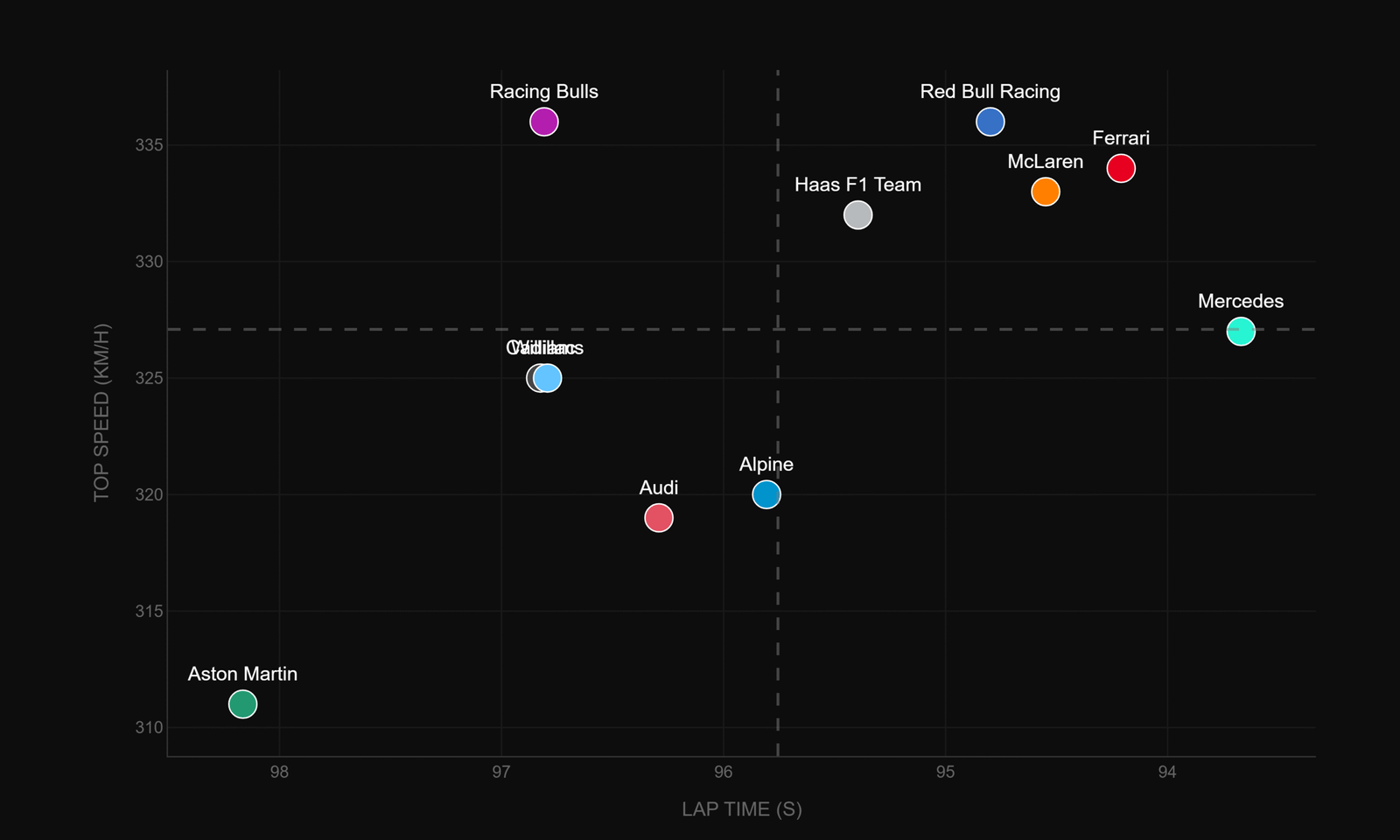
The data paints a brutal picture for some. Aston Martin looks increasingly like they are competing in the wrong category, lacking both the straight-line punch and the cornering stability of their rivals. Meanwhile, Red Bull, Ferrari, and McLaren have firmly established themselves in the ‘Efficiency Club,’ with Mercedes (thanks to George Russell’s flyer) currently holding the edge on outright lap time.
The real surprise is Haas. Their entry into the high-efficiency quadrant suggests they are punching well above their weight, showing significantly better aero-correlation than both Alpine and Audi.
However, the most intriguing battle is in the lower midfield. While Racing Bulls, Cadillac, and Williams are locked in a dead heat on lap times, they are achieving them in vastly different ways. Racing Bulls’ 10 km/h top-speed advantage suggests a very ‘slippery’ low-drag setup, whereas Cadillac and Williams seem to be finding their time in the technical sectors. This efficiency gap will be the primary storyline as we head into the final test and the season opener in Australia.
One critical factor to consider when reading this matrix is the assumption of full power deployment throughout the lap. A lower top speed paired with a competitive lap time can be a strong indicator of a different energy deployment strategy – potentially focusing on ‘clipping’ early to save battery for the technical sectors. In the 2026 era, a car must be both aero-efficient and energy-efficient to reach its true maximum potential.
What to Watch for in the second round of Bahrain pre-season testing
Look for the frontrunners to finally move into representative performance runs.
Can Aston Martin resolve their RPM limitations?
How will the Midfield evolve, I am hoping to see more long-run stints, to give further indications.
If you made it this far, thank you for reading and please leave a comment