
The 2026 Japanese GP at Suzuka produced one of the season’s defining battles. Pierre Gasly held off a four-time world champion for lap after lap. Franco Colapinto couldn’t get past a Williams. Same circuit, same conditions, same window — and two completely opposite outcomes. The telemetry data from Gasly vs Verstappen at Suzuka 2026 tells you exactly why.
The data tells you exactly why
The Energy Game
Using cleaned telemetry from laps 30 to 53, we can map how the Gasly–Verstappen battle actually unfolded – not just who was faster in the aggregate, but where each driver gained and lost, and crucially, why the faster car couldn’t pass.
On pure speed, Verstappen had the edge. On every straight, he carried 9–12 km/h more than Gasly. By raw numbers, that should be enough to make a move. It wasn’t.
The time-delta chart explains it. This isn’t a gap chart – it doesn’t show who’s ahead. It shows where each driver is gaining or losing relative to the other on average over the laps. When it dips negative, Gasly is the faster man. When it climbs, it’s going Verstappen’s way.
What it shows is a masterclass in circuit management.
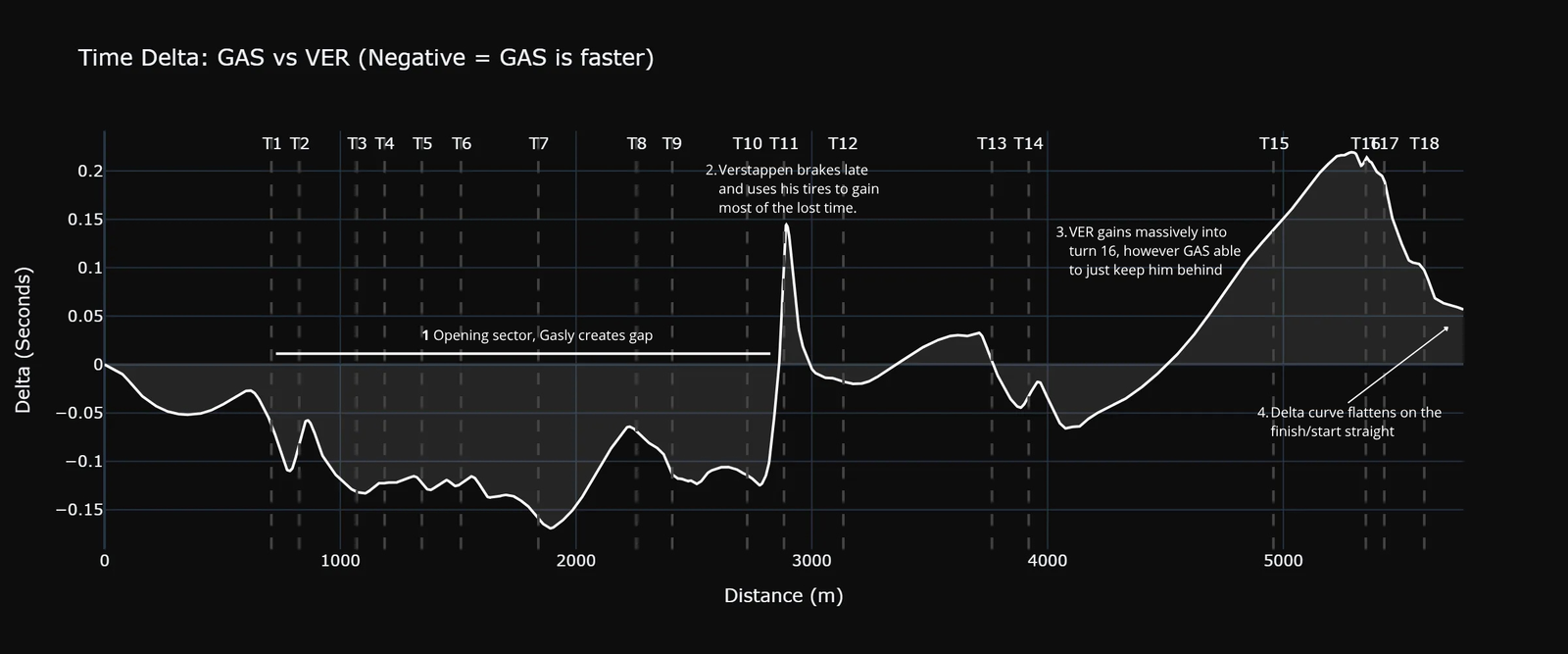
Through the opening sector – the tight, technical stuff up to T11 – Gasly is consistently quicker. He builds a cushion in the section of the track where dirty air punishes the chasing car most, and where a driver’s inputs matter most.
Then right after the hairpin on their way to T13 and T14. Verstappen claws it back, and through the R130 straight that follows, he gains massively – this is where he deploys the bulk of his energy, hunting the gap. Gasly is just able to keep him behind before T16 and the deltalines flatlines after T18.
They’re running at identical speeds on the obvious overtake straight. And into Turn 1 – the decisive point, the overtaking opportunity – Gasly is quicker again.
The read: Gasly deployed just enough battery on the long straight to stay out of reach, then held his full charge for the start-finish straight where the pass would actually have to happen. Verstappen arrived at the braking zone with an empty gun.
Verstappen tried once into to T16 on lap 48 – and Gasly had so much more in reserve on the start-finish straight that he immediately retook the position. After that, Verstappen never tried again. The chess match was over.
The Contrast: Why Colapinto Couldn't Do What Gasly Did
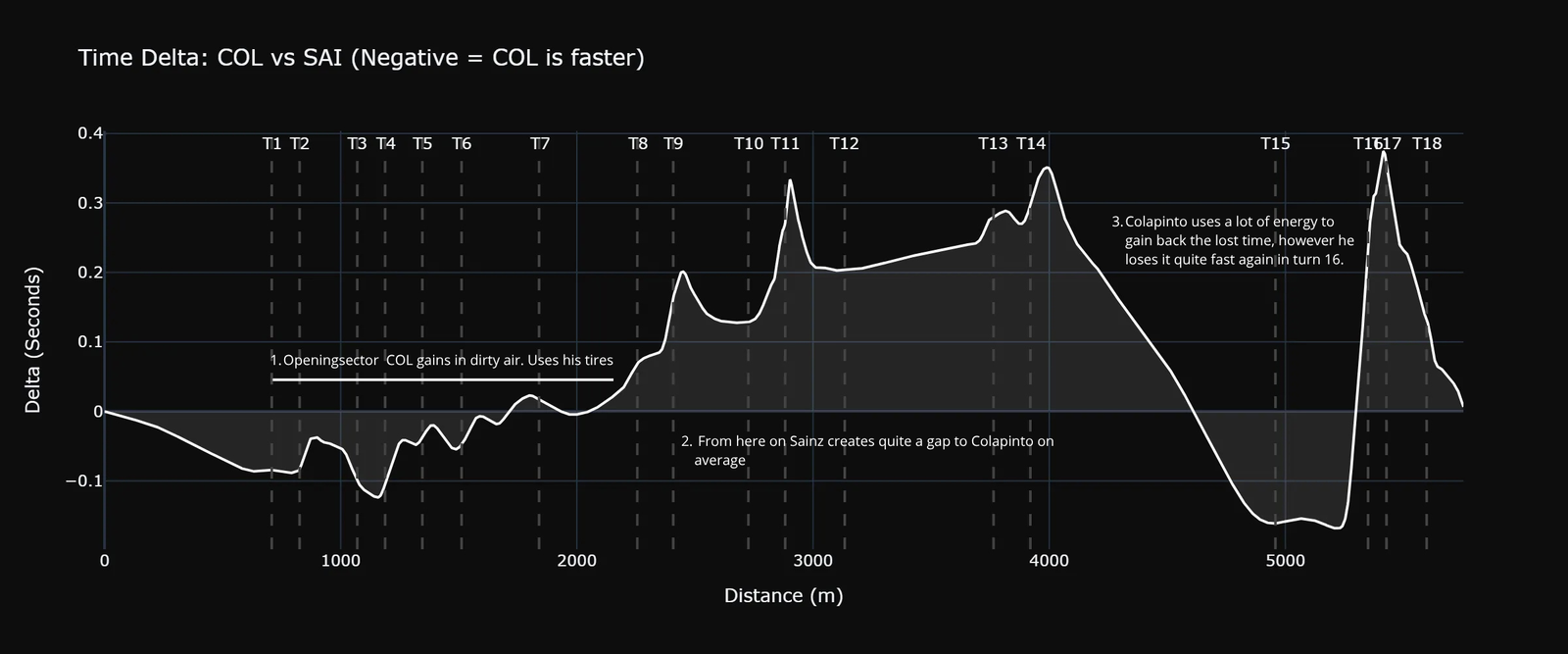
Flip the roles. Same circuit, same window. Colapinto is now the hunter, Sainz the defender. And the delta chart tells the opposite story.
Colapinto is actually gaining in the early sectors – he has pace on Sainz through the opening technical section. But he’s spending it in the wrong place.
Attacking in dirty air through the early corners, he overheats his tyres before the lap has really begun. By T8, the delta swings hard in Sainz’s favour. Sainz opens a gap, holds it deep into T14, and when Colapinto finally catches up again, he’s had to burn battery just to close what he’d already given away. He arrives at the key braking zones with less than he needs.
Sainz, meanwhile, brakes late into T16 like a metronome – systematic, unhurried, in control. He doesn’t need to be faster. He just needs to be where Colapinto isn’t.
Verstappen understood what he had to do: forget the first sector, manage the tyres in dirty air, and focus everything on the hairpin where a decisive move might actually stick and gain pace. He was disciplined. Colapinto forced his hand early, spent his resources, and found himself chasing for the rest of the lap.
The comparison between Gasly and Colapinto makes it definitive. On average across their shared laps, Gasly dominates. The gap isn’t just about car pace – it’s about how each driver chose to use what they had.
Skill. Patience. Experience.
The new power unit regulations have drawn plenty of criticism for the yo-yo effect – lead changes driven by energy deployment rather than outright speed. That’s a fair debate. But what Suzuka showed is that the format also creates a very pure kind of head-to-head. The energy game definitely makes it hard to make an overtake stick, which theese fights definitely shows. However if you can force your rival to spend more battery than they intended, you’ve already won the next corner. Make the right call, and you can hold off a faster car for twenty-three laps. Make the wrong one, and you can’t pass a Williams.
Gasly made the right calls. Colapinto didn’t.
The Performance Everyone Missed
While the Gasly story dominated the headlines, something else happened at Suzuka that deserves attention. I could not stop myself from looking into the Hulks pace.
Nico Hülkenberg had a terrible start – lost multiple positions before the first corner – and still finished 11th. On clean air pace, fuel-adjusted to account for lighter loads in the later laps, Hülkenberg was inside the top 9 of all drivers on the grid. By the final laps, he was closing on Ocon at a rate that suggested P10 was only a matter of time.
It’s one data point, but it’s a significant one. The Audi machinery is further along than most people think. We’ll have more on that in next week’s three-race pace deep-dive – but consider this a preview.
The chart below is the median pace for all drivers across all laps, adjusted for fuel which take into account lighter loads of fuel in the later laps of the race. The best comparison is done on free air laps, however not all drivers spent equal amount of time. However for the Hulkenberg comparison it does not matter. Read below
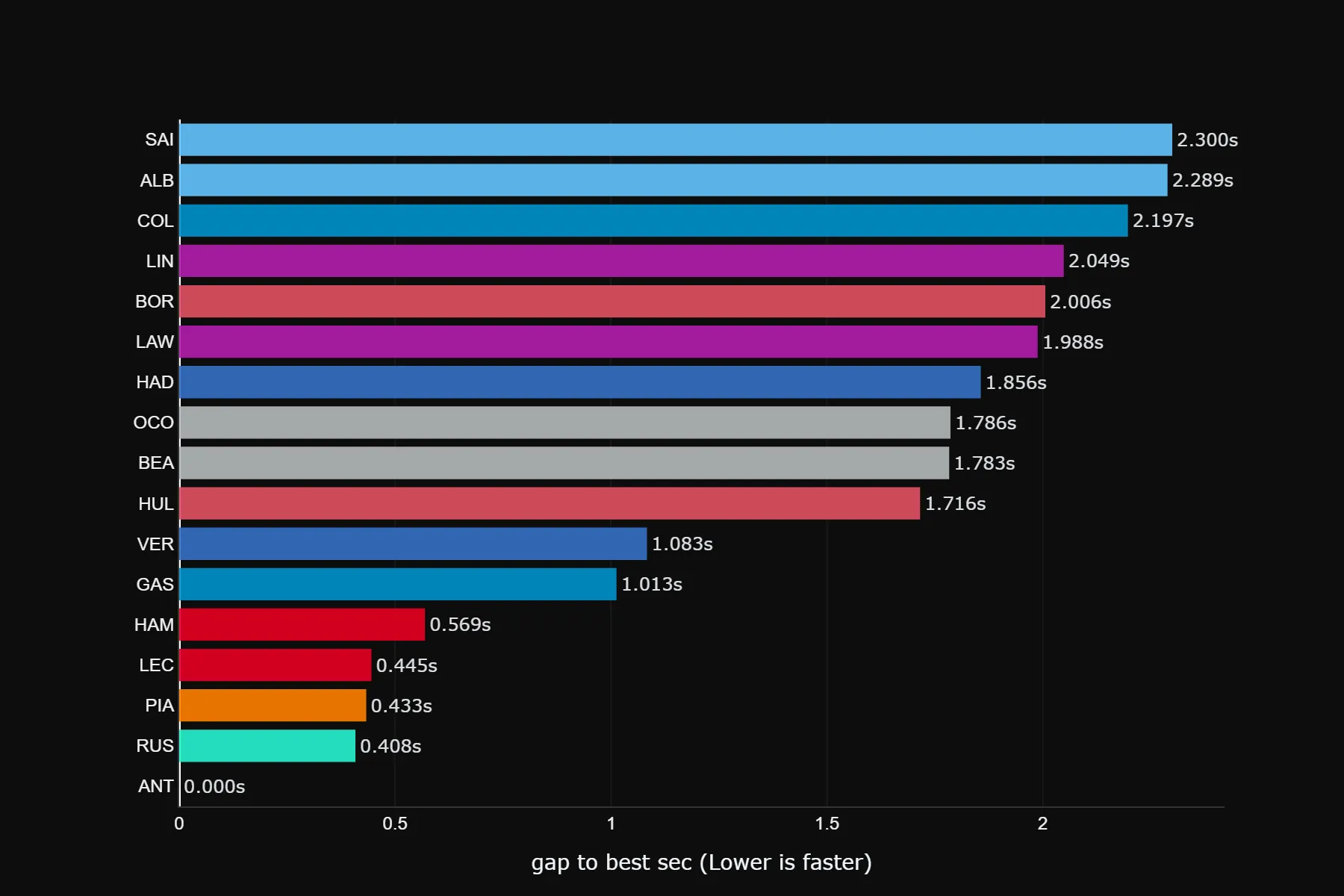
Based on this Hulkenberg had a quite good pace, compared to rest of the mid-grid. I am quite sure if he did not have the bad start, he might have gotten some points home for Audi.
It should be pointed that Hulkernberg time can be compared to the other midfield drivers, because most of them were on the almost exact same strategy and because Hulkenberg was one of the drivers spending most of his time in dirty air, which makes his pace even more impressive. How the rest of the grid is stacking up is up for a debate which I will be going into the next few weeks where we wont have any races.