
The sandbagging is over. Australia delivered the first honest lap times of 2026 — and the pecking order that emerged was both clarifying and, in places, genuinely surprising. Mercedes reminded everyone why they spent the winter so quietly confident. Now the rest have to respond.
Weaving has never been more important
One of the defining characteristics of the 2026 regulations is how much weaving matters on the out-lap. It’s not new – drivers have always worked the tires side-to-side on straights to generate heat. However this year it’s become critical in a way it hasn’t been before.
Here’s why: under the new power unit regulations, battery deployment on warm-up laps is severely restricted because driver do not want to waste energy. Less electrical power means lower straight-line speeds, which means tires are spending more time at low load and shedding heat faster. To compensate, drivers are weaving more aggressively than ever, trying to keep the rubber in its operating window before they commit to the lap.
The the outlap in qualifications have never been more important than now.
Energy Deployment: The Weekly Optimization Puzzle
In 2026, the battery deployment map is almost as impactfull as the mechanical setup of the car, and unlike the setup the battery harvesting and deployment can be changed during qualifications, making greater understanding of energy harvest and deployment the biggest factor this year for performance gains.
The tradeoff is simple but brutal: harvest more energy and you lift off the throttle, costing you time. Deploy more aggressively and you’re fast, but you’ve borrowed from a finite budget. Teams and drivers are solving a different version of this equation every Saturday. Meaning there are many strategies in how to deploy and harvest. One team which partically has a set way of doing this is Audi.
Comparing Bortoletto’s best Q3 run against Hadjar’s, Bortoletto had a meaningful advantage through the sector two straight – consistent with what we flagged in Bahrain testing and across the practice sessions: Audi are running the highest top speeds on the grid for now. Outside of that straight, Hadjar was ahead. Whether that gap reflects a deliberate strategic choice or a genuine setup difference isn’t clear yet — but Audi clearly found something, because Bortoletto made Q3. That’s not nothing.
The Pecking Order
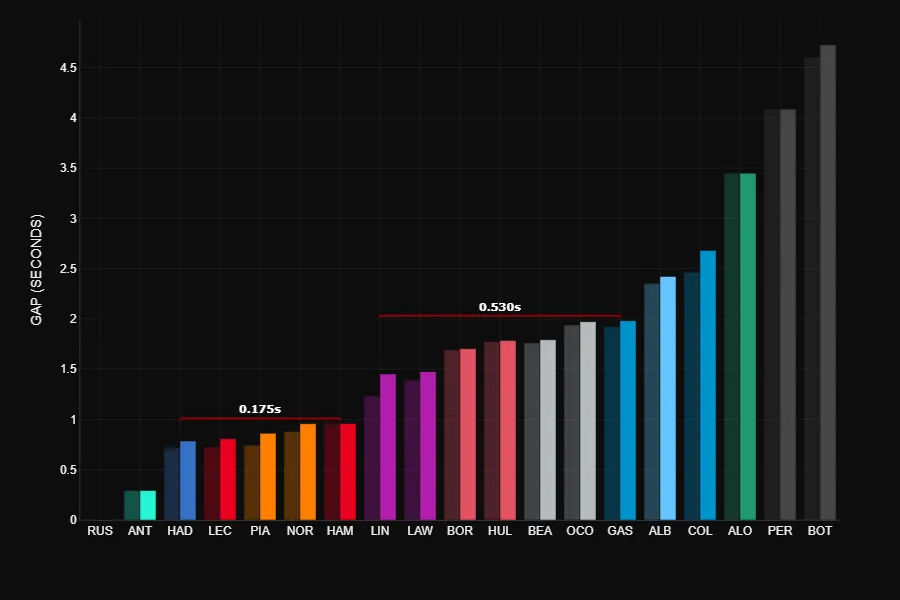
Each bar shows a driver’s gap to pole. The filled bar is their actual best lap; the outlined bar is their theoretical best – built by combining their three fastest individual sectors. Where the outlined bar is shorter than the filled one, the driver left time on the table: they had the pace, but didn’t string it together when it counted.
Mercedes are in a class of their own. Russell took pole and did not sound surprised over the radio. Antonelli – in just his second season – was 0.2s back, and that gap still put him 0.4 clear of everyone else. That’s not dominance. That’s a different category.
The chasers is where it gets interesting. Ferrari, Red Bull, McLaren, and the rest of the leading pack were separated by just 0.175 seconds in qualifying. Under a completely new regulatory framework, that kind of convergence is remarkable. The race tomorrow is genuinely open for these teams.
Further back, Racing Bulls lead a tight cluster of teams that includes Audi, Haas, and Alpine – five teams within 0.5 seconds of each other.
Williams had a difficult Saturday: Sainz didn’t make it to qualifying due to a technical issue on his car, which will make Sunday harder. Stroll also failed to progress, though Alonso managed a solid lap and wasn’t far off the main group.
And Cadillac? Bottas climbed out of the car and said it best: “The only way from here is up.” Hard to argue with that.
Don't Trust the Timesheet - Yet
The Contenders: Ferrari and McLaren
The practice data – limited as it is – points to Ferrari and McLaren as the most credible challengers. What’s interesting is that on median pace, Ferrari were actually the quickest team across the sessions, with McLaren close behind. Neither result is definitive given the lack of proper long runs, but it’s a signal worth noting.
Red Bull slot in just behind. The gap is real but manageable, and Hadjar has the racecraft to make it count on race day with is position on the grid.
Midfield: Alpine the Surprise
Alpine showed stronger practice pace than their qualifying position suggests, leading the midfield on median times. Audi were next, consistent with what we’ve seen since Bahrain. Williams and Racing Bulls sit in a tight cluster just behind – for that group, strategy and track position will matter more than outright pace.
At the back, Haas and Aston Martin are carrying a real deficit, and Cadillac remain a work in progress. The gap is not small.
Key thing to look at in Australia is reliability. I will not be surprised to see few team not finish due to machinery.