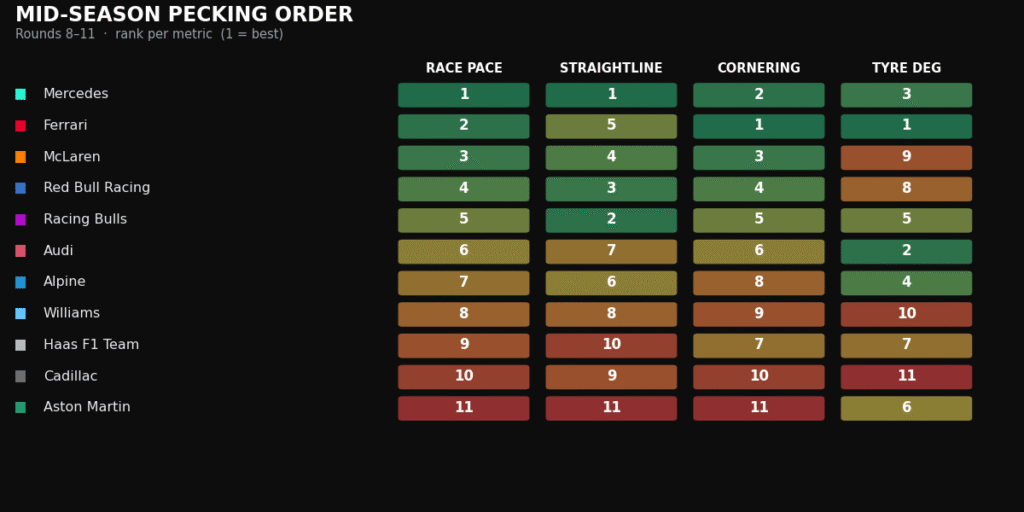
Halfway through 2026. One team without a weakness. A chasing pack sorted by trade-offs. This F1 2026 mid-season pace analysis ranks every car on the four metrics that help decide weekends, fuel-adjusted clean-air pace, straightline speed, cornering and tyre degradation, across the last four rounds.
Before we get into the details, here’s how we’ll read it. First the fuel-adjusted clean-air pace, to set the pecking order. Then the three pillars that explain it, straightline performance, cornering, and tyre degradation. And finally the strategic tendencies, where each team leans on its strengths to hide its weaknesses. The numbers set the order; the pillars tell you why.
Upgrades and Points
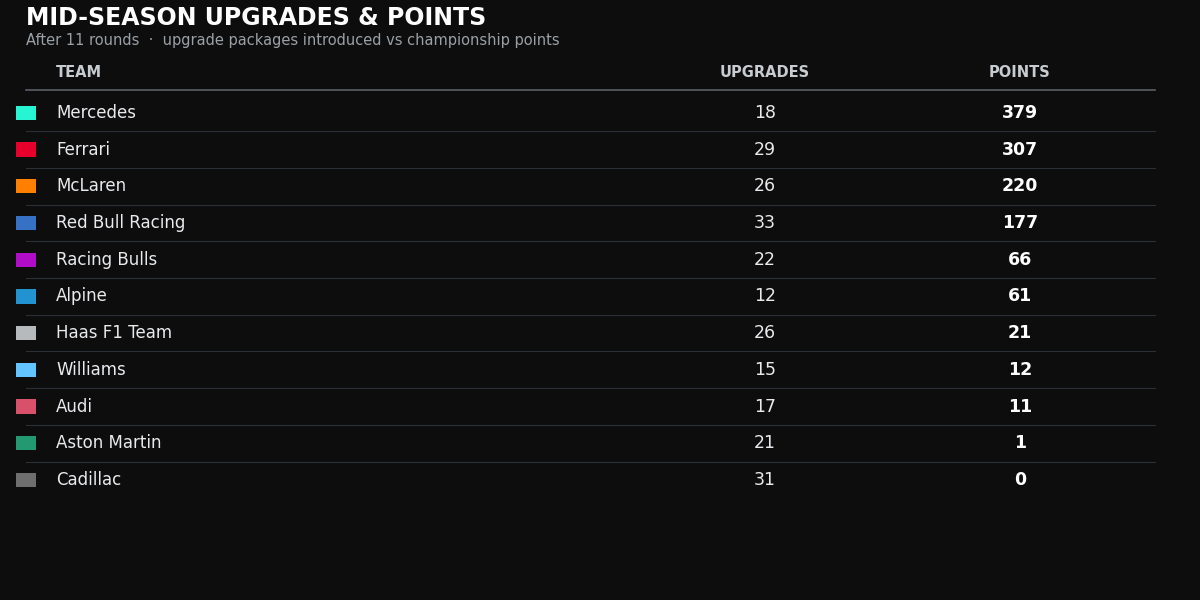
Mercedes has a comfortable lead going into the second half of the season, with Antonelli leading the WDC by a safe margin. Mercedes have delivered the least amount of upgrades (18), when comparing the top 4 teams. However Mercedes are feeling the pressure as Ferrari and especially McLaren are gaining momentum.
Ferrari are second, they are in reach of getting the World Constructors by 70 points (307 vs 379). They have been quite aggressive in their development of the car, with bringing upgrades quite often (29 to date). On the other hand Mercedes have been holding back on the upgrade path and are strategizing their upgrades. Holding on to upgrades for longer in the factory can increase performance, without a high increase in costs.
McLaren are gaining momentum as well, there is still a large gap to P1 (159 points), however they are chasing down Ferrari (87 points back). McLaren had a rough start to the season with none of the drivers started in China GP. Red Bull have been bringing loads of upgrades (33, the most of any top team), this has swung them from a midteam car to a competitive top car in the season, which is impressive. However if the next few races don’t give any indication of a competitive car they will be focusing on 2027. This makes sense from a constructors championship, as the financial incentive is not there to bring upgrades if the team can’t change their constructor position. Currently they are in 4th (177 points), with a very comfortable gap down to Racing Bulls (111 points).
Racing Bulls are currently leading the midfield with momentum. They have been able to get into Q3 on most weekends, leading to consecutively score points and be present when top teams DNF to extract more points. Alpine on the other hand have brought the least amount of upgrades of any team (12), they started the season strong with both drivers scoring significant points and Gasly’s podium in Monaco created a cushion to Haas and Audi, where the latter is catching up. Gasly has in several interviews marked the importance of new upgrades, and it is rumored they bring more critical upgrades in Zandvoort, focusing on aero.
Then Haas had a great start with Bearman delivering impressive driving and scoring points. They have been quite aggressive in their development of the car (26 upgrades), however they have been running into financial limits and it is not in view that they will reach the 2026 cost cap of $215m. Haas has been out developed by rivals, their early points might save them from Williams overtaking then into the season (21 vs 12).
Williams have struggled the whole season, their car started out to be one of the most overweight cars on the grid. They spent the entire season bringing that down, taking it away from other pace developments. It is rumored Audi have a full-scale upgrade plan, for the final push before focusing on 2027. P9 and 11 in Hungary have been their best two-car results this season. Aston Martin gained a single point from the Monaco GP, which was a GP full of disruption.
Already in pre-season testing, Laptime wrote that Aston Martin were far behind in several departments, where time on track was one of them. This carried over to the season start, as the drivers were not able to drive for more than 20 laps, which led to massive loss of data to the team. Their chassis and engine have failed the drivers and fans massively, however they were able to make a big step in Hungary with a total of 16 upgrades in a single package.
We wrote an analysis on that part. Aston Martin are expected to bring an upgraded engine and chassis to Zandvoort. At last we have Cadillac, from a new-team point of view they had a great start. They obviously have issues, however they have been able over time to gain time on competitors. They have brought the most upgrades of anyone (31), in the backend of the field and are planning to bring more upgrades. They are a new team and they need to experiment. The next goal for them is to get into Q2.
What is true is that half the season has gone and teams spent all their time upgrading and analysing the current car, to gain performance and see where they would be at, in the summer break. Now the second half begins, and they will be strategizing between 2026 and 2027, doing resource-allocations. Some teams will sniff a higher constructors placement and be more aggressive, others will try to hold current and focus on 2027.
To get a better indication of the cars where they are strong and weak, we dive into a few well known metrics.
In this roundup we take a closer look at how the cars performed in the last 4 races. Austria, Silverstone, Spa and Hungary. Using multiple races gives a more robust foundation, than just looking at the last race. However the last weekend skewed Aston Martin as they were able to gain pace in the corners.
Adjusted Pace
To begin the overview, the fuel-adjusted clean-air pace becomes our closest friend. It strips out the noise from traffic, though it lacks tyre knowledge. A rundown of each team gives us the following picture
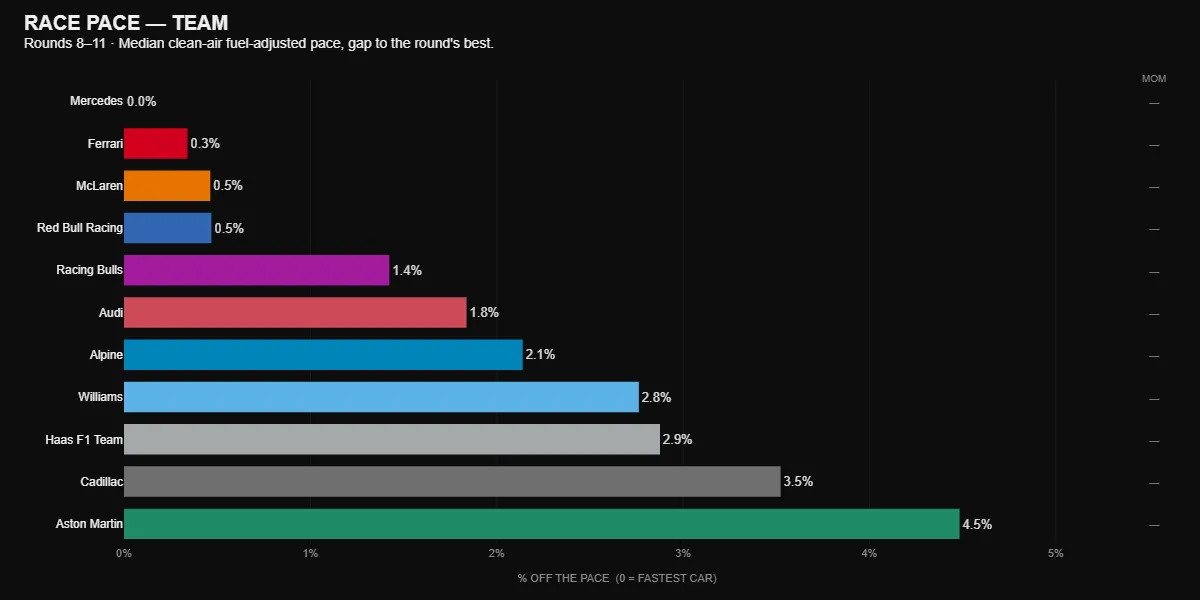
No surprise at the top, Mercedes are the car to beat, the benchmark of the window.
They still hold a gap to the other three at the front. Their one real problem this season has been reliability as both cars have suffered overheating, and Russell’s has had energy deployment and harvesting issues the team is still chasing to fix.
Ferrari are the closest contender at 0.3% off, and here reliability has paid off. Hamilton has finished every race in the points, and Leclerc’s DNFs have come from driver error and a brake fault, never the engine or its components. Ferrari showed in Spa and Silverstone that they can challenge Mercedes, then both cars fell through in Hungary, where they were considered favourites.
McLaren have had their own reliability troubles, but they seem to have found their mojo. Norris took pole in Spa, Piastri had good pace until he picked up damage, and in Hungary both drivers were quick. At 0.5% off, they have closed right up on Ferrari, it is now a fine margin between them.
Red Bull sit level with McLaren at 0.5%. Hadjar is a step behind Max on race pace but is getting there in qualifying, and it will be worth watching how he develops. Red Bull hold two advantages the others don’t: a clear first and second driver, and four cars on track.
In the next few races Mercedes stay favourites of the big four; which of the other three joins the fight will depend on the track layout. On to the midfield.
Racing Bulls have found real momentum over the last four races and are the clear best of the rest at 1.4% off. Since Barcelona they’ve held the upper hand in the midfield, with two capable drivers both scoring regularly.
Audi follow at 1.8%. They struggled early but have stayed afloat while other midfield teams fell away. They are not closing on Racing Bulls, though, the gap is 55 points, and with only 2–4 on offer most weekends, Audi will need a weekend of opportunity to make it.
Alpine have dropped drastically, down at 2.1% off. They were strong early, scoring in China and Japan, but after Miami the season turned the wrong way and have since Monaco not been in the points.
Haas are at 2.9%. Australia and Japan were great, but since Miami they’ve been nowhere. It is critical for them to get the upgrades under control. Gene Haas should consider what type of a team he wants to run and take any financial opportunities ahead of him for the sake of the team.
Williams sit just ahead of Haas at 2.8%. In Hungary they were almost on par with Cadillac. They been sagging behind all season, spending quite the time on reducing weight and less on optimizing other parts of the car.
Cadillac have neither gained nor lost pace all season, holding at 3.5% off, usually dead last or just ahead of Aston Martin. That changed in Hungary, where they were the slowest car on show.
I put Aston Martin last, not because I think they are last, but because they’re in no man’s land. On the four-race window they are the slowest at 4.5% off, and they’ve been the season’s biggest disappointment. But Hungary was a resurrection: the short straights made cornering the way to find laptime, and it suited them. The AMR26 gets its real test in Zandvoort, with the new engine and more parts to come, a fairer judgement waits there.
That gives us the general pecking order, and it sets up the next metrics. Teams this close on pace lean on different strengths to find it, for some it’s cornering, for others the straights and others tyre degradation.
That’s the order, the next sections explain why. Get every race weekend’s data breakdown in your inbox.
Straightline performance
We jump straight into the straight line performance.
2026 is different from previous years, because deployment for longer is better than reaching top speeds. In the past top speed was an ok ish indicator for straight line performance. Now it is higher for longer.
We use qualifying runs as the parameter, as it is the cleanest type of runs. Equal fuel, no traffic, same tires. Almost perfect conditions, except track rampup.
However this continues to be a good indicator. In this comparison we use the weighted time average across the straight lines of each track.
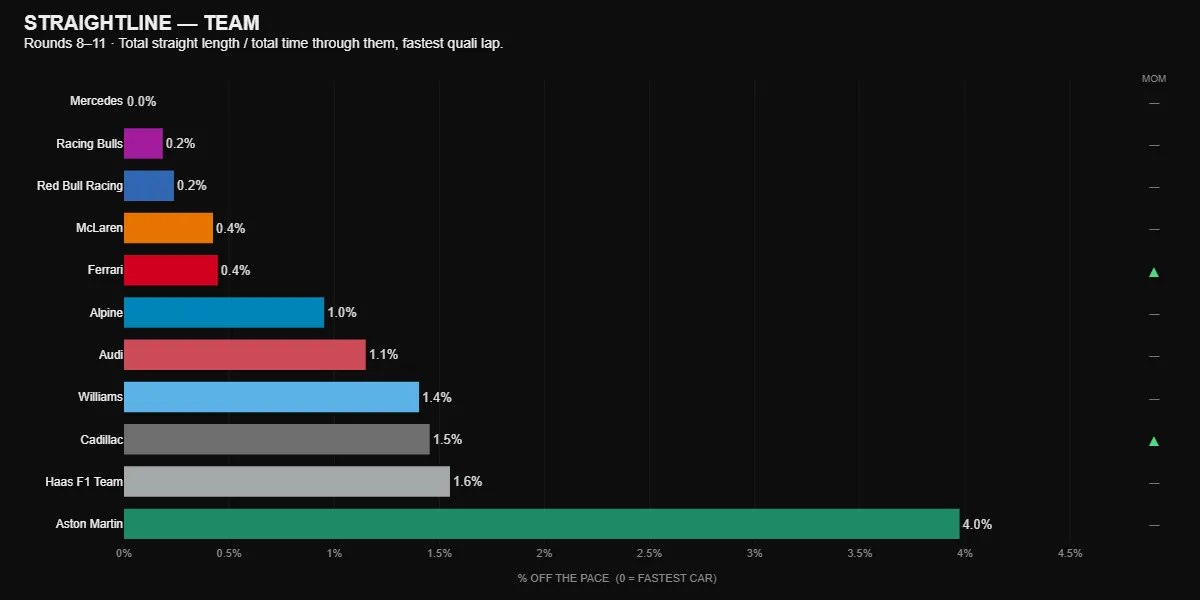
Mercedes have the upper hand currently, their car is currently designated as a rocketship on the straights. However the Red Bull Powertrain engine is just behind them at 0.2%, and this could give us some indication of why the Red Bull engine have been designated as the best engine. If we look at the spread of the Mercedes engine, it does not show a clear advantage. Straightline speed is of course also dependent on the decision of drag on the car on the specific circuit, however it is telling that Racing Bulls (0.2%) and Red Bull Racing (0.2%) are so close and ahead of Mclaren (0.4%). Ferrari are able to match Mclaren on straightline speed (0.4%), which is crucial when we go and look at the cornering ability of each car afterwards.
Racing Bulls currently as a midfield car has very proficient speed in the straight, making it much easier for it to overtake the other car’s on track. Then the gap begins to widen as alpine (1.0%) with the least amount of upgrades to some degree are saved by their engine, with Audi just tagging along (1.1%). Then we have a cluster of Williams (1.4%), Cadillac (1.5%) and Haas (1.6%). Two Ferrari engines in the bottom, I can understand why the engine to some extent is set to have ADUO. At last by no surprise the new Achilles heel of the AMR26 is the slowest by far on the straights at 4.0% off, more than double the next-slowest, making it very difficult for it to overtake on the straights, however possible with the new energy system.
Cornering
The profile of each cars cornering ability also stems from the qualifying runs. We measure the time through corners.
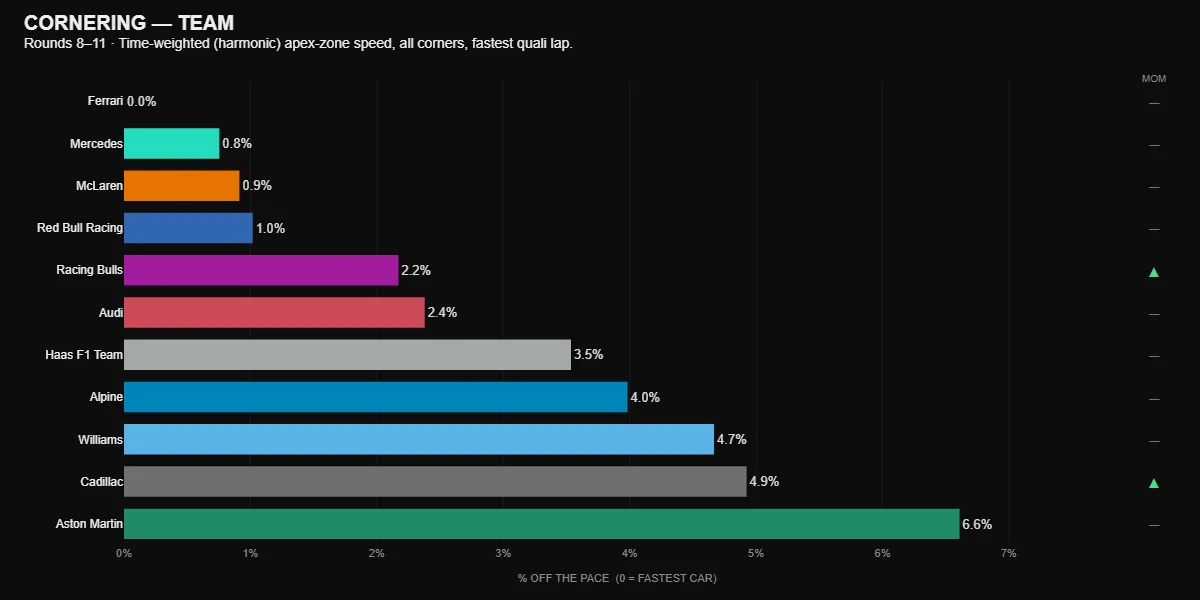
Ferrari have the whole season had the upper hand on this part, they are clearly ahead of the pack when it comes to cornering, especially medium and slow corners. This is why everyone expected Ferrari to perform badly in Silverstone and Spa, and great in Hungary. On the straightline Ferrari were behind, they make up for it here to gain their advantage over both Mclaren and Red Bull Racing. If Ferrari want to make it to Mercedes, they need to up the straightline as Mercedes will continue to have the advantage.
Next three teams are on par (Mercedes 0.8%, McLaren 0.9%, Red Bull 1.0%), if Red Bull wants the upper hand on Mclaren this is a place to get it. They already have it on the speed, now they need it in the corners. Mercedes has lower mechanical grip, making the Monaco pole quite surprising.
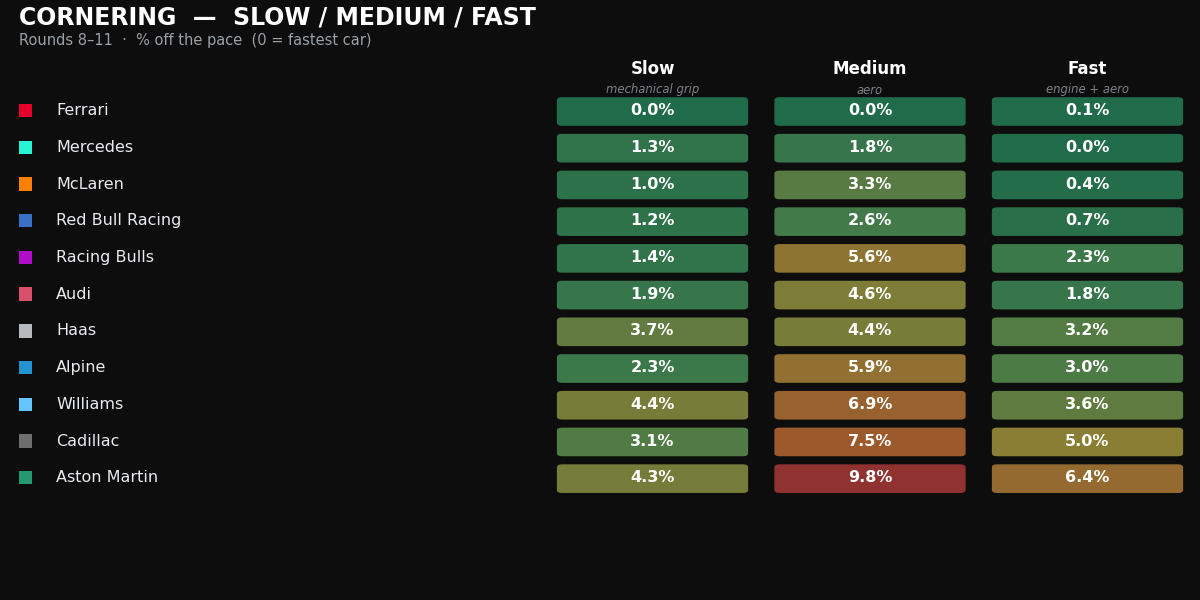
In the top of the midfield both Racing Bulls (2.2%) and Audi (2.4%) can be found, they have a clear advantage, showcasing why the midfield is about those two teams currently, they are moving away as best of the rest. Alpine were quicker than Audi on overall pace, however this chart showcases where Audi gained it’s advantage over Alpine, cornering with Audi at 2.4% against Alpine’s 4.0%. The Racing Bulls gained their advantage over Audi in the slow corners.
Haas at 3.5% is the best of the midfield, truly showcasing how traction and straightline speed should be their concern. Haas leads the midfield in medium corners (4.4%), but lacks the speed for highspeed corners (3.2%).
Williams stays in the back together with Cadillac who is slowly gaining some momentum (Williams 4.7%, Cadillac 4.9%). Williams primarily lacked mechanical grip in the corners. However Cadillac is not that far behind in the mechanical grip, infront of Haas but lacking the aerodynamics to make a real step up the chart.
Zandvoort will be telling as the team begins to set its focus on 2027. At last Aston Martin, 6.6% off on the four-race window. If we only took Hungary into account they would only be 3.7% off the pace in the corners, however before settling in on a rank based on the upgraded car, we need to see the performance in Zandvoort.
If we put them into the known cornering categories Slow, Medium and Fast cornering we can see their pace in the following table. This can be useful to understand in which types of corners the car gains its advantage. Breaking it down from mechanical grip through aerodynamic grip.
Degradation
Degradation is the last pillar. Hardest to measure, therefore not as precise. We use adjusted fuel pace in clean air to find the best fit and adjust degradation to pace. It is a residual against each car’s own pace – below 0 means the car is kinder to its tyres than its speed predicts. We then score each race weekend for each team between 0 and 100. Over time we get a relative index, which can be found below.
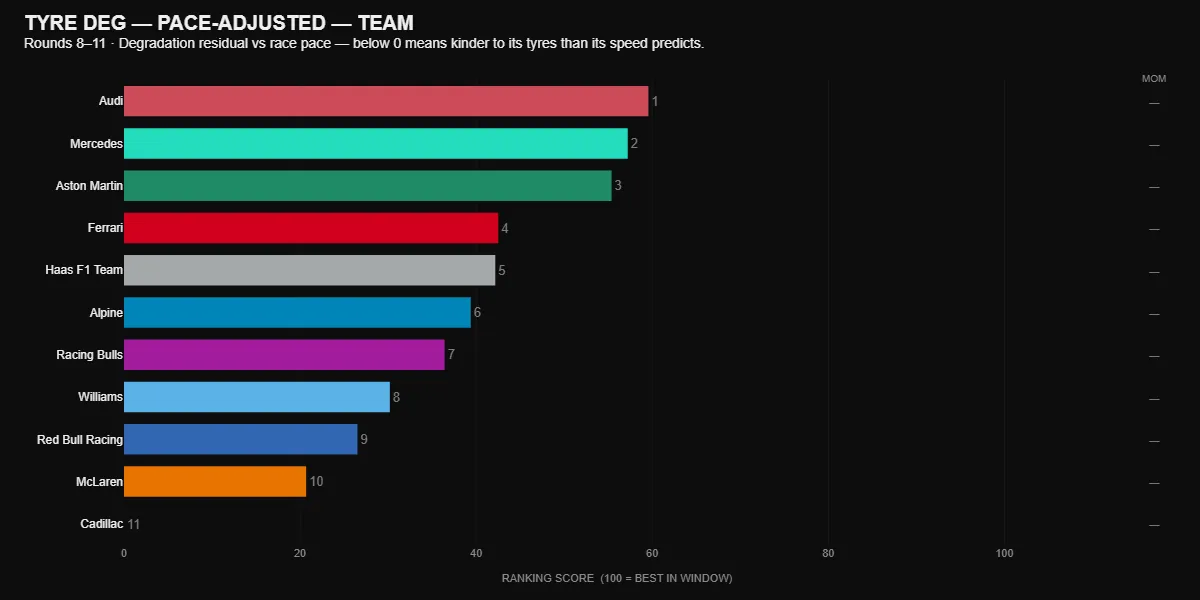
Degradation as described in the Miami post, is relative to who you are competing against. That is where you gain the advantage. Saying Audi has better wear than Ferrari does not make a difference for points for Audi or not. They should be compared to their closest competitor which currently is Racing Bulls.
Audi lead the whole field on this metric (rank 1), however their ability in the races to keep the tyre degradation low, helps them keep up in the last parts of the stints, which opens the door for multiple strategic decisions. Worth noting they lost in both high speed and cornering, so the tyre score is doing a lot of work for them.
The tyre degradation on the Mercedes car has all season been rumored to have low degradation, and here they sit second, the cooling around the tyres seems to be superb to keep the tyres in the correct window. In Silverstone Antonelli showcased how the degradation wasn’t an issue at all compared to its closest competitors, holding back on performance to gain free air and cool the tyres. They are just a step ahead of Ferrari (rank 4) who are the closest to them among the top 4 teams. We also see this in the overall strategic decisions of the team from Mercedes. They prefer in general to extend their stints, while Ferrari like to pull the trigger early. In Barcelona it gave Ferrari the upper hand as deg was higher than anticipated and they got it wrong.
Aston Martin is up there in third, they might not have been great on pace, however having a slow car in the corners helps on the overall tyre degradation score, since the rubber ain’t pushed as much. However what was truly interesting from Hungary, their best race in 2026, they did half race distance on Softs as the only team, Stroll’s degradation pattern was almost neutral. The flattest line I saw the whole season on softs.
Other honorable mentions from this chart are Red Bull Racing (rank 9) and Mclaren (rank 10) who relative to their closest competitors are quite behind on degradation, which can explain some of the difference in the race pace between the top 4. At last Cadillac seems to quite struggle on this part, dead last of the field, which is concerning as they already have a quite slow car. As they will increase the pace of the car in the corners, they will be putting more strain on the tyres. They are probably working on a long term solution going into 2027. For now it is a bit worrying.
Pit tendencies
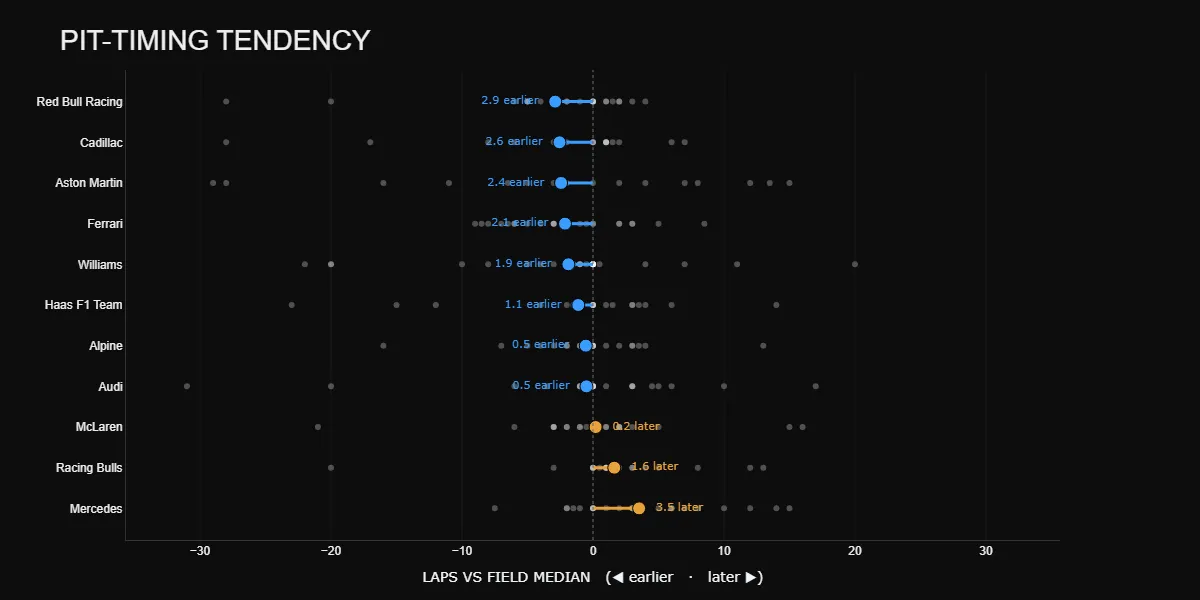
The pit tendencies is just a term used to understand if teams are more likely to pit earlier or later. This part is based on all races of the season, since the data points are quite limited with only four races. Safety car stops are excluded, so this is to illustrate voluntary strategy calls. A tight scatter shows consistent, scattered either opportunistic or due to mechanical issues or damage.
Just a few highlights from this graph. In regards to the top 4 Red Bull are considered opportunistic, pitting on average 2.9 laps earlier than the field median. They like to pit early to put on the pressure on the car’s front, as does Ferrari (2.1 laps earlier). On the other hand Mercedes likes to wait, 3.5 laps later than the field median, and they can as they have the luxurious great pace and good tyre degradation to stay out and wait for opportunities or create a tyre delta.
Conclusion
Put the four metrics side by side and one thing jumps out: no car is complete except one. Mercedes are top three in everything and first in two, race pace, straightline, and a tyre-deg number that lets them dictate strategy rather than react to it. That’s not a car with a strength; that’s a car without a weakness. It’s why they lead both titles while spending the least of the top four on upgrades.
Everyone else is a set of trade-offs. Ferrari own the corners but give it back on the straights, and until they find that lost tenth in a straight line, Mercedes stay out of reach. McLaren are the interesting case, third on race pace but only sixth if you average the three pillars, dragged down by the worst tyre degradation of the front-runners. They are racing better than their components say they should, and that’s usually a sign of a car and a team hitting form, not a fluke. Red Bull have hauled themselves into the fight, but the same deg problem is quietly costing them on Sundays.
The midfield is a two-team story. Racing Bulls and Audi have pulled clear as best of the rest, and they get there by different roads. Racing Bulls on straightline speed and overtaking, Audi on the tyre life that keeps them in the fight late in a stint. The 55-point gap between them will decide who wins that battle long before pace does.
At the back, degradation is the whole story. Cadillac have a slow car that also eats its tyres, the worst combination on the grid, while Aston Martin’s slow car at least saves its rubber, which is the one green cell on an otherwise red row. Whether Hungary was a genuine step or a track that happened to suit them is the AMR26’s real question, and Zandvoort answers it.
Because that’s what the second half is really about. The first half was every team pushing the current car to see where they’d land at the break. Now the resources will split between 2026 and 2027, and the pecking order above decides who spends where. Do Ferrari and McLaren keep throwing upgrades at a Mercedes that may already be gone? Does Red Bull cut its losses? And does anyone in the midfield have the nerve to chase a place they can actually reach? The grid is set. The choices start now.