
Hamilton’s Barcelona 2026 win was a weekend to remember and finally a masterclass in strategy from Ferrari. They brought 8 upgrades to the car; while their Friday practice sessions did not show it the qualifying and race talked all for it. The race was one of the most entertaining to watch due to the massive role strategy played for the race results, alongside some spectacular overtaking in turn 3.
Before diving into the stories of Barcelona a few premises to have in mind for the weekend. Barcelona was the first race on the calendar which was a real test for the tyres, it was a race which purely split the top and bottom teams in terms of pace and tyrewear. More tyrewear naturally opens up the strategic playbook for the teams, forcing them to gamble and pivot between 1,2 or even 3 stop strategies, having to time their under- and overcuts.
Going for an undercut is in general carries more risk as a top team compared to a midteam, especially when the pit window already starts on lap 13. At this stage the field has not been stretched out, meaning an early stop risk dropping a driver directly into traffic behind a slower car. Despite the margins, execution across the pitlane was quite high.
The defining story of the weekend was Hamilton, he went on aggressive from the start of the race on the softs, but struggled on the softs, which seem to overheat in the race and thus struggled to reach Russell, who started on the mediums and were able to have a much better first stint. However Hamilton went on with an early pitstop to put on the hard tyres, whereas Russell followed shortly after. On the first pitstop Hamilton earned 2.8 seconds in total, this was a clear signal to the Ferrari pitwall that the degradation was massive in Barcelona and that a 3 stopper might be the correct way. Mercedes however were confident that a 2 stopper was the winning strategy.
In this piece, we first try and understand how and by how much Hamilton earned after each pit and thus managed to close the gap to Russell. However we also look into the Virtual Safety Car (VSC), if it had not disrupted the race and strategies playing out, would Hamilton still have taken the victory? Finally, we take a closer look at the midfield, where Racing Bulls made some brilliant unconventional strategic calls, only to see their hard work undone by the timing of a VSC.
Hamilton vs the Mercedes
Free practice did not really give any clear indications of upgrading packages working. Neither race pace or one lap time did look impressive. However, when early saturday afternoon was upon us, Hamilton delivered magic in qualifying. He was ahead of Russells most of the lap, however at the very last corner Russell was able to claw back around 0.100 seconds in a single corner in combination with a short straight to secure pole position.
Hamilton chose to start on the soft tyre, it was rumored that the soft was almost just as durable as the medium compound, but quicker. However Ferrari clearly noticed the high degradation under race conditions of the soft, quicker but overheating.
Antonelli, who started behind Hamilton on mediums, was told to start pushing, and as he was just about to catch Hamilton around lap 11, Hamilton went for the pits to put on a new set of hards. Mercedes reacted and pitted Russell at lap 12. However with a single undercut lap on hard tyres, Hamilton was able to gain 2.8 seconds on Russell. This showcased the amount of tyre degradation and the power of the undercut this year in Barcelona.
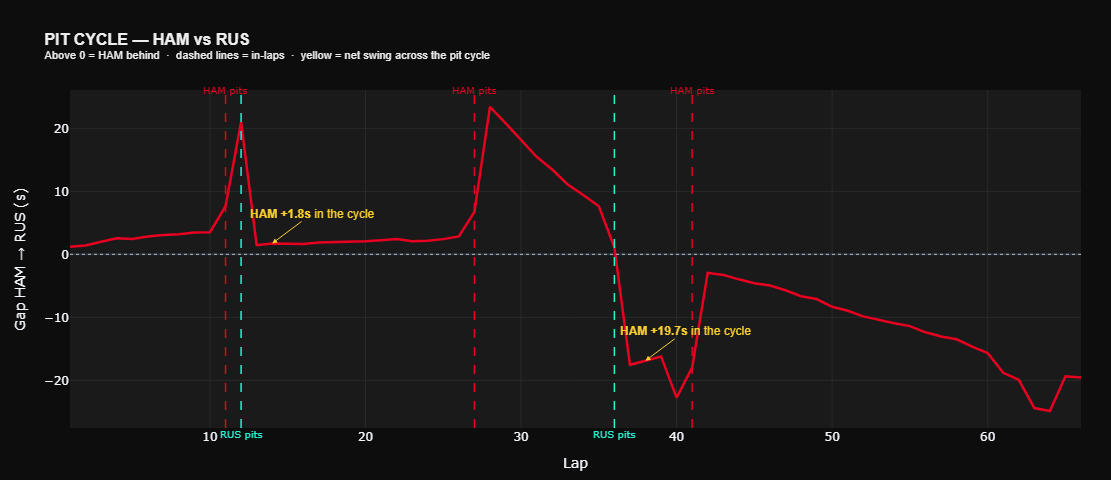
Russell covers him off quickly, however Hamilton’s tyres are already warmed up and are able to gain a few tenths during Russells outlap. Despite the pressure, Hamilton could not create a genuine overtaking opportunity, he remained trapped a few seconds behind, eventually drifting back as the stint progressed.
Hamilton then pits at lap 27 for mediums, and this is the moment when things take a turn. Russell and Mercedes do not react to the undercut, as they now know Ferrari are going for a 3 stopper, they want to make it a two stopper. You lose around 25 seconds doing a pit, taking into account inlap and outlap. Hamilton was taking chunks of time out of Russell every single lap. Just after the pit on lap 28 the gap was 23.4 seconds, at lap 36 when Russell pits the gap is 1,1 second, when Russell comes out behind Hamilton he is 16.9 seconds behind. Hamilton gained 19.7 seconds between lap 27 and lap 37.
The TV script at this point is set. Hamilton has to pit once more, forcing him to hunt down Russell on track in the closing stages of the race. However, everything is flipped on its head when the VSC was deployed, neutralizing the gaps and handing Hamilton the win. After Hamiltons final stop back to the Hard compound, he was steady maintaining a 5-lap tyre advantage over Russell.
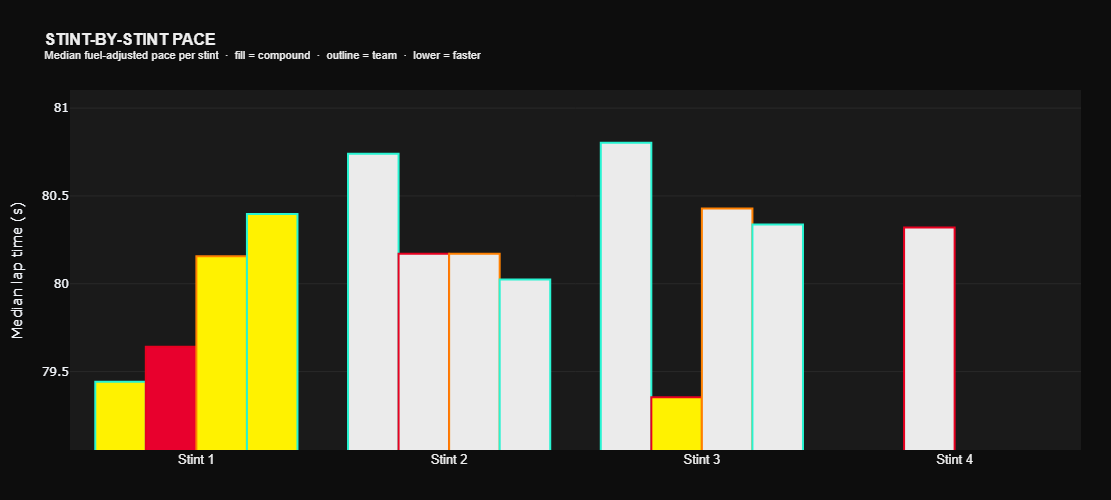
To fully comprehend the stint performance of Hamilton and how much he pushed the car to its limits. Below is a chart which breaks down the average stint pace for Russell, Hamilton, Norris and Antonelli across stint 1,2,3 and 4. Because Hamilton was the sole frontrunner executed a true-3 stop strategy, he alone registers data for stint 4.
During stint 1, Hamilton clearly lacked the pace to match Russell, in Stint 2 the charts shows Russell lagging significantly behind, though we must note that this was a highly aggressive short stint for Hamilton. Furthermore it also dictates that Russell experienced quite a drop in laptimes. In the 2nd stint Hamilton were not able to catch up to Russell despite a quick pace, and then he pitted to new mediums. As Russell continued he hit the cliff and laptimes dropped, making his average pace drop. If we compare stint 3, the data confirm Hamilton was making monumental gains. Consistently averaging sub 1:20 lap times, while Russells saw a nearly 1:21 per lap.
Was Hamilton given the win?
However all us, the viewers was left with an unanswered question after the race. Would Hamilton have won if it was not for the VSC at lap 41 and 42, giving him a fresh set of hard tyres for free? Did it make a difference? To answer this question, we have simulated an estimated guess on how the race could have unfolded if the VSC did not come out at lap 41.
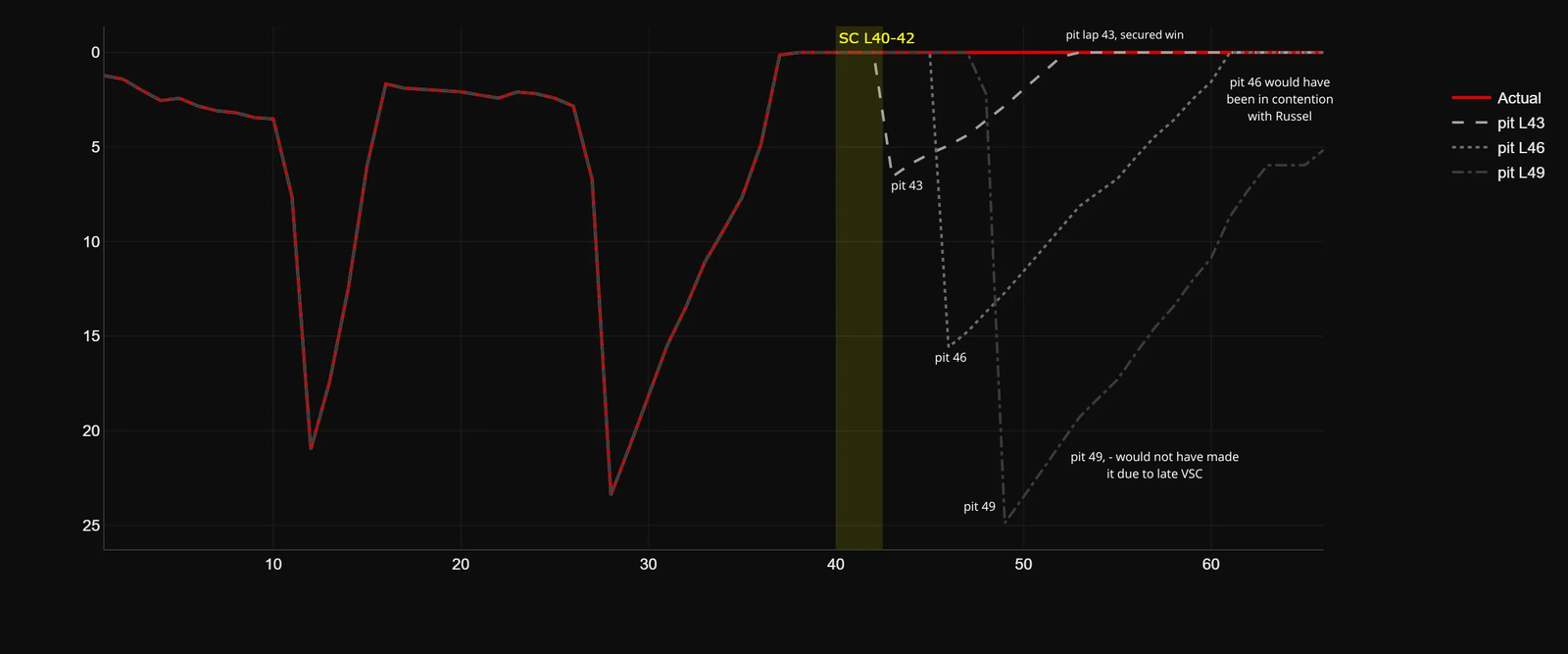
Below we have created three alternative paths for Hamilton. We know for sure he had to pit one more time, we also know that Russell were doing his last stint. We did a simulation at lap 43, 46 and 49. Giving us three slightly different results. We assume a few things in the methodology, which can be read in the bottom of the page.
We take a brief look at the three scenarios.
Scenario 1 – Lap 43
Hamilton pits at lap 43, he is now 6,56 seconds behind. He is able to catch up fairly well in just about 10 laps, and presumably have the tyreadvantage and time to create an overtake opportunity.
Scenario 2 – Lap 46
This is where things begin to get a little more exciting. Just as Hamilton on fresh mediums were able to gain seconds per lap on Russell. At the point when Russell pits, Hamilton is now on quite old mediums and Russell has a high tyre advantage, eating into Hamiltons lead. If Hamilton would have ran the mediums for just 3 more laps, he would be 15 seconds behind Russell, when comming out of the pits under full race conditions. However due to a better tyre off-set Hamilton is able to gain more seconds per lap on Russell and thus be in contention.
Scenario 3 – Lap 49
At this point Hamilton would be 24 seconds behind Russell, and not be able to catch up to Russell. This is due to the fact Russell gained so much on Hamilton and because Hamiltons pace would be interupted by the late VSC in the concluding laps of the race.
Simulation Assumptions based on evidence from the data
- Tyre degradation on hard is based on an estimated guess between Hamilton’s own deg rate and the median rate, we choose to be the most conservative of the two.
- Russells times under the VSC windows are projected and estimated on his past few laps + tyre deg.
- The baseline for Hamilton’s pace when coming out of the pits later is adjusted for fuel and estimated tyredeg.
- We assume no traffic.
- Lap in / lap out + pit is estimated on his earlier pitstops under race conditions.
Concluding Remarks
Without the VSC Hamilton could still have won with ease. The actual VSC window fell almost exactly at his optimal pit point. Only 6 laps later and he would not have been able to gain enough time each lap to hunt Russell down. This showcases the amount of degradation in Barcelona and how a misjudgement on pit strategy can be a deciding factor in a race. Ferrari were able to get the most out of Barcelona with their new package, they were able to force Mercedes to follow through on an early pitstop, which did not play into the hands of their 2 stop strategy. Mercedes were on the backfoot for the rest of the race and their only hope to win, was if Ferrari proved their strategy wrong. However Ferrari did it to perfection this weekend.