
The Austria 2026 GP delivered on entertainment, strong overtakes, sharp strategy calls, and minimal safety car interference. The winner of the weekend was Russell, who made great use of his qualifying position, keeping his closest contenders behind him even though he didn’t have the fastest car. Because his closest competitors were fighting among themselves, he gained multiple seconds over the race from that alone, meaning he never had to watch another car in his mirrors the whole race. Russell’s garage went with a set-and-go strategy: once they realised Ferrari wasn’t their main competitor, they could commit to it. They identified early that Verstappen was the real threat, and decided to use the gap to create a strategic advantage, pit before him or after him, but don’t fight him.
Mercedes’ main goal was to beat Verstappen through strategy, not on-track defending or overtaking. The reason: Antonelli was closing in over time, making significant gains on Russell. Antonelli on paper in the race showed better pace than both Verstappen and Russel. This is important, because it might have explained why Redbull wanted a high tyredifferntial to Russell. We break some of this down in the post, and also discuss how Verstappen could have taken the win if they’d just pitted a bit earlier.
RUS vs. VER
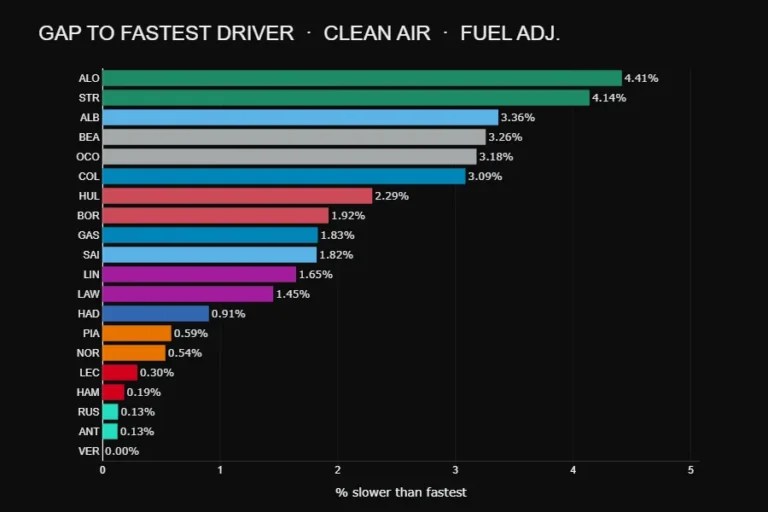
Last week Mercedes were outstrategized by Ferrari, this week it was the other way around. Ferrari brought the most upgrades after Red Bull, but couldn’t find ground on Mercedes during the race. That meant Ferrari were quickly out of contention for the podium, as Antonelli and Verstappen showed great pace.
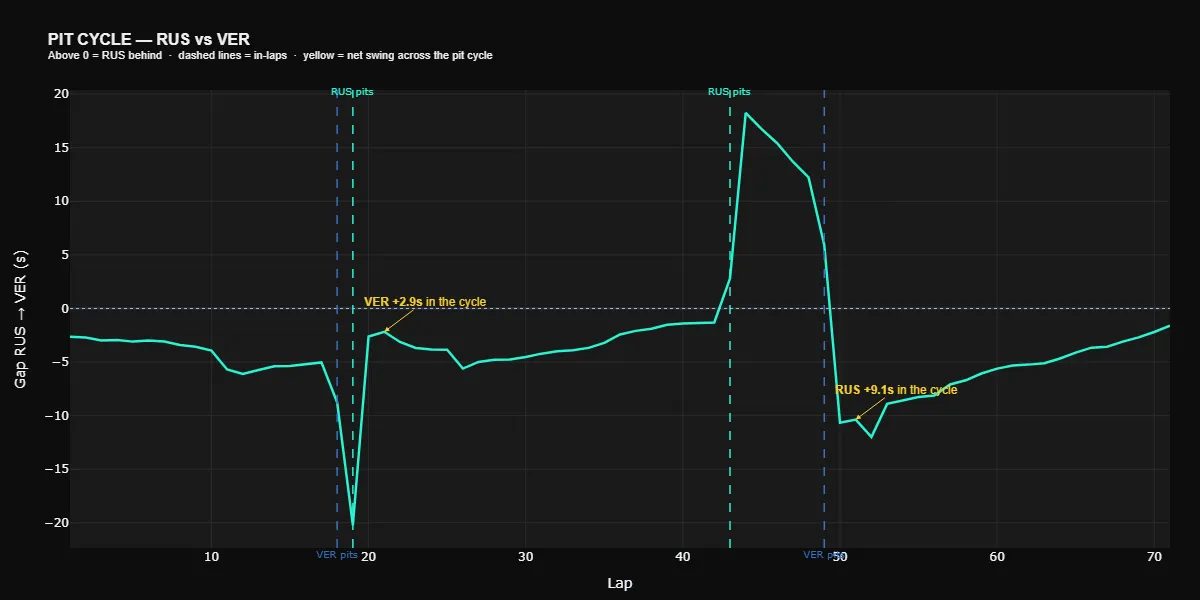
In this view, a pit cycle is when both drivers pitted at two different times, this shows how much one driver gained or lost from either pitting early or staying out. The total time lost is based on pit laps plus out/in-lap and warm-up, as warm-up laps are included in the equation when working out the strategy.
When the line is below zero, Russell is ahead of Verstappen; when it’s above zero, Verstappen is ahead. When the lines close in on zero, the two drivers are closing in on each other.
The first stint was clean for Russell, he got out into clear air early and drifted away, whereas Verstappen had a great start but had to fight his way up into P2. This showed at lap 11 and 12, where the delta to Russell increased by almost two seconds. Verstappen started closing the gap again. This was the point when Mercedes became aware of who their real competition was. As the projected pit window from Pirelli approached, Verstappen pitted for hard tyres on lap 18, with Russell following a lap later. In this window alone, Verstappen gained 2.9 seconds on Russell, closing to 2.18 seconds Russell. His next problem was Hamilton, who’d already pitted on lap 11 and was now just ahead – but a great lunge got Verstappen past and into clear air, costing him around a second. Then, when the VSC was deployed on lap 25, Verstappen lost a bit more ground to Russell.
After that, the data clearly showed Verstappen gaining time on Russell consecutively, in a deliberate and controlled manner. The radio message to Verstappen was clear, they wanted a tyre differential going into the last stint, meaning they’d extend the stint for fresher tyres on a lighter car at the end. Russell pitted on lap 43, Verstappen waited until lap 49. Those six laps gave Russell a 9.1-second advantage that Verstappen now had to close. As the race progressed, it became clear the delta Verstappen was earning each lap wouldn’t be enough to catch Russell.
Cornering degradation - updated Redbull, no wear
One key thing I noticed when looking through the data, was how Verstappen were able to stay ahead of Russel in the corners. His ability to push the car to its limits and making around the outside overtakes were quite incredible to watch.
In this visual, take a look at the average gain or lost in each corner for Russel and Verstappen in Austria. To make it somewhat comparable I used the first 12 clean laps from each driver, so traffic is not affecting the score or comparison.
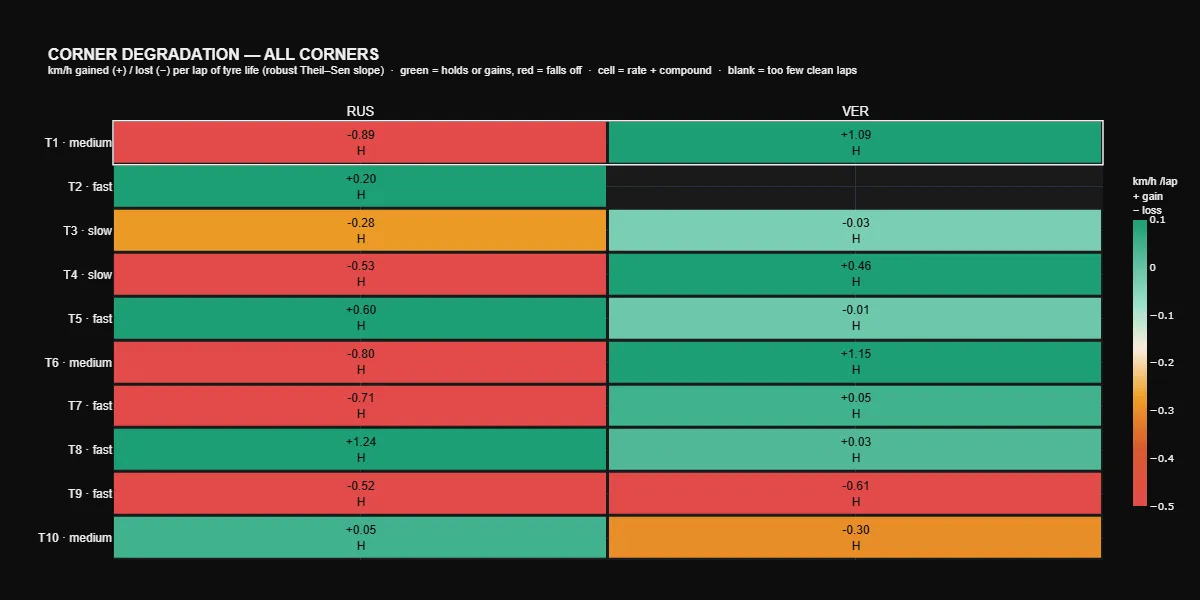
The Red Bull has been updated significantly this weekend, and it shows on some of the data. From the read of the graphic, in almost every corner Russell is losing time each lap, while Verstappen is able to keep it at an even pace. Verstappen is able to stay at pace in all corners except the last two corners. The read from this is that Redbull had exceptionel good tyrewear, while many others were struggling.
Could Red Bull have won if they pitted earlier?
Should they have pitted earlier? Probably. Let’s run a quick check based on Austria’s tyre degradation.
This analysis follows the same principle as the Hamilton Barcelona stint simulation where the VSC was removed.
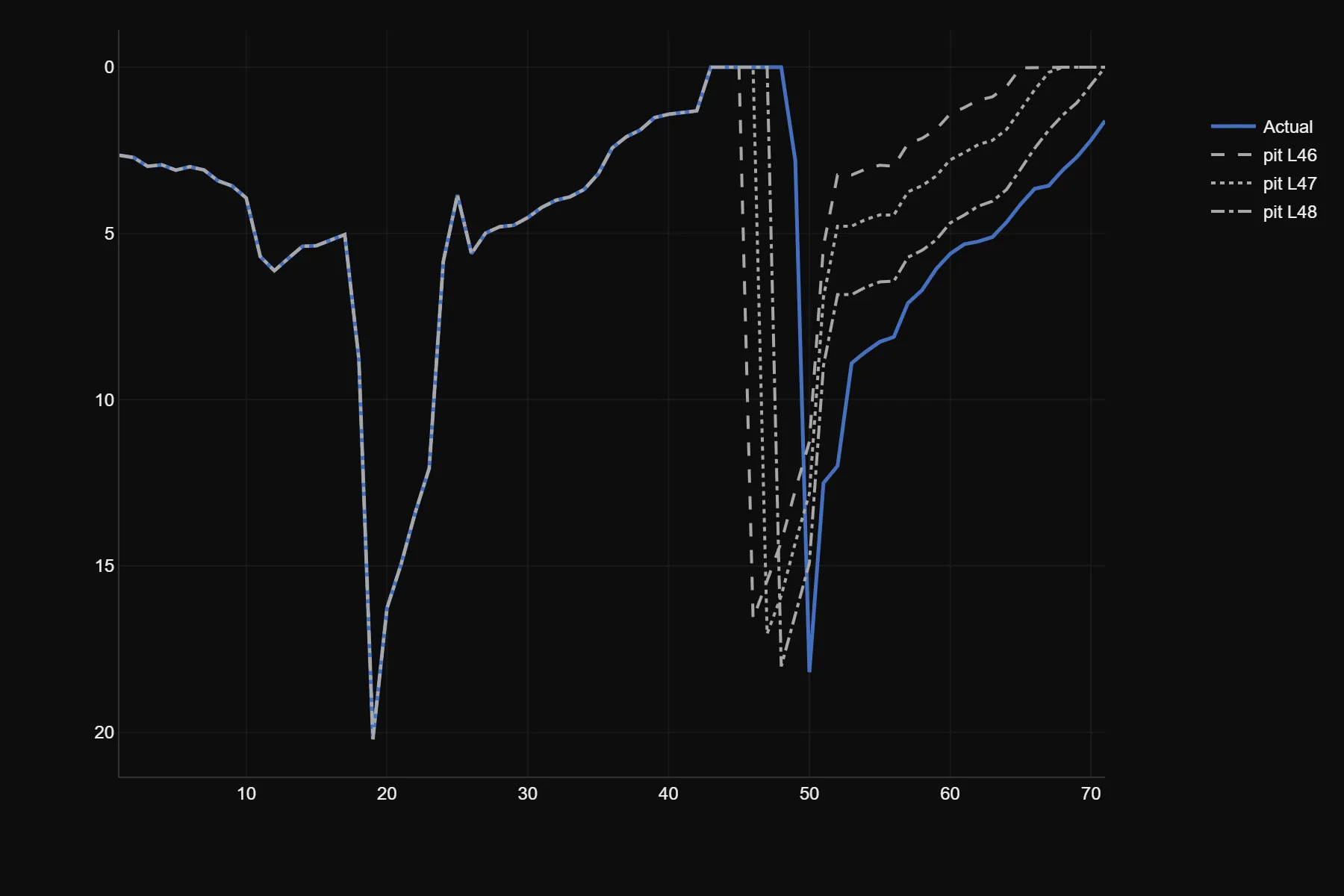
Verstappen came very close to catching Russell in the end. He pitted on lap 49 and nearly got there. But how would it have played out if he’d pitted 1, 2, or even 3 laps earlier? He’d still have a tyre differential, but more time to close the gap. Let’s take a look.
Below is the figure. The grey lines are the what-if scenarios we just discussed, they follow the same line as the blue until Verstappen goes into the pits.
Pit at lap 48
Had Verstappen pitted just one lap earlier, he would have caught up to Russell, and maybe fought for position.
Pit at lap 47
The steepness of the lap-by-lap gains on Russell starts to flatten a bit, due to a smaller tyre differential. Still, he makes it in the end, a few laps before the finish, making an overtake more likely.
Pit at lap 46
He would definitely have made it, but overtaking would be more difficult, and the back-and-forth between Verstappen and Russell would give Antonelli time to catch up and join the fight.
This may also be why Red Bull gambled on a higher tyre differential, they wanted Verstappen able to make a secure pass on Russell in one move. If Max had to fight back and forth with Russell, Antonelli would have caught up, and Verstappen might have lost second place to third.
Antonelli showed great pace all weekend, and was arguably the fastest man on track.
Bonus: Why Austria werent a real win for Russell
It was a perfect weekend for Russel, many things turned in his favour, which he obvisually earned due to his very unlucky start on the season, with bad safetcar timing and a harsh DNF in Canada followed by a harsh penaly in Monaco. Canada was a win on paper, he closed the gap. However things might not help him next weekend and he need that, because Kimi was faster than Russel in Austria.
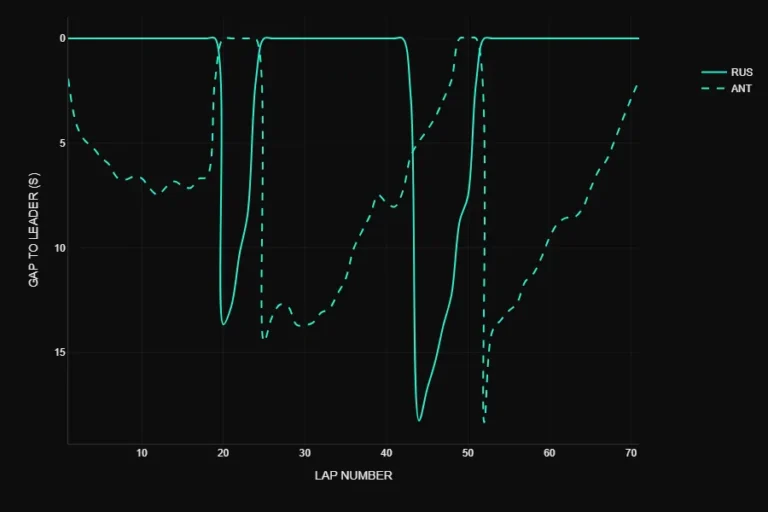
In the first stint, he lost a lot of time at the start, then ran on par pace with Russell. But as the graph tells on him, Antonelli was able to gain massive time on Russell after the first and second pit stops. It should be said he also had a tyre offset, just like Verstappen. Still, his ability to take seconds off Russell was already visible in the second stint, where he only had a 6-lap offset. In the end, Antonelli was just 2 seconds off Russell when the chequered flag fell. The race would have unfolded very differently had Antonelli been P2 and Verstappen P3 – but because the two Ferraris qualified higher and ran a 3-stop strategy with Hamilton, both Antonelli and Verstappen had to overtake them twice.
To some degree, this was of course a well-executed race from Mercedes – but it was also a cruise for Russell. His biggest pain the whole race was the backmarkers in my opinion.
Conclusion
So what does this mean going forward? Ferrari brought the most upgrades after Red Bull this weekend, but it did not translate into race pace, a concerning sign if it continues into the next few rounds. Red Bull, on the other hand, showed real pace with their update, and if Verstappen’s tyre strategy had gone differently, this could maybe have been a win instead of a P2. Antonelli’s late charge is also worth watching, if he keeps closing gaps like this in the final stints, he will not stay two seconds behind for long.
Key takes from this piece:
- Russel won on strategy, not pace.
- The updated Red Bull car is performing well, not the same can be said about the upgrades at Ferrari.
- Verstappen were almost able to take the win from 5th place, overtaking cars on track in the progress. The tyredifferential gamble almost worked out.
- Antonelli continues to be fast, and were also catchting Verstappen in the end.