
Racing Bulls vs Alpine is currently the most interesting fight in the 2026 midfield, Silverstone showed why. Alpine peaked early in the season, with Gasly on the podium in Monaco, but the data has them slowly falling back while Racing Bulls keep scoring while Audi in regards to some metrics are closing in from behind. We take the temperature on where each car is genuinely gaining, then look at the telemetry behind Antonelli’s overtake on Hamilton. And then a quick schematic on how Cadillac have improved from each race.
Telemetry Analysis: Hamilton and Antonelli
By now we all probably would have guessed who would have won, were it not for the curb creating damage to the car, forcing a pitstop. Antonelli, he got no points this weekend, however he kept fighting until points were out of reach. Two point would have been given, if it weren’t for the track limits. The Mercedes car in the hands of Antonelli this weekend showcased how confident Antonelli were with the car, as he first an foremost managed to stay consistent behind Hamilton, while setting up the move to secure the overtake. Secondly he was able to manage his pace and control the gap with Leclerc, waiting for Leclerc to pit and then increase the pace in order to do the overcut. Antonelli only lost 2.4 seconds by extending his stint Leclerc. The Kimi we seen in Silverstone were quite different to the one we saw in Canada, however this time around it was not his teammate, he had to overtake.
We take a quick look at the telemetry between lap 3-10, which below is an average delta between Hamilton and Antonelli. Then we compare it to the time delta of lap 11 where Antonelli did the overtake. When it is positive, Hamilton is gaining time on Antonelli.
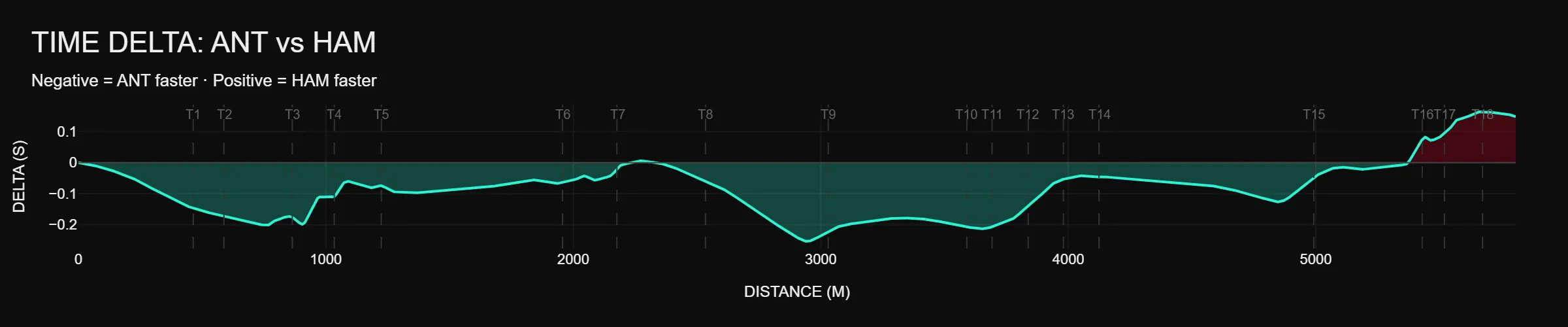
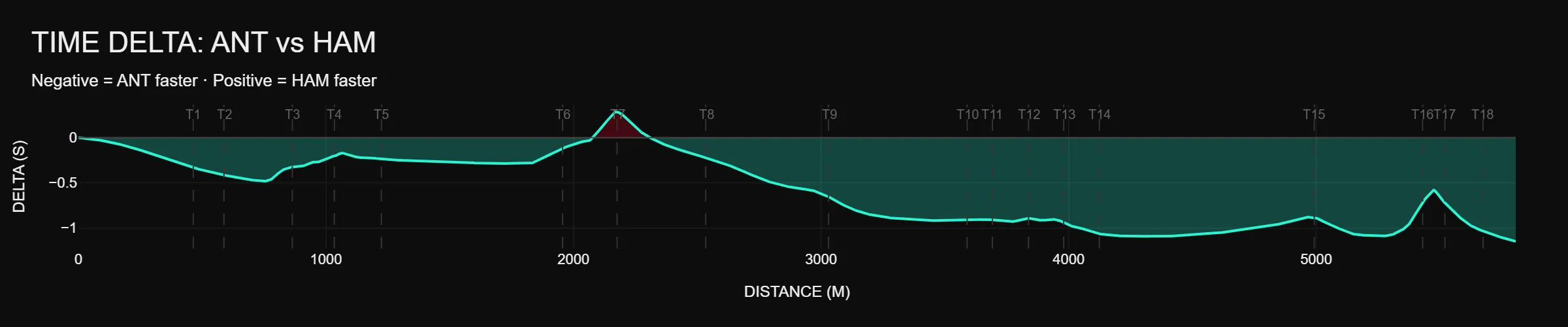
By looking at the telemetry between lap 3-10 between Antonelli and HAM, it clearly illustrated that ANT were gaining the whole lap, until the hangar straight where Hamilton deployed all his energy to stay ahead. Looking at lap 11, ANT had the upper hand to make an overtake stick. Looking at the average delta gained / lost between ANT and HAM between lap 2 and 10, it is clear Hamilton chose to let ANT get closer until the Hangar straight where he afterwards pushed the car’s battery deployment, staying ahead. However after several laps of doing this, Antonelli was able to have more and more energy available, and started Hamilton for the final push on lap 11, where he did the overtake on the Hangar straight. Hamilton did everything in his capabilites to defend, but the Mercedes just had more in it.
Deep dive on Racing Bulls and Alpine, with Audi catching up
Alpine had a good start to the season, peaking in Monaco with Gasly in P3. Since then, Racing Bulls have been crawling up behind them, scoring consistently. The data shows Alpine slowly falling back, they are still bringing upgrades, but they haven’t been as aggressive as Racing Bulls. Racing Bulls brought a big package in Miami and have dripped in smaller updates since, mainly focused on the rear corners of the car. A relativley sensitive part of the car since it ties together the brake ducts, the rear suspension fairings and ultimately the diffuser, changing how the air behaves around the rear wheels. In short, it improves aerodynamic efficiency: not a dramatic visible change, but it helps with the rear stability that these 2026-regulation cars can struggle with.
Audi have been performing at a steady level all season, sitting right in front of Williams. They have been solid overall, but bad luck has kept us from fully seeing what they’re working on under the hood. At Silverstone, Bortoleto showed the Austria upgrades were working, taking four points, though it was helped by Verstappen, Antonelli and Piastri all either retiring or losing significant time to damage. Alpine, on the other hand, haven’t fully developed their car yet, bringing only around 14 upgrades, which is eight fewer than Audi and Racing Bulls. Their focus has been the rear wing, which again adds to rear stability.
We take a quick look at some metrics, which can help us understand where each team have been strong and where they are in need.
Pace development
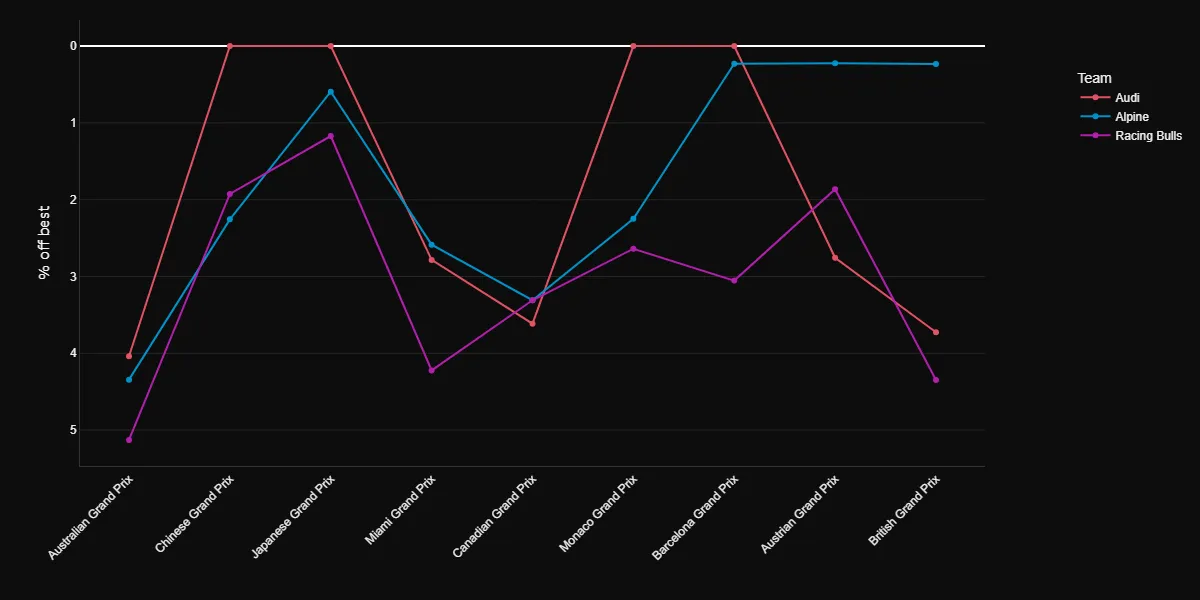
First we look at the pace of each car. This is done fully by clean-air, fuel-adjusted lap times, which is crucial for comparison. It’s a relative comparison in gap to the fastest team ahead, making each race weekend more comparable. The reason for the big drop in Barcelona is Hamilton, who had the best pace that weekend, he did a 3-stopper and drove quite aggressively, however the relative metric still stands.
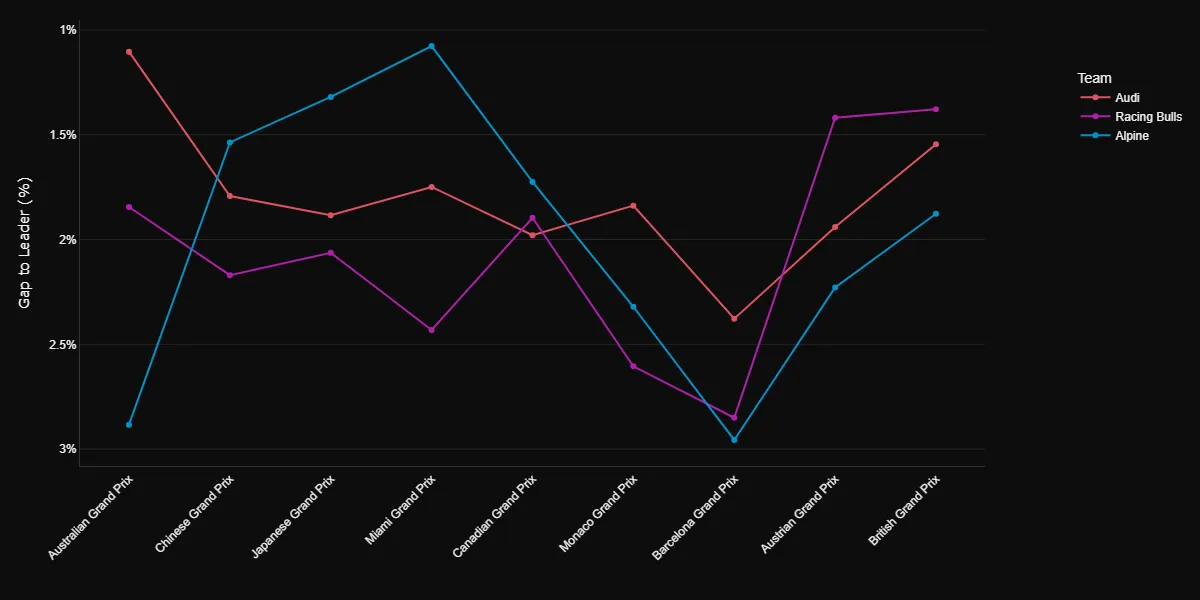
It all started out quite badly for Alpine in Austrialia, however they were recover quite drastically from Shanghai onwards, then creating a clear gap to Racing Bulls. Audi showed high hopes in Australia, but had to settle being in the middle of it.
In Miami Racing Bulls came with a big upgrade, which they were able to understand more fully in Canada, bridging the gap to Alpine. In Barcelona Alpine lost the upper hand and were not catching the Racing Bulls. Audi have been performing quite consistently throughout the season, keeping a constant gap to the leaders, however in Barcelona where the deg was high, they were able to showcase the performance of the car. Audi brought a significant package in Austria, which already in FP2 showcased the performance, however they were not able to make it into the points. In Silverstone Audi were able to show clear pace advantage. What Austria, Silverstone and Australia have in common is the average lap speed is the three highest on the calendar.
Corner Speed
This metric is computed based on qualifying laps. Qualifying laps is the cleanest laps of a car in the whole weekend. It showcases the true profile of the car pushed to its limits on low fuel, fresh tyres and pedal to the metal for the wrong reasons.
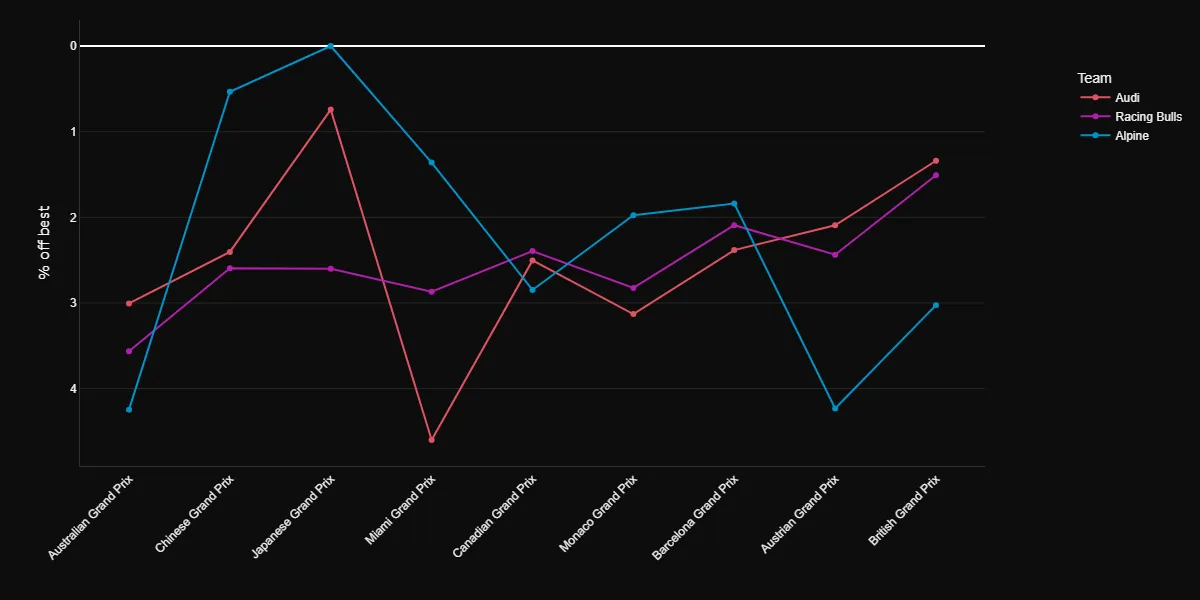
We to some degree see the same trends as in the pace diagram, Alpine on top and Audi in the middle at the beginning of the season. However as things progress, Racing Bulls are making steady gains, keeping up with the leaders, while Alpine round after round are falling behind. On the other hand Audi had a great setup in Japan, where they performed quite well, while Miami – as tricky as it is as the first “street circuit”, really tested the car. However since then they have been able to follow Racing Bulls in their progress, and gain significantly on Alpine. From this chart it could tell that Racing Bull’s advantage actually comes from the cornering of the car.
Top speed
This is taken from the race and it measures the top 95th-percentile of top speeds for each team in clean laps, with no dirty air and no extra deployment. A single 352 km/h due to excess power usage isn’t really a good indicator of the speed of the car. In general they are quite close, which is expected, however top speeds also come down more to setup choices and energy mapping. Even so, it helps us together with the cornering, to get an indication of how the cars are performing.
Audi had the highest top speeds going into the season, which was expected from testing in Bahrain where they showcased a low-drag profile. However, already in Japan Alpine were able to gain and stay ahead. Racing Bulls have been keeping a general high-drag profile the whole season, mainly gaining their advantage in the cornering, which they over the season have developed quite well. Alpine have since Canada been able to have some of the highest consistent top-speeds on track.
What is interesting is the significant drop between the teams going into Silverstone: Alpine going for low drag, while Racing Bulls and Audi went for the more draggy, aerodynamic setup, leading to lower top speeds but better cornering.
Degradation
Degradation is one of the hardest measurements to calculate, so it’s important to take some of these results with a grain of salt too. But it is my best qualified guess on how the deg is. I used fuel-adjusted lap times, assuming the car has certain amount of fuel in the bag, and then splitting it across each lap to create lap times adjusted for fuel. I find this more reliable than the standard 0.3 sec, which is correct on some tracks, but on tracks like Spa it underestimates the fuel adjustment by a mile. My methodology has it’s weaknesses as well, however I find it more precise across tracks, making it more compariable across tracks. This is again done on clean air. The degradation rate is also affected by how much the car was fighting others on track, which is not considered in the data.
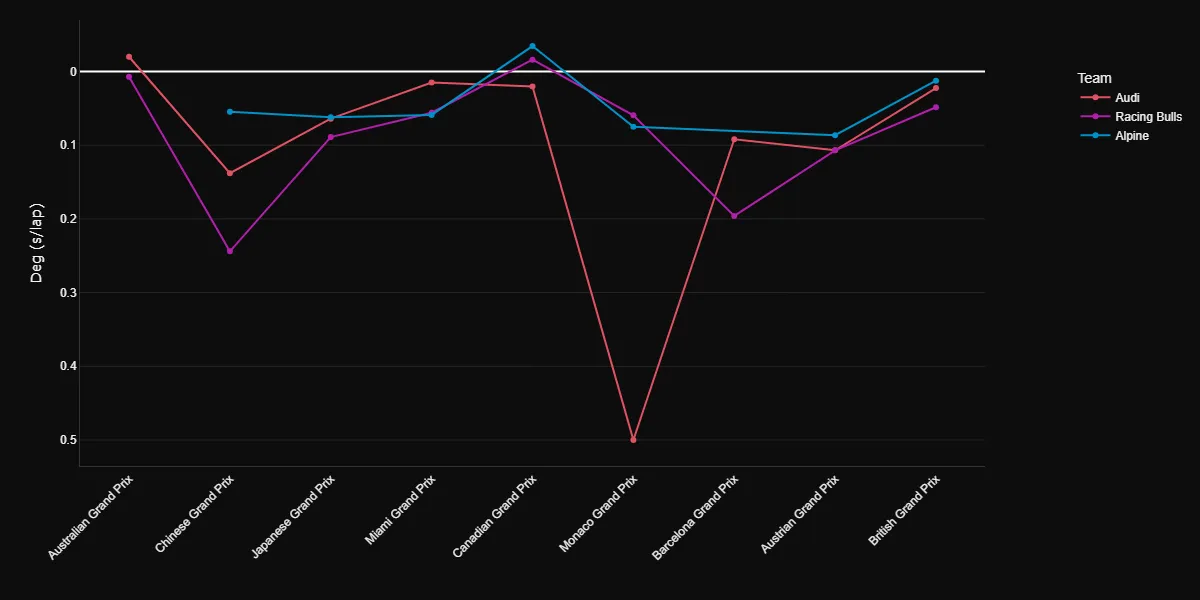
Monaco is a clear outlier, which we disregard in this piece. Degradation is probably where Racing Bulls currently are struggling the most. Throughout the season they have been dragging along in the tyre degradation, and this really comes to show in Barcelona, which is by far the most degradative track we have seen this season. The only race coming close was the Austrian GP, which was predicted to be a 1-stopper, but due to high temperatures became a 2-stopper, which encourages strategic play. In general it seems like Alpine has the upper hand when it comes to degradation. Having less degradation opens the doors to strategy: you can comfortably do an undercut without having to worry about the long-term deg, or you can stay out in clean air to do the overcut and extend when others can’t, leading to better options.
Strategy
Barcelona is a great example of this. Barcelona has been one of the weekends where the strategic call mattered the most. Here Lawson was the quickest based on pace, while both Gasly and Colapinto were trailing him by around 0.1 seconds per lap.
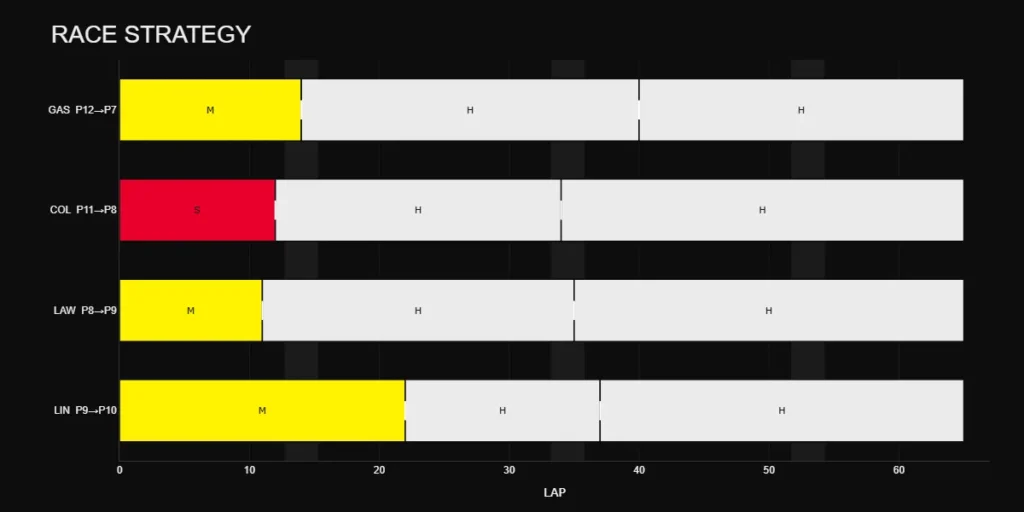
Lawson and Lindblad were able to qualify ahead of both Colapinto and Gasly, and throughout the race Lawson and Lindblad on paper had the quickest car. However when the race ended they had switched places. Alpine came away with the more points – one of the reasons was a VSC helping out Gasly, but Colapinto still went ahead and was able to gain places from both Lawson and Lindblad. Alpine went with a split strategy: give Colapinto a great start to gain places, then pit early to come out in clean air and make the tyres last. Lawson pitted just before Colapinto, while Lindblad was going quite long on the mediums.
When Lindblad pitted, Colapinto had gained around 17 seconds on him, ultimately ending Lindblad’s chances to get ahead. In the second stint Colapinto was closing in on Lawson and chose to pull the trigger at lap 33 with a 2-second gap to Lawson. Lawson defended by pitting just afterwards, however in just the single pit cycle Colapinto gained almost 4 seconds. This alone came from a better outlap and a better pitstop. Afterwards Lawson tried to catch up to Colapinto, but did not make it to the end. Colapinto had the lowest amount of tyre wear on the softs and was almost identical to Racing Bulls on the hard compound.
This is just a single example of where Alpine had the inferior car, but were able to get on top due to great strategy calls. This does not discredit Racing Bulls ability on strategy.
Going into Spa
Silverstone suited Racing Bulls well, probably because they currently have the best engine overall and their rearupgrades are paying off. Audi were, in my opinion, a close competitor. It’s a high-speed flowing circuit at approx 76% throttle, with almost no big stops, making Maggotts and Becketts a charging station for the cars.
Spa can as well be quite a headache under the 2026 regulations, as it would be around the same throttle percentage. However there are more hard breaking zones such as La Source (T1), Les-Combes (T5), Bus stop (T18/19). But the track still contains massive long on-throttle straights on Kemmel and in sector 3 before the Bus-stop chicane, while sector 2 is primarly dominated by long corners where drivers might be forced to do some lifting to recharge for sector 3. I think Racing Bulls will be favorites, they had quite the upper hand in Silverstone and will probably have it again. If rain or a safety car comes into play, Alpine will probably have a better chance of getting a better outcome.
Cadillacs best performance yet?
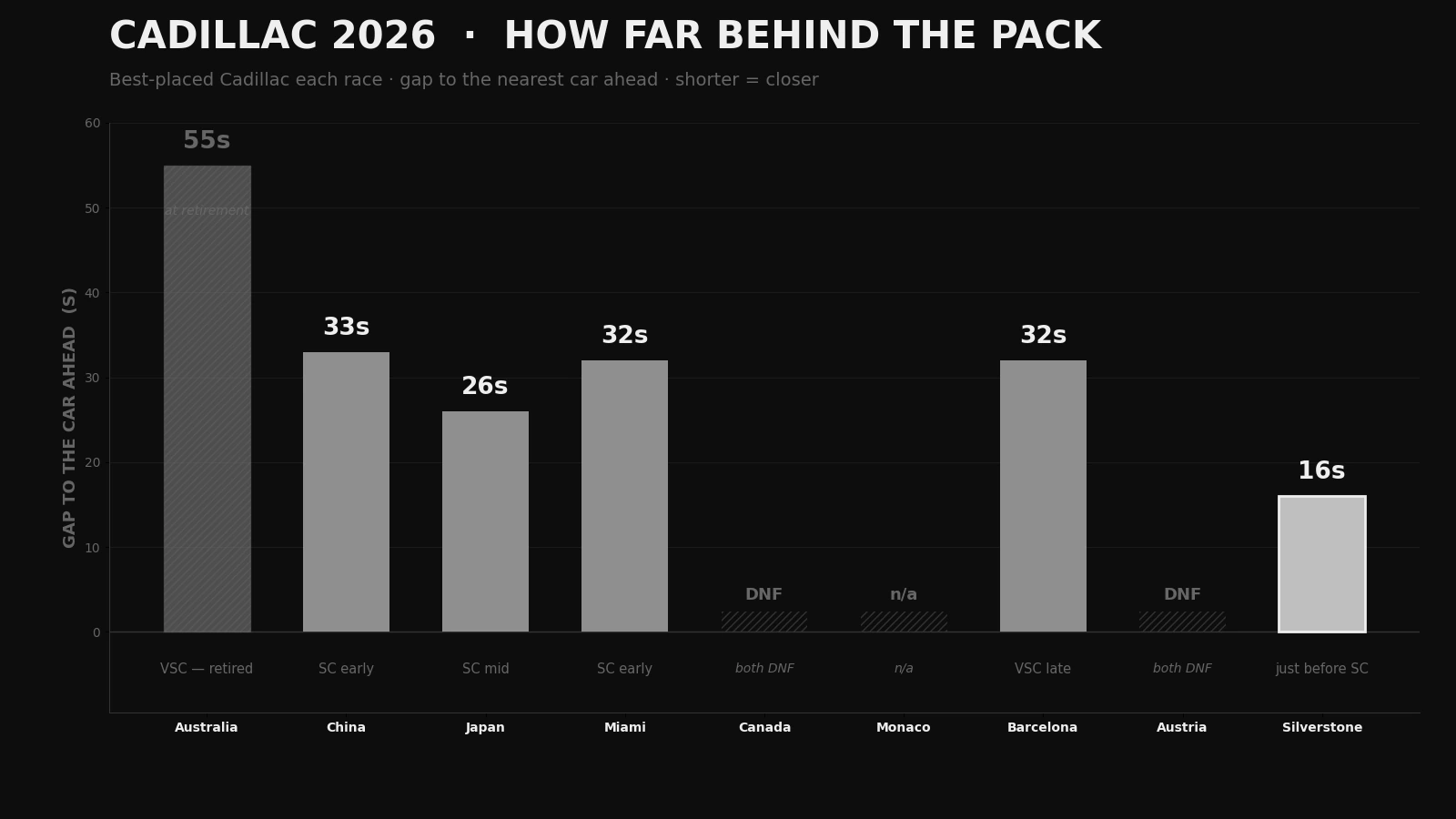
Cadillacs is the newest addition to F1. They have had a tough start in the season, and are mostly just spending their time with Aston Martin looking them in the eye and letting durability decide the placement. They had several issues this season, but are consistently working on solving them. In order for Cadillac to move forward, they need a stable platform to build from. They are still finding it, and this weekend was a good sign when both cars finished, which Bottas told F1 after the race. Cadillac is still behind, however Silverstone has been the weekend this season they have been closing in.