
Aston Martin were the team on everyone’s lips this weekend, and with good reason. They finally brought the B-spec package the whole team and definitely the drivers had been waiting for, as well as fans. Until now, their only battle had been the private one between their own two cars at the back of the field. This Aston Martin B-spec analysis breaks the weekend into three parts: what changed in the corners, what it did to tyre degradation, and how much of the deficit is still sitting in the engine.
Upgrade Recap
Until Hungary, Aston Martin had brought the fewest upgrades of anyone on the grid. They started the season with a relatively big package in Australia to fix what they had seen in pre-season testing and then, as the problems unfolded, added smaller packages in Japan and Monaco totalling 6 minor parts. Hungary changed that, 16 declared upgrades, by far the biggest package any team has brought this season.
Newey won’t call it a new car. The FIA documentation makes that a generous piece of modesty, the team declared changes to every permitted surface of the floor. And this is only the first instalment: a new engine follows at Zandvoort, with further chassis steps at Monza and Baku.
The B-spec focuses on a few things. The biggest is the floor and diffuser, declared by the team itself as a package “to increase the load on the floor”. In ground effect, the floor and diffuser are the most efficient downforce you can develop. Increased load without much drag to pay for it.
Second is the weight reduction. As Mike Krack put it in Budapest, the package is “a significant aerodynamic upgrade and a weight reduction — that is the key, or the red line of it“. Our fuel-adjusted pace analysis going into Miami showed how much lap time a car carries in ballast and unlike aero, that gain follows you to every circuit on the calendar.
Third, in my opinion, is the front end. The nose is longer and slimmer, which changes how much air is routed inside the front wheels rather than around them, and the front wing has been reprofiled to support that choice. The front wing is the first surface the air meets and it sets up everything behind it. Much like an orchestra conductor orcehstrating the flowdynamics around the car.
The rest is not filler. The rear wing package is built to increase load in corner mode while cutting drag in straight mode, which, given where this car loses time, is the part worth watching. The sidepods and engine cover were reshaped to feed the new floor, and the brake ducts, front and rear, are aerodynamic work dressed as cooling. Their external surfaces manage the airflow around the wheels, which also helps control tyre temperatures.
First Q2 appearance for Aston Martin
First indications of how the upgraded AM26 performed was in FP1 where Alonso were able to set some quite competitive midfield times. However it was not until qualifying the upgrades truly showed their effect on the timesheet.
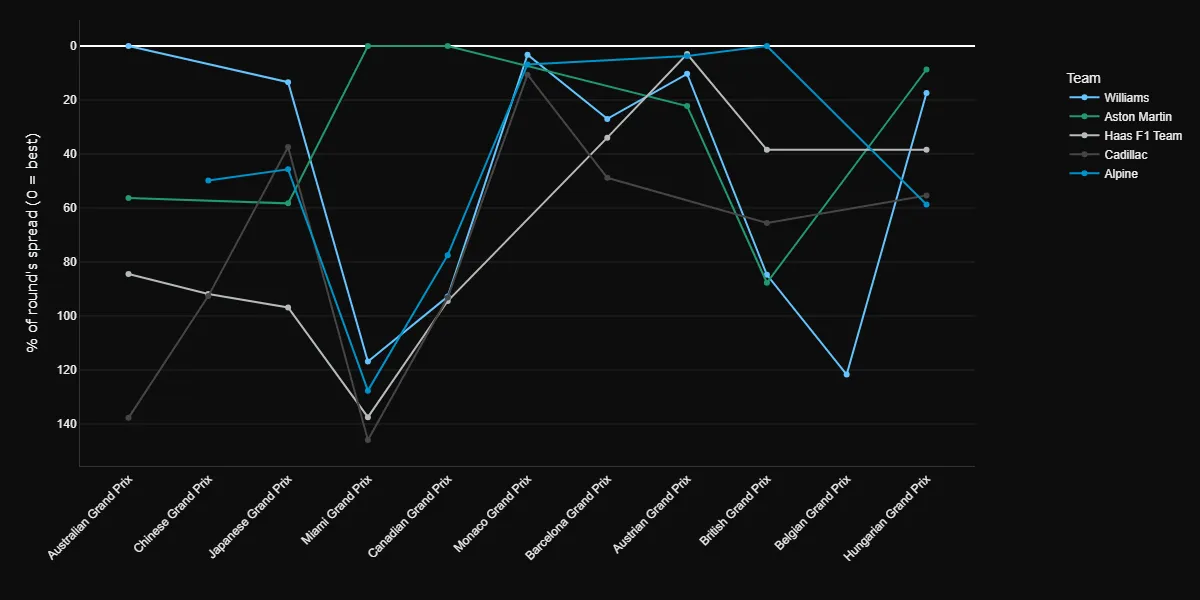
To track this across the season we measure each team’s qualifying gap as a percentage of the polesitter’s lap. The percentage normalises for lap length, so Monaco and Spa can sit on the same axis. What it does not normalise for is track type and that matters here, so hold onto it.
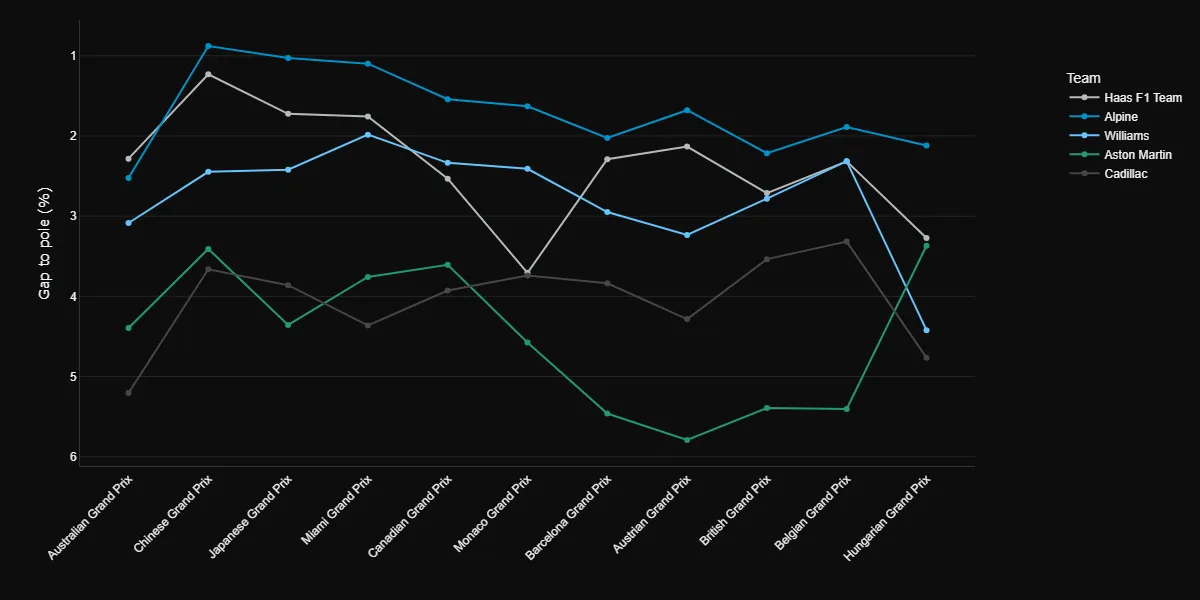
Historically Aston Martin have been in the bottom, switching places with Cadillac who in Monaco were able to gain some distance and leave Aston Martin behind. At their worst, in Austria, they were almost 6% off pole. In Belgium it was 5.4%. In Hungary they were 3.4% behind and jumped several places up and now in touching distance of Alpine by a small margin.
That 2-point step is real, but part of it belongs to the circuit rather than the car. Belgium is a power track at over 70% full throttle; the Hungaroring is 53%, with more than twice the corner density. The cleaner comparison is Monaco, the only circuit on the calendar with a similar profile, where they were 4.6% off. Even against that, the step stands up.
The more telling detail is what the chart shows over the whole season: everyone else has held a broadly constant relationship to the leaders, while Aston Martin’s line has drifted steadily away from them. Hungary is the first time that line moves back.
Race pace tells a similar story, and a more important one.
Race Pace
For race pace we use the median of each car’s fuel-adjusted laps in clean air. Fuel adjustment removes the burn-off that helps on laptime late in the stint, the clean-air filter removes laps spent stuck behind someone. It is the best available read on race-condition car performance, with one caveat worth keeping in mind: a car running in free air with nobody to fight can afford to lap conservatively, and that shows up as pace.
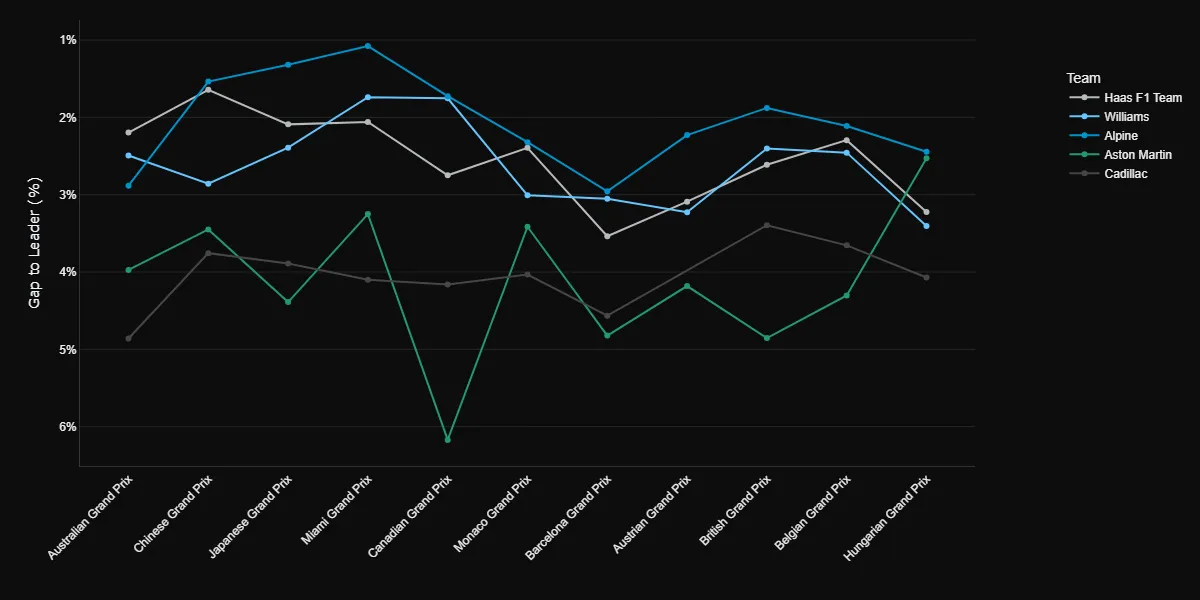
The picture matches qualifying. Aston Martin traded places with Cadillac for most of the season and then fell behind them. In Hungary they made a step, and a bigger one than in qualifying: 4.3% off the pace in Belgium, 2.5% in Hungary.
The same caution applies as on Saturday, and more strongly. Belgium and Silverstone are close to the worst circuits on the calendar for this car 79% and 76% full throttle against Hungary’s 53%, and a corner density of 1.58 per km against 2.3. Some of that 1.8-point step is not the car at all, it is the Hungaroring being more suitable for the upgrades which have been brought.
Aston Martin were able to clear Haas and come into a window with Alpine where they were able to compete directly. In Japan Gasly was able to hold off Verstappen, now they are slowly falling behind and fighting Aston Martin. Alpine’s podium in Monaco have probably saved them a constructors P6 as the amount of points up for grabs each weekend is quite narrow, unless the top teams DNF. We wrote about this in an earlier piece, link to it here.
So where did the improvement come from? To answer that we break the race pace delta into three pillars: cornering, straight-line speed, and degradation. It is not a decoposition, they will not sum to the total pace. Two of the three are measured on qualifying laps, where traffic and fuel load do not contaminate the signal. But between them they cover most of what makes a car quick.
Corner Performance - Where the AM has improved the most
Cornering performance is measured as a gap to the quickest car on the grid, taken across every corner on the qualifying lap taking the average apex speed across all corners. Working in relative terms rather than absolute speed means the number survives the move from one circuit to the next, every car is being asked the same question by the same corners.
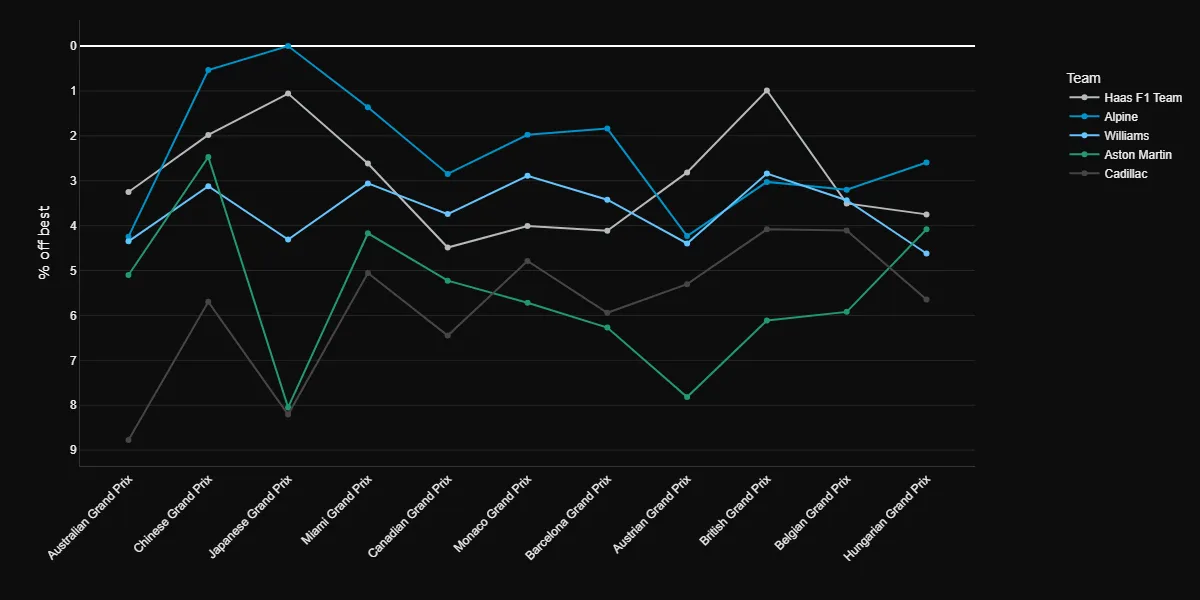
Aston Martin’s cornering gap has closed sharply from Spa to Hungary: from 6% to 4%, two percentage points found in one weekend, and enough to put them within reach of Haas and Alpine. The floor package was declared as a downforce package, and downforce is supposed to show up in the corners, so this is at least consistent with the upgrade doing what it was designed to do. Which must be seen as sucess from point of view from Newey.
The same chart also shows the shape of the car’s problem. Their worst weekend of the season was Austria, and the circuit profile explains why: 1.4 corners per km, 68% full throttle, an average speed of 234 km/h. Austria asks a car to be aerodynamically efficient at speed, and over very few corners. The Hungaroring asks something else entirely, 2.3 corners per km, 53% full throttle, 203 km/h average, most of it spent turning at low and medium speed.
So Austria being their worst weekend and Hungary their best is not a contradiction. It is the diagnosis. The AMR26’s weakness has historical been high-speed aerodynamic efficiency, and the Hungaroring does not test it. The weakness also comes from other parts of the car, like… the engine.
However this gives us something to check rather than something to argue about. If the floor is genuinely working, the cornering gap should hold at Zandvoort. If it was the circuit doing the work, it will reopen the moment the corners get quick again.
Now for the Achilles heel of the AMR26.
Straight Line speed - where AM is still losing
Straight-line speed has been a problem all season. Early in the year the team reportedly were running the Honda unit detuned because both drivers reported vibrations severe enough that they could not complete consecutive laps without pain in their hands, with concerns raised about permanent nerve damage over longer runs.
We measure straightline performance by weighting the total time spent on the straight. The slow part of the straight occupies the most seconds and should count for the most. Peak speed is a wrong measurement in 2026, as how long a car can hold deployment down a straight is more important than reaching peak speed.
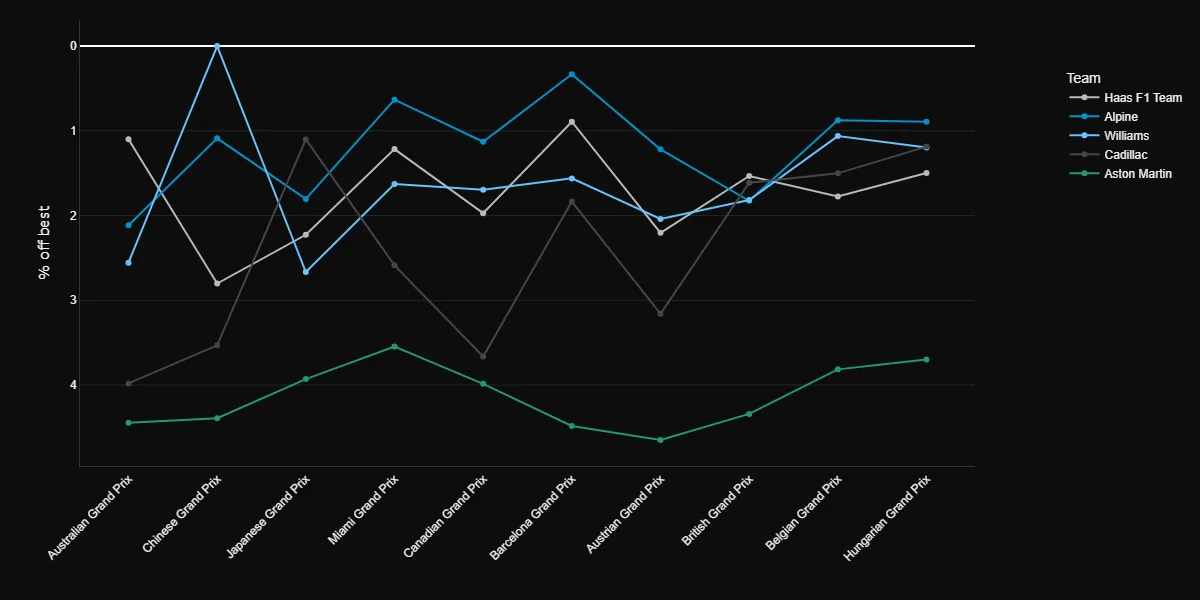
The graph shows the weakness has not moved. The gap to the field is still substantial, and it is why the Honda upgrade at Zandvoort matters more to this team than the next aero package in Monza/Baku.
What is positive from this measurement, is that the gap did not increase as they brought new aero upgrades, which again showcases the upgrades are efficient, probably a off-set between wing elements and weight reduction. However, only an educated guess.
This weakness leaves a question. Aston Martin were behind Alpine in cornering and well behind them in straight line. So how were they almost on par on pace and how did Stroll beat Colapinto?
Degradation
Driving a car quickly is one thing. Keeping it quick as the tyres go away is another. Degradation is the strategy enabler for a team, it can force your hand or it can give you the advantage the other teams don’t have.
Degradation is always relative. A slow car can degrade beautifully simply because it never asks much of the tyre, so the number means nothing without race pace beside it. Compare within a group, top teams against top teams, midfield against midfield or you are measuring the wrong thing.
Aston Martin ran only softs and mediums in Hungary. Both slopes are fitted on fuel-corrected laps in clean air, so neither fuel burn-off nor time spent in traffic is doing the work.
On mediums they had the best degradation of the group: 0.06s per lap against Alpine’s 0.10s. On softs the picture is the same, Aston Martin at the bottom of the loss table, with some of the flattest lines I have seen all season. That is worth more than it sounds, because by our own season measurements the Hungaroring is among the harshest circuits on tyres, matched only by Austria and Barcelona.
Why would a floor and a weight saving improve tyre life? Alonso, after qualifying, described the car as more consistent and more forgiving: “corner by corner, an entry meets an exit“. A car that carries more load and less mass slides less, and a car that slides less puts less heat into the surface of the tyre over a stint. That is the mechanism, but it is an inference, not a declaration. No team ever lists tyre degradation as the purpose of an upgrade; the FIA categories are load, efficiency, cooling and flow.
And there is a competing explanation that deserves saying out loud. Aston Martin spent most of this race in clean air with nobody to fight, Alonso ran 34 laps on a single set of softs, a stint driven to a target, not driven flat out.
The AM26 is now much better at cornering and degradation, however it still fails to perform on the straight lines. The issue is however that overtaking requires straightline speed. In 2026 the extra deployment available to a chasing car is supposed to make passing possible but this car’s straight-line deficit is large enough that it might not be enough. This affects the strategy calls.
Strategy
Aston Martin came into Sunday with a car that could corner, but had difficulty passing. That combination dictates everything: if you cannot overtake, track position has to be bought in the pit lane rather than won on the road.
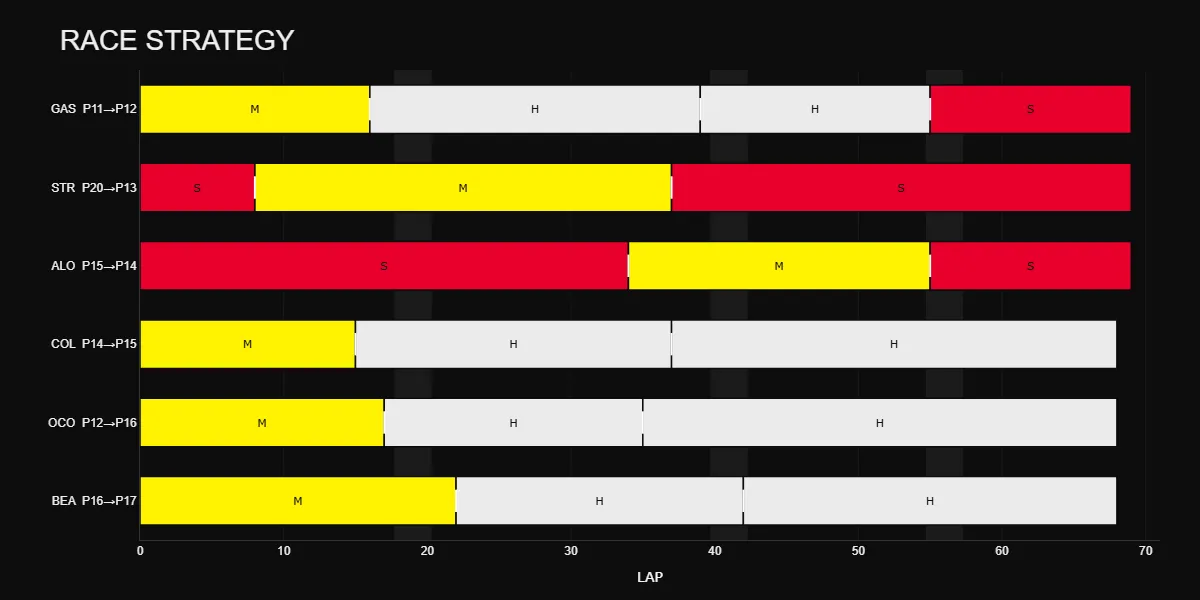
Both cars started on softs, and the race split them onto opposite strategies. Stroll got caught in traffic early and was pitted on lap 8, an undercut driven by circumstance as much as by plan, and the fastest available route to clean air. Alonso went the other way entirely, running 34 laps on the soft compound, almost half race distance, before stopping. One car undercut, the other overcut about as far as the tyre allowed.
The reasoning behind both is the same. In 2026 a chasing car gets extra deployment to help it pass, but when a queue forms, every car in it is deploying and harvesting in the wake of the one ahead, an ERS train, where the extra energy cancels out and nobody moves. With this car’s straight-line deficit, Aston Martin were never going to break one of those. They had to avoid being in one.
For Stroll it worked completely. He started 20th and finished 13th, undercutting Colapinto, Ocon and Bearman, and ran the final stint on softs with almost no measurable degradation.
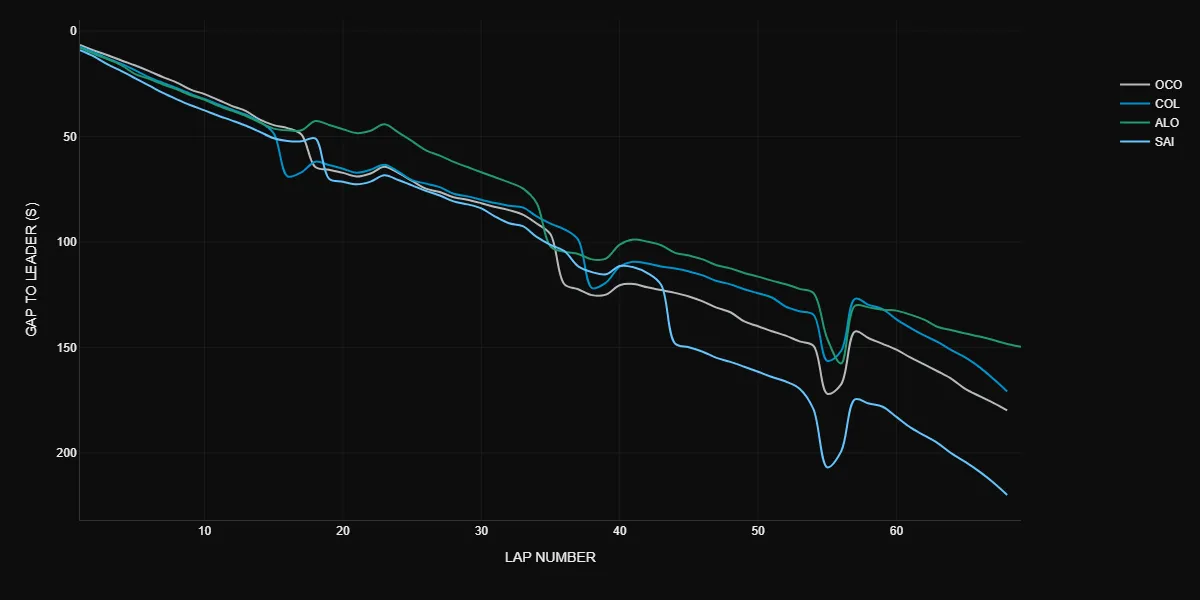
The gap chart is where it becomes clear. From lap 38 Stroll is on softs while Ocon and Colapinto are on hards only a few laps old. The expectation is that the soft goes away first and they come back at him in the closing laps, however they never do.
The pitwall call this weekend I almost find more remarkable than the upgrades themselves. But that gets the order wrong. The upgrades are what made the call available, a car that degrades like the old one could not have run 34 laps on a soft, and a car that could not corner would have been swallowed the moment it emerged in traffic. The strategy was the visible part.
Conclusion
Aston Martin came with a big package this weekend, and it delivered. For the first time they got into Q2. Two numbers carried their progress. The cornering gap has been closed. Degradation as well, best in their group in Hungary. However the straight-line deficit is now where they need to focus.
Aston Martin did great strategy calls this weekend, which enabled them to gain positions off the track.
What we cannot say yet is how much of the performance belongs to the Hungaroring. This car’s weakness has always been high-speed aerodynamic efficiency, and Budapest is the circuit least equipped to expose it. We have to look at these metrics again, as the calender progresses.
Three things to watch at Zandvoort
- The straight-line index. The aero package carries over unchanged, so anything that moves here is the Honda upgrade and nothing else. If that line lifts off the bottom of the chart, the engine story is real.
- Whether the cornering gap holds. Zandvoort’s quick, banked corners ask exactly the question Hungary did not. Hold 4% and the floor is genuinely working. Reopen, and Hungary was the circuit doing the work.
- Degradation under pressure. In Hungary they ran in clean air with nobody to fight, with only about 13-16 laps in dirty air. However if we put them in direct battle with other car’s on same compounds we get a better indication how the degradation holds up.