
The final race of Zandvoort 2026 has just run its last lap, and this analysis digs into the stories the weekend left in the data. There were plenty of them, we focus on a few here.
Norris claimed his second win of the year, showing McLaren are in this for a fight. Mercedes issued strict team orders while Ferrari fumbled. Red Bull seem to be falling behind, while Audi, Alpine and Aston Martin are gaining.
In this review we dig into how Hulkenberg climbed from P13 to P8 on an alternative SSH strategy, how Alonso went from P18 to P9 as the only driver on a one-stop, and why Piastri was so slow compared to Norris.
To do that, we go into the data.
Audi and Hulkenberg struck again
Audi were again able to get points on the board, and they got more than their competitors, bringing the gap down closer.
Hulkenberg started P13 and ended P8, starting behind Gasly, Lindblad, Colapinto and Gasly. Colapinto is not particularly interesting to follow, as he got a penalty which put him out of the points. However the continuous battle with the others became interesting to follow.
Both Alpine drivers started on the medium while the Racing Bulls and Hulkenberg went for the softs. Hulkenberg did two amazing things in the first lap. He got into P10 before the red flag and he was able to fly around his teammates who were surrounded by a tsunami of smoke in the last corner.
At the restart of the race Hulkenberg stayed on softs at P10, while Gasly and Lindblad went for mediums. Shortly after the restart Lindblad had an incident, which put him into the back of the grid and he was out of any points. However he was able to recover positions, however no more a threat to Hulkenberg. The real threat at this point became Gasly and Tsunoda, this were transparent by a few factors. Still at lap 15 Hulkenberg was right behind Gasly, while having Tsunoda at his tail.
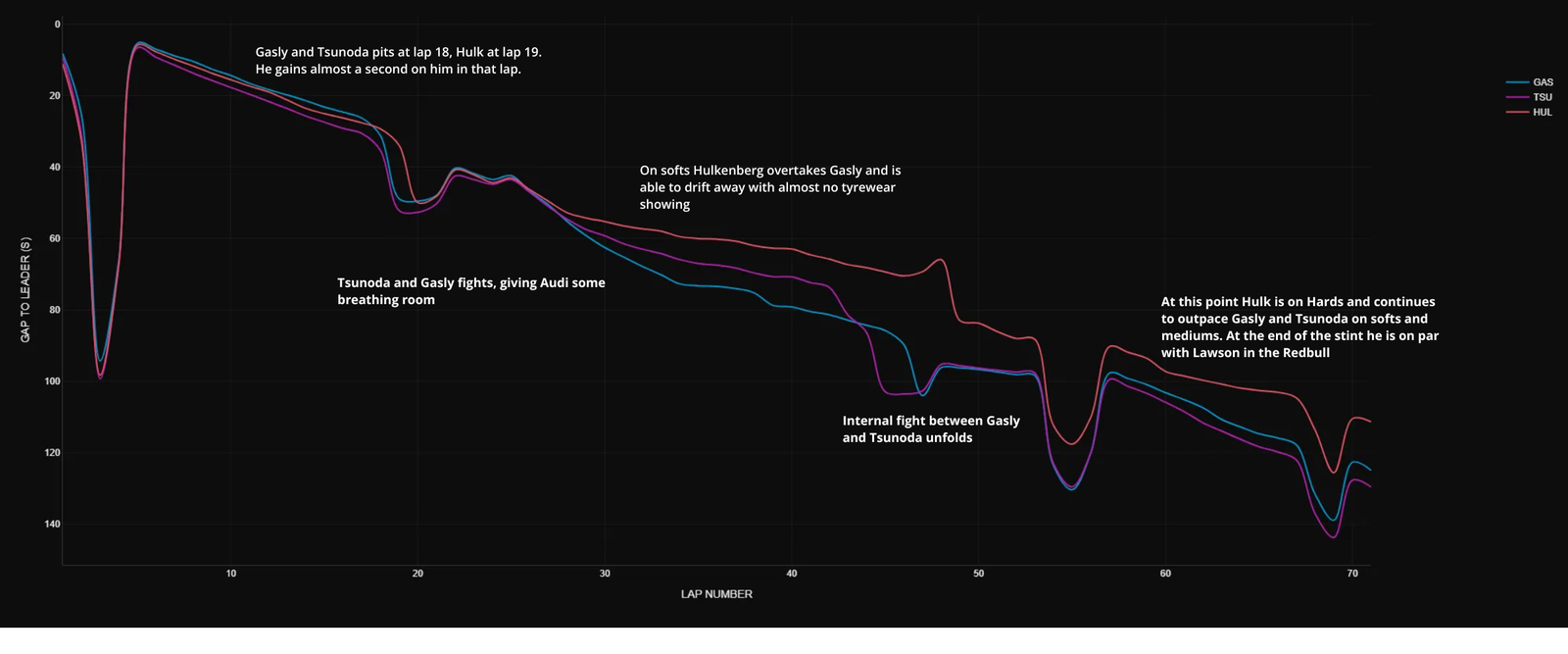
At lap 18 both Tsunoda and Gasly went into the pits to put on a new set of hards, This was hard defending from Gasly and an early punch from Tsunoda. Hulkenberg responded promptly the lap after, however he went for a new set of softs.
When Gasly went into the pits Hulkenberg was 1.3 seconds behind him, as he left the pit he was 0.3 seconds behind him. However at the same time Tsunoda gained 0.9 on Hulkenberg. Hulkenberg was able to cover them off because of their tyre choice as hards are more difficult to fire up.
As Leclerc surely showcased on Saturday that the soft compound was able to hold on for a long time, Hulkenberg was able to push on the in-lap into the pits, before switching on a new set of softs. That meant Hulk was on the softest compound while Tsunoda and Gasly on the hardest compound. Just for reference the soft compound showed same degradation rate in the sprint as the mediums did.
This meant Hulkenberg went for the gearbox of Gasly. However Gasly had the Mercedes engine making it difficult for Hulkenberg to overtake on the start/finish line. This meant he was stuck behind Gasly for a few laps, which meant Tsunoda was able to catch up. All three were stuck together from lap 23 to lap 26. Shortly after lap 26 Hulkenberg was able to slowly pull away from both of them as Tsunoda also overtook Gasly. If we look at the tyre degradation we can understand why.
Hulkenberg lost 0.07 seconds each lap on softs.
Tsunoda lost 0.04 on hards.
Gasly lost 0.11 on hards.
This meant Hulkenberg had pace as if he were on the softs, but degradation as if he were on the mediums. With that pace gap between softs and hards he were able to drift away with a constant speed in clean air, keeping the temperatures down.
They now had the upper hand and just had to defend. On the last stint Hulkenberg put on a new set of hards and were able to run it safely from Gasly and Tsunoda to the finishing line
The pace difference is really showcased by each stint. What you see below is the fuel adjusted laptimes for each of the three drivers. The first bar is Gasly, then Hulkenberg and then Tsunoda.
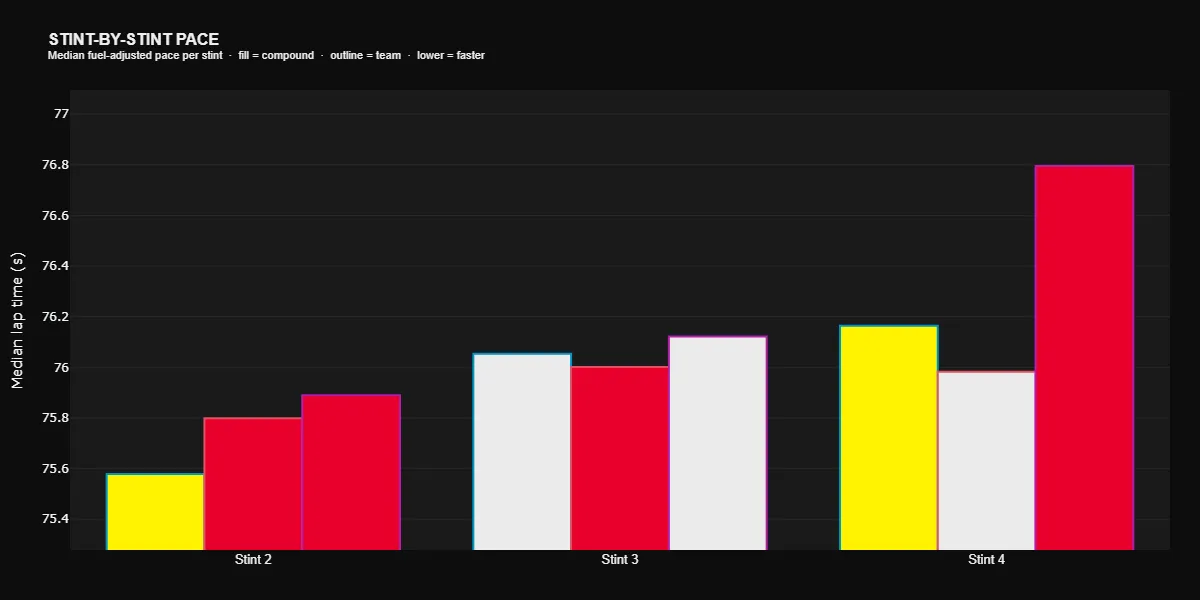
From it we can clearly read that in stint 3 and especially 4 Hulkenberg pace was superb compared to them. Even on the hards in the last stint, Hulkenberg was much quicker in clean air.
Alonso says no to degradation and continues to go half distance on softs
One car went from P18 to P9, gaining 11 places, many of those had a dnf, but only first after they were overtaken. Alonso started on the softs, and was able to gain a few places before the red flag. As he went out in Q1 he had multiple fresh softs set left. At the restart he had fresh softs on again. Somehow Alonso managed to hold on to those softs for half race distance, before pitting and finishing on the hards.
The strategy
This is not a big surprise, because in Hungary Aston Martin were able to run softs on half distance as well. A track where the cornering density is the second highest after Monaco. After Hungary it stood clear that the AMR26 had become much faster in the corners, however it still lacked straightline speed.
This meant the overtake possibility was poor, as you need straightline to do safe overtakes. In Zandvoort it was clear the upgrades weren’t tuned all the way up yet or at least did not deliver. This had major implications on the strategy. They need to overtake off track, rather than on track.
In Zandvoort the team went for an alternative strategy as it was clear Alonso was faster than the guys in race pace in front of him. However he kept being stuck behind on the straight. It became about clean air vs. dirty air. Keep Alonso in clean air.
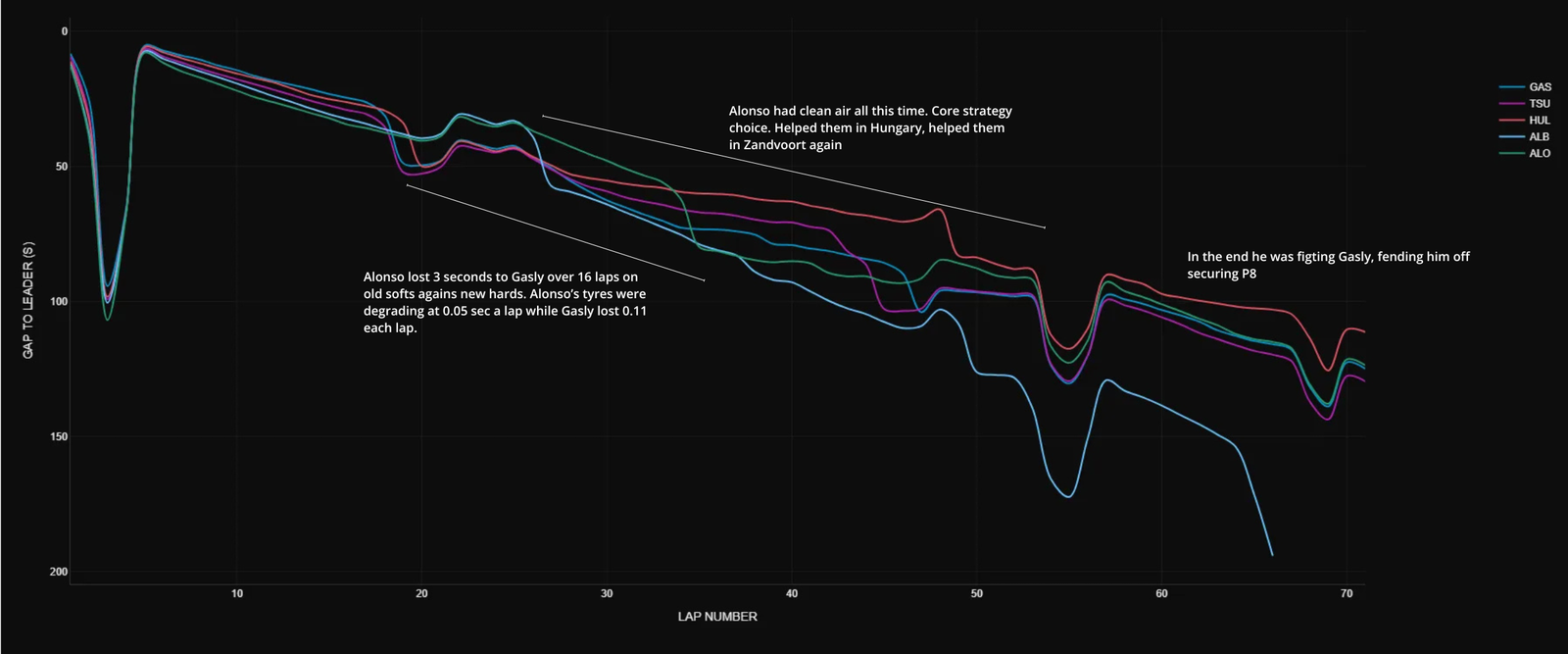
As the restart began other teams were sure Aston Martin would pit again, so they managed their strategy around his constant threat behind. Trying to cover a potential undercut early, Ocon pitted at lap 15, Alonso was now stuck behind Albon for multiple laps until finally overtaking him at lap 26 where Albon also chose to pit.
They waited for Alonso to pit again, lap after lap. However after 34 laps on the softs, Alonso went for the pits. At this point in time he only lost a few seconds to those near him at the pit. He came out in front of Ocon, and just behind Albon. Losing only 1 single sec over 7 laps. At this point Ocon and Albon realised they weren’t racing Aston Martin anymore, as he came out on hard and did not plan to stop another time. With the tyre-offeset (having more fresh tyres than those drivers around you) he was able to catch away easily.
What they infront, Lindblad and Gasly did not realise was that Alonso was not just catching them, and as they came out of their second pitstop, Alonso was ahead.
Let’s look at a few charts to help us understand the strategy. Looking at the graphic, the exposure had 18 laps in dirty air. Almost all of those were in the beginning of the first stint after the restart.
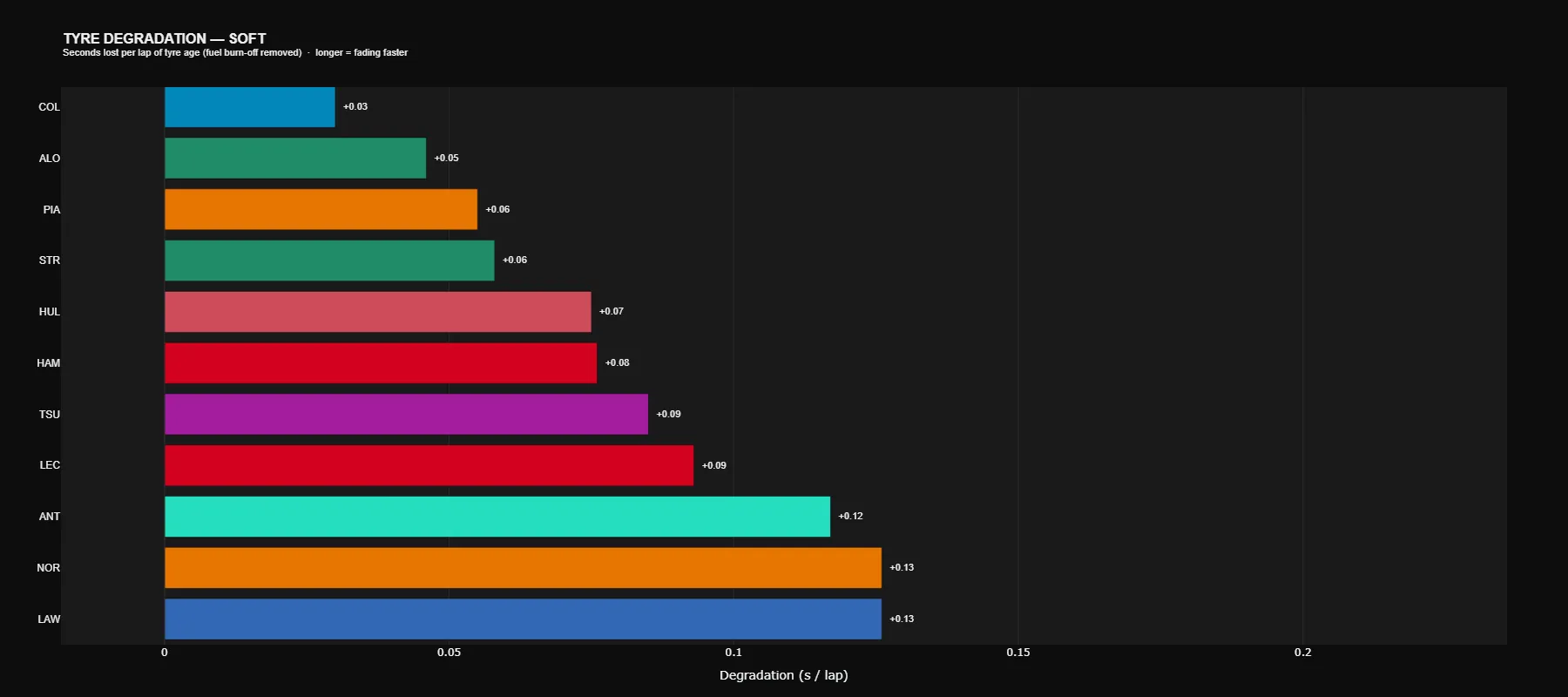
Alonso had among the lowest tyredegradation of the field on softs, even though he did almost half race distance on softs, while many others only did a quarter. As we have talked about in our latest midfield comparison in regards to the pillars of a racing car, degradation is relative. But it is a strategy enabler. It makes a team more potent to undercuts/overcuts as you have more trust in the car’s capabilities and other teams wont have the power to force your hand.
The other teams weren’t able to force Aston Martins hand, instead forced each other’s hand giving Aston Martin a clear advantage in the race.
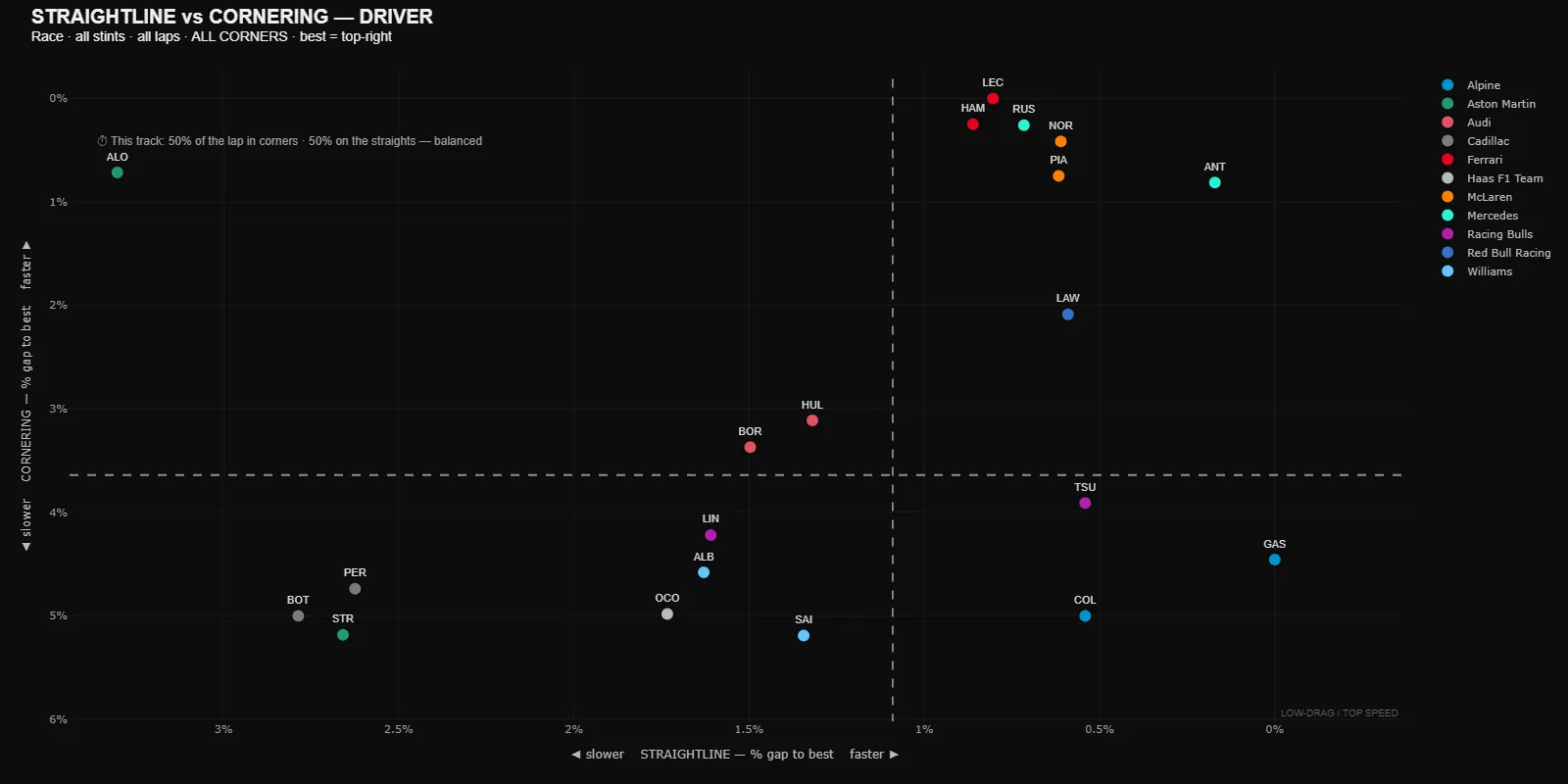
The Car Signature chart is one of my favorite charts, because it helps us understand how each car behaved in the race and explain why some decisions were made.
Being in the top-right corner, you have the best of both worlds. Fast cornering and amazing straightline speed. Being in the bottom-left, means the worst of both worlds. And then you can be inbetween. Alonso found himself alone in the top-left. Superb cornering, despite using the only two sets of tires, however with very low top speed overall. The straightline speed can in this case to some degree be shaped around having boost mode, so can the cornering be affected by dirty air. However we use all laps, which should still give some robust measure to help us understand the ranking a bit.
Three things shaped Alonso’s strategy
1. Straightline vs. Cornering –> Need for clean air
2. Low tyredegradation –> Enabling clean air for longer
3. The others on the grid fought each other –> Losing time to Alonso
I don’t know this, but this is what I see from the data provided by FastF1.
What happened to Piastri?
Norris won the race and fought both Kimi and Russell, as Piastri found himself alone in the race for most of the race. He experienced by far the less amount of traffic, compared to rest of the grid. But why was he so slow? It all comes down to the 3rd stint.
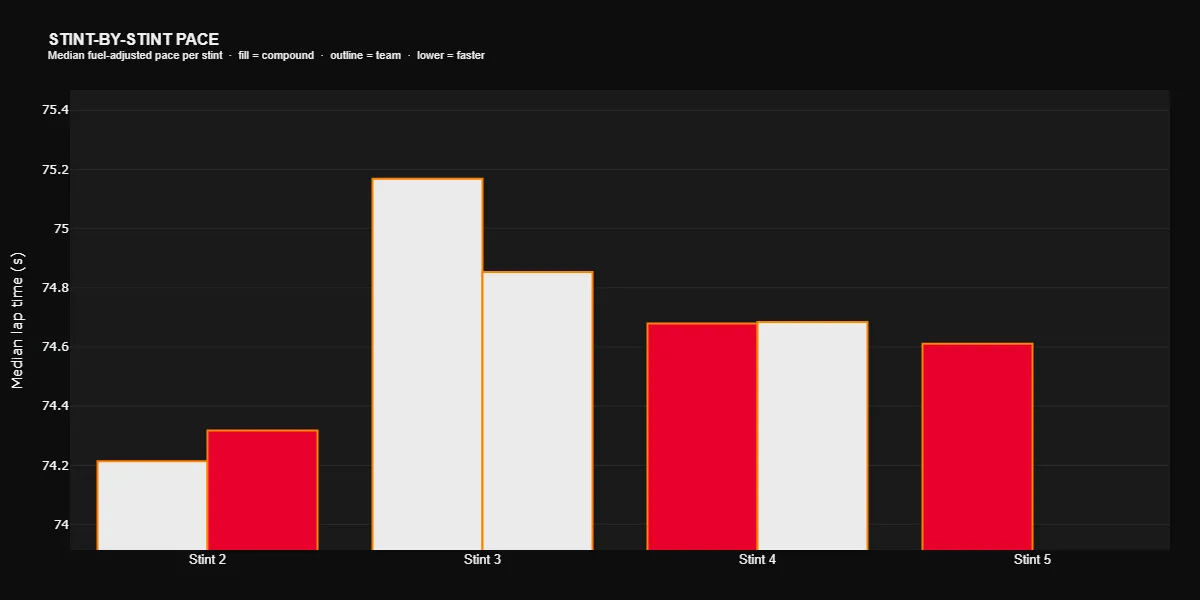
This is a stint by stint comparison between Norris and Piastri. The first bar is Piastri while the second one is Norris.
First and foremost if we look at the overall pace across all laps in clean air Piastri are only just ahead of Norris despite using one more tyre in the race. Looking at the first stint Piastri, was actually faster on the hards than Norris was on the softs. In the 3rd stint where both were on the hards it all fell apart.
In the 4th stint he was on par on softs.
Looking at the above Car Signature chart it can be observed Piastri and Norris are on par on straight-line speed but Piastri just a notch behind on cornering.
If we zoom in on the corners of the second stint we can see it clearly.
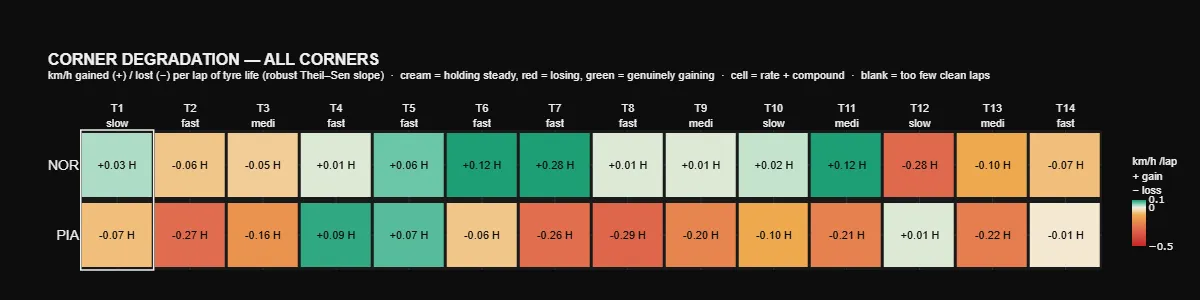
The chart takes clean laps across the 2nd stint and measures the time it take for each car to get through the corner and translates it into kmh. Very robust as it rewards good cornering and not deep dives in into the apex.
When the heatmap becomes red it means the driver is losing speed across the laps in that specific corner. As we can read from the diagram Piastri is losing time almost across the board in all corners, while Norris either gains pace or keeps it at a minimal loss.
This also comes to show on deg charts where Piastri lost 0.11/lap while Norris lost 0.09/lap.
Conclusion
Racing Bulls and Alpine have 40+ point advantage over Audi. If top teams stay in the race there will only be 3 points available in each race. This is not enough for Audi to get up there and push them off the board. Therefore Racing Bulls and Alpine are stille racing eachother as there are only 3 points between them. Audi will need a chaotic race to reduce the gap as Monaco gave Racing Bulls and Alpine a great chunk of points.
Audi is hoping and will create a gap to secure 7th place in the constructors.
Aston Martin had a great weekend once again in Zandvoort after their improvement from Hungary. However the lacking of straightline speed forced them to pursue alternative strategies which were possible because of their true clean air pace in Zandvoort. They went with a 1 stopper creating maximum clean air for Alonso. Aston Martin had a great weekend in Zandvoort because their chassis has become the best of the midfield, however Zandvoort is 50% cornering. Next time it will be the temple of speed in Monza where they spend half if not less in the corners.
I expect Aston Martin to struggle, but over the course of 2026 they could reel in Haas, provided Haas fail to improve. As a midfield contender, a single standout strength pays off big: it lets you consistently score at every “dense corner” track while your competitors need a miracle just to get close. When you’re fighting in the midfield or at the back, it’s far better to be exceptional at one thing than a jack of all trades.
Piastri were beaten by his teammate in Zandvoort, he lost most of his time in the 3rd stint on the hards in the corners. Maybe he will make his comeback in Monza when the corners are only a partially part of the track, however they stay important.