
First race at madring. Expectations were high, deliverence was low. Everybody expected a thrilling race, even I, with high degradation and a race of chess by strategist sweating their hands and second guessing every decision. Instead we got Monaco, but worse. I am personally a great defender of the sport, I can defend Monaco. I can defend Hungary. However I cannot defend the Madring.
We lost Spa, we lost Zandvoort. This is a whole new circuit for 2026. They knew about the size of the cars, they knew what both new and old F1 fans want. However still they failed to deliver. The fans lost and so did the lando Norris.
Lando had a perfect weekend. Only issue he had until the race was not attending FP2. He put it on pole by a margin, however he was 0.3 sec ahead before brushing the wall at the last exit. He put it on pole and he flew away in the race. However the VSC and the layout of the circuit ultimately decided his faith in Madrid.
In this piece we dive into a few things.
1. Why it was the right thing to pit Norris regardless of the VSC.
2. Could fresher tyres have helped Norris?
3. Why Madring was such a dissapointment.
Did Mclaren do it right?
First digging into the laps before and after Norris pit.
We can see that Norris the tires were reaching a cliff-point. The mediums were beginning to degrade by 0.2 sec a lap, taking into account fuel. That is a massive loss pr. lap. On the other hand the laps on a new fresh of tyres were multiple seconds faster than a 13 stint medium.
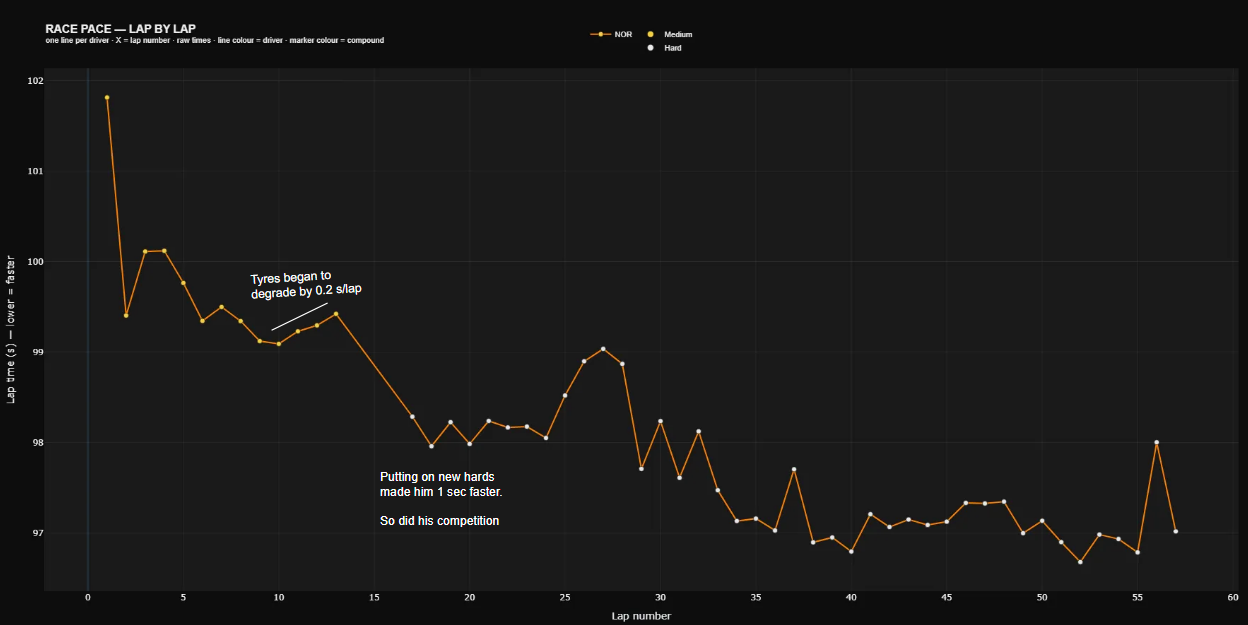
However one could argue that losing a few seconds on the mediums, could be saved by having a better tyre-off-set which then could have helped Norris in the end to actually overtake Verstappen.
However Russell also choose to pit during the VSC, in order to do something different than Leclerc. Russell was 15 seconds behind Norris, when Norris came out of the pits Russell was 7 seconds behind. Had Norris waited only 4-5 seconds, Russell would have overtaken Norris, taking into account Russell would be 1 sec faster than Norris and Norris’s tyres were degrading.
Thus Norris would have to overtakeRussell before getting the chance to even overtake Verstappen. Across the race hrunning in dirty air costs the field around 1.5 s a lap compared to clean air. This was way too expensive to give up for Mclaren, and thus they choose to play it safe and keep P3 with a chance of P2.
Ultimately Norris made a charge, but the circuit denied him
After the VSC Norris were on the backfoot, he was effectively 10 seconds behind Verstappen now, and 16 seconds behind Antonelli.
However after after nursing the tyres into the right window and awaiting Russell to do his second pitstop he was of to a charge against Verstappen and Antonelli. Basically taking 0.5 s/lap on both of them. However his charge hit a plateau when he reached Verstappen were he werent able to overtake on the track.
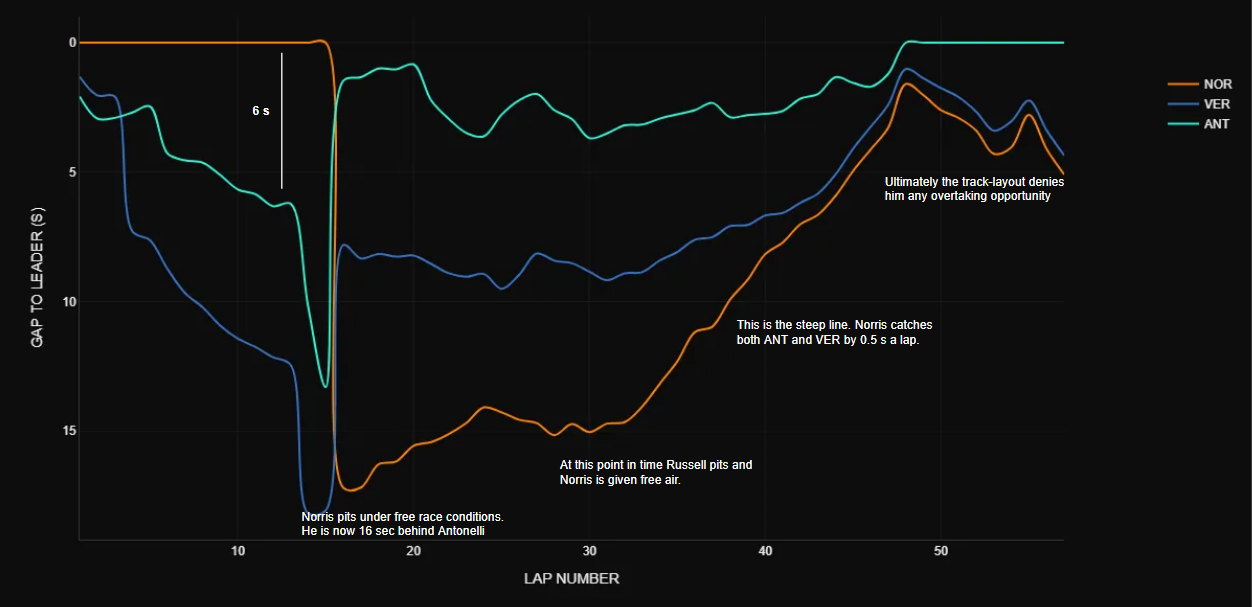
Norris clearly had a racepace which was much faster than Verstappen. However I think due to the layout and Verstappen’s skill he werent able to overtake without taking too much risk. The race for the win was done. Ultimately he could gain 3 points by overtaking Verstappen, however it was not worth it.
Looking at the average race pace of each driver, Lando were among the top across the field, however the circuit ultimately denied him the posibility to overtake and win the race.
I am not in a believer that the VSC should have let all cars have the possibility to pit. It would be the same to say that cars starting on hards in a 1 stop race, should be given the option to use HH when the red flag occours. It is bad luck, however when the driver who were put on the backfoot is able to come back, the layout of the race should atleast make it possible for him to overtake or atleast try.
Next we step into the real issues of the Madring
Why I dislike the Madring
I think the introduction to this piece says it all, so I just want to dig into the issues.
I run through a few exhbits, they build upon eachother so have patience.
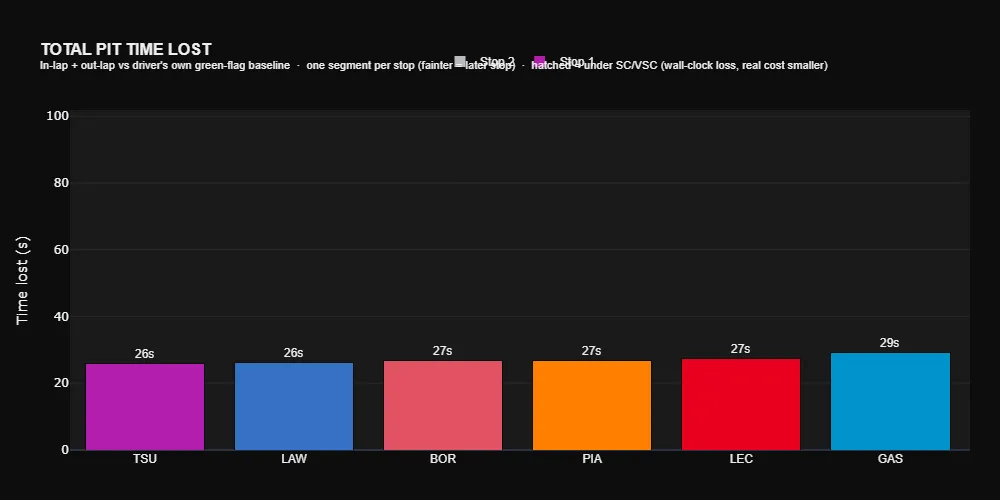
Pirelli estimated that it would take 25 seconds for a pitstop. This is ultimately true. However taken into account the in/out-lap the average pitstop loss under full-race conditions was 28 seconds. That is extra 3-4 seconds, which is huge when considering a two-stop versus a 1 stop. Encourgering a 1 stop even more.
Lets jump to the next exhibit.
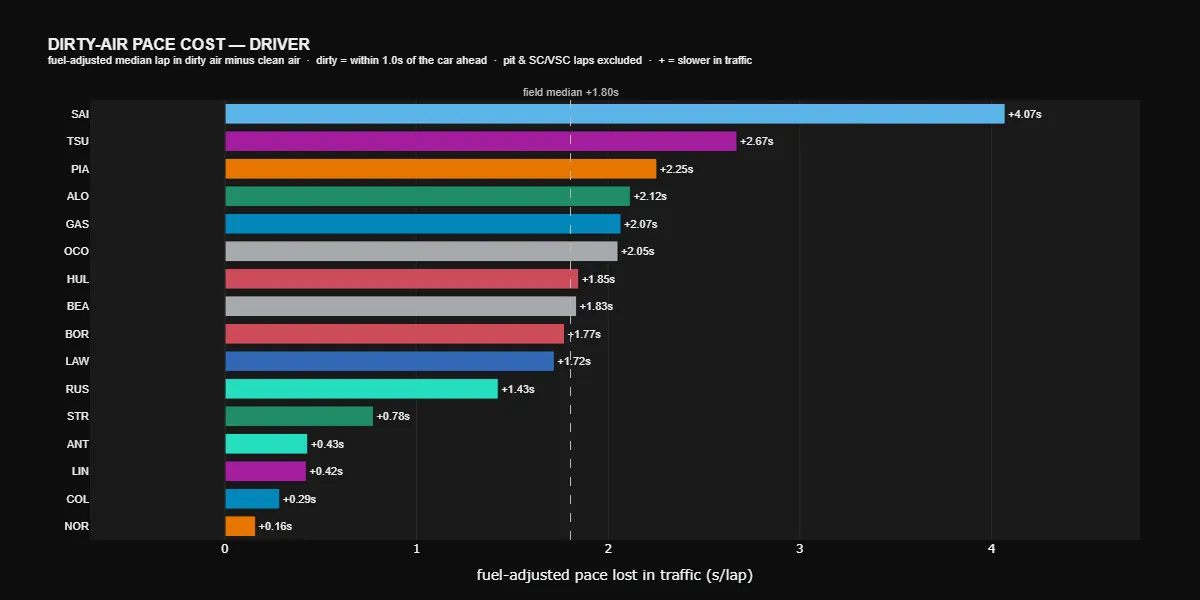
You are looking at the laptimes of each driver in dirty air compared to clean air. What we are reading from the chart is that the field median across the grid was 1.8 sec a lap, compared to running in clean fresh air. That is a massive loss of pace, and is due to the layout of the sector in S2/S3 where fast corners are evident and dirty air reduces the aerydinamic efficiency of the car.
What does this mean to the race? It means that you want to be in clean air for any given price, you even want to take an additional pitstop if it means you can drive in clean air for the rest of the race, however you wont because you can’t overtake. We touch upon this later.
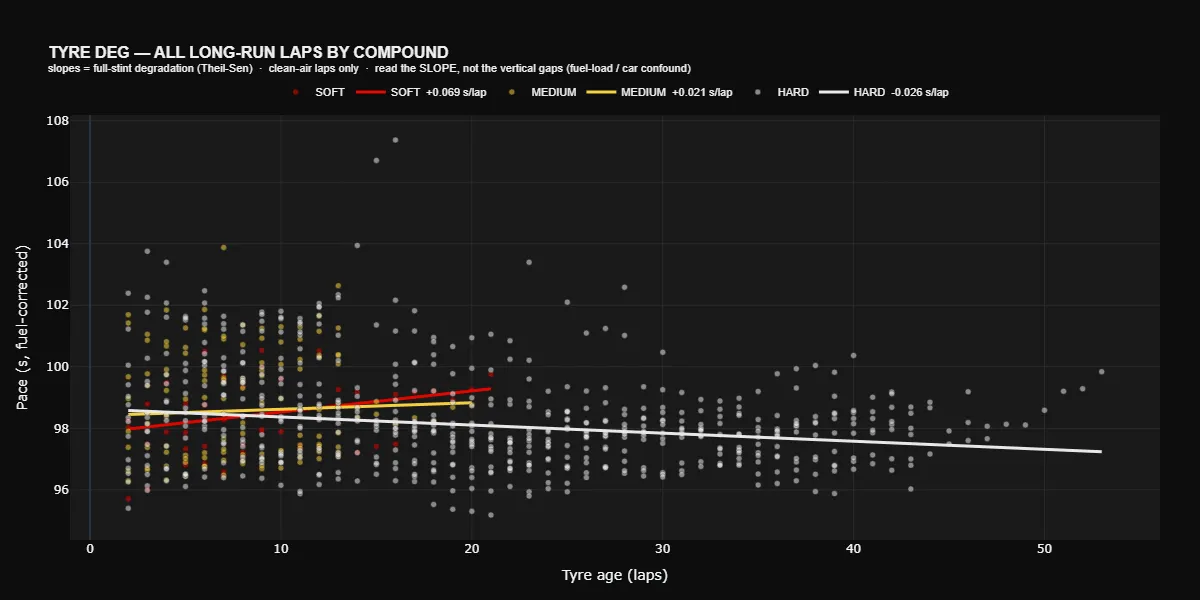
This is the classical degradation chart. We se two things. Softs are degrading at 0.07 s/lap, mediums as 0.021 s/lap, while hards essentially have a negative or zero degradation.
And we could ask ourselves. Why is that? Well the median Q3 time in qualifying was 1.32 minute, the best lap set in the race was set by George Russel 1.35 the average laptimes of the top field was 1.38.
This is 3 and 6 seconds slower than the median Q3 time. This indicates to me that drivers were managing the hards tyres by a lot. Even taking into account the fuel we would still be a few seconds off qualifying even on the softs.
Now to the nail in the coffin.
The overtaking at the Madrin was not very good. This was already the case in both F2 and F3 where DRS were activated by lap 2. The F1 teams ofcourse knew this and so did the drivers, they are quite experinced and can sense racing lines like a hawk can see a mouse in the field. There were very few racing lines were the report from most drivers.
So to get a better sense of what would it actually take to overtake in the Madring I did some digging.
This is a monster comparison but we compared overtaking opportunities across all straights in Monza and compared them to Madring. Depending on the lenght of the straight and the gap, a car essentially need a certain amount of speed to overtake the car in front. So we ran the numbers and took all “almost or did overtake” opportunirties in the race and ranked each straight by how far back the opportunity were created going into the corner and compared it to the gap the cars typically had during the race.
First we take a look at Monza
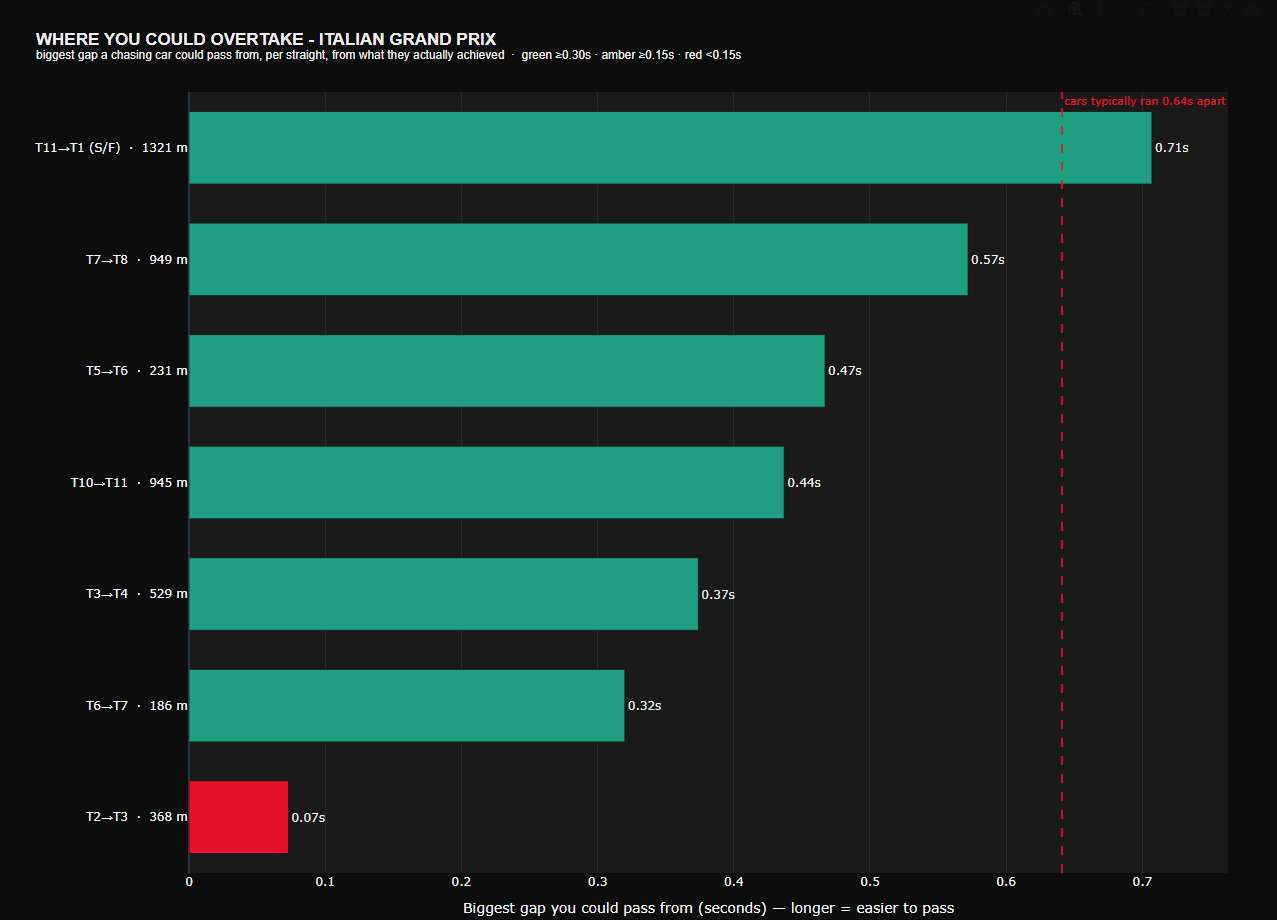
Typically in Monza cars spent 0.64 seconds apart, while in closing distance. At the start/finish line into turn 1 there were reports of drivers overtaking or close to overtaking the driver ahead by being 0,71 behind. This was also the case between T7 and T8, as well as T5/T6. In general this indicates Monza is a track where overtaking is quite possible to due slipstream and long enough straights from “fast” corners. Great track, not so much strategy, but a lot of action. Fair trade-off.
Lets take a look at Madring, exact same methodology applies.
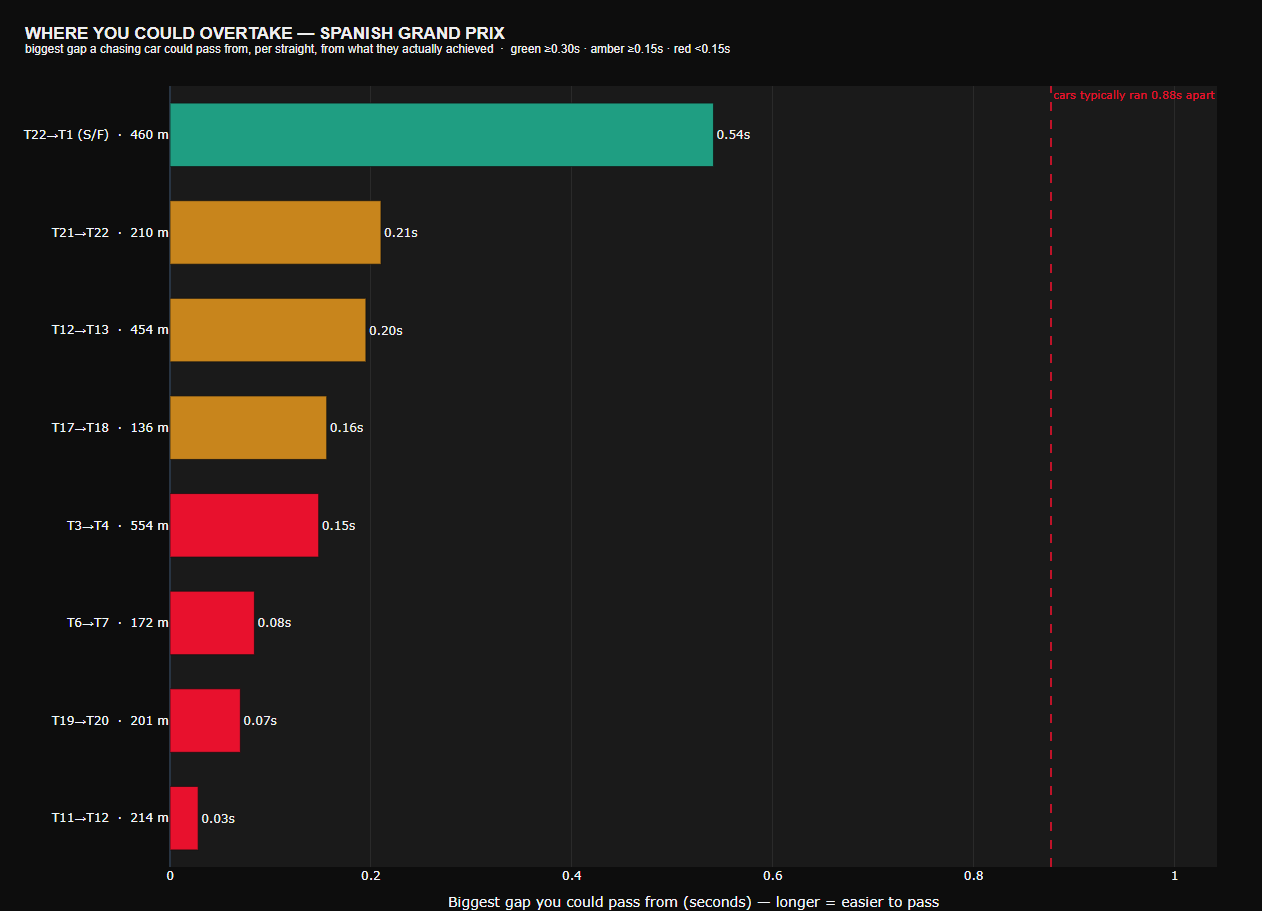
At Madring drivers spent ultimately a gap of 0.88 seconds apart when in traffic or dirty air, this is as we wrote earlier due to dirty air in S2/S3 reducing downforce immensly.
So effectively at the Madring.. what we observed in the race, the best and only opportuinty for overtaking was Turn 1 and that only happend if you were able to keep yourself 0.54 seconds behind the car in front. The straight from T3 to T4.
I know a lot of not reliable straights are showing in the picture, such as T6–>T7, but it is just an overall picture and I will be judging it alone on the real straights.
So after reviewing some different things from the madring. The overtaking issue is not an issue in itself, either of the above is an issue by itself. It is the combination.
1. Long pit
2. Dirty air loss above 1.5 sec
3. Overtaking seems extremely difficult
The result is every team sees the 1 stop nursing strategy as the best, as doing anything different would be too big of a risk due to the above.
Solutions?
1. Softer tires
2. Shorter pit
3. A longer straight