
Constructors' P5: Racing Bulls vs Alpine
For every team outside the top four, P5 is the best result on offer. It is “best of the rest”, and it matters to owners, sponsors and the prize money alike. This year it is a straight fight between Racing Bulls and Alpine.
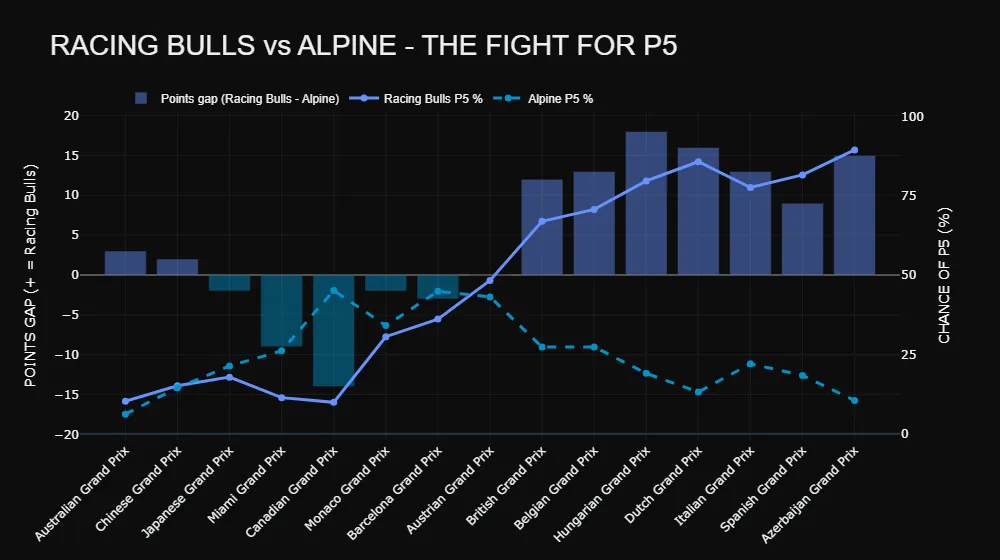
Racing Bulls lead by 15 points. But the pace has swung Alpine’s way.
How the fight developed
Racing Bulls made the stronger start. With both Lawson and Lindblad able to score, they banked points steadily, while Alpine’s season took longer to get going. Early on, Haas were in the mix too, with Bearman scoring in Australia and China.
The fight tightened from Japan, where Gasly held off Verstappen to bring home valuable points. From Miami, Haas dropped out of the picture and it became a two-team battle. After Canada, our model had Alpine at 44% for P5.
That chance faded in Monaco. A chaotic race first put Alpine ahead, but they lost a podium-level result late on, and Racing Bulls left with the bigger haul. From Austria, Audi joined the fight for a few races, at times finishing between the two.
From Silverstone to Zandvoort, Racing Bulls turned their pace into points and built a lead of more than 10 points.
Why the pace swung
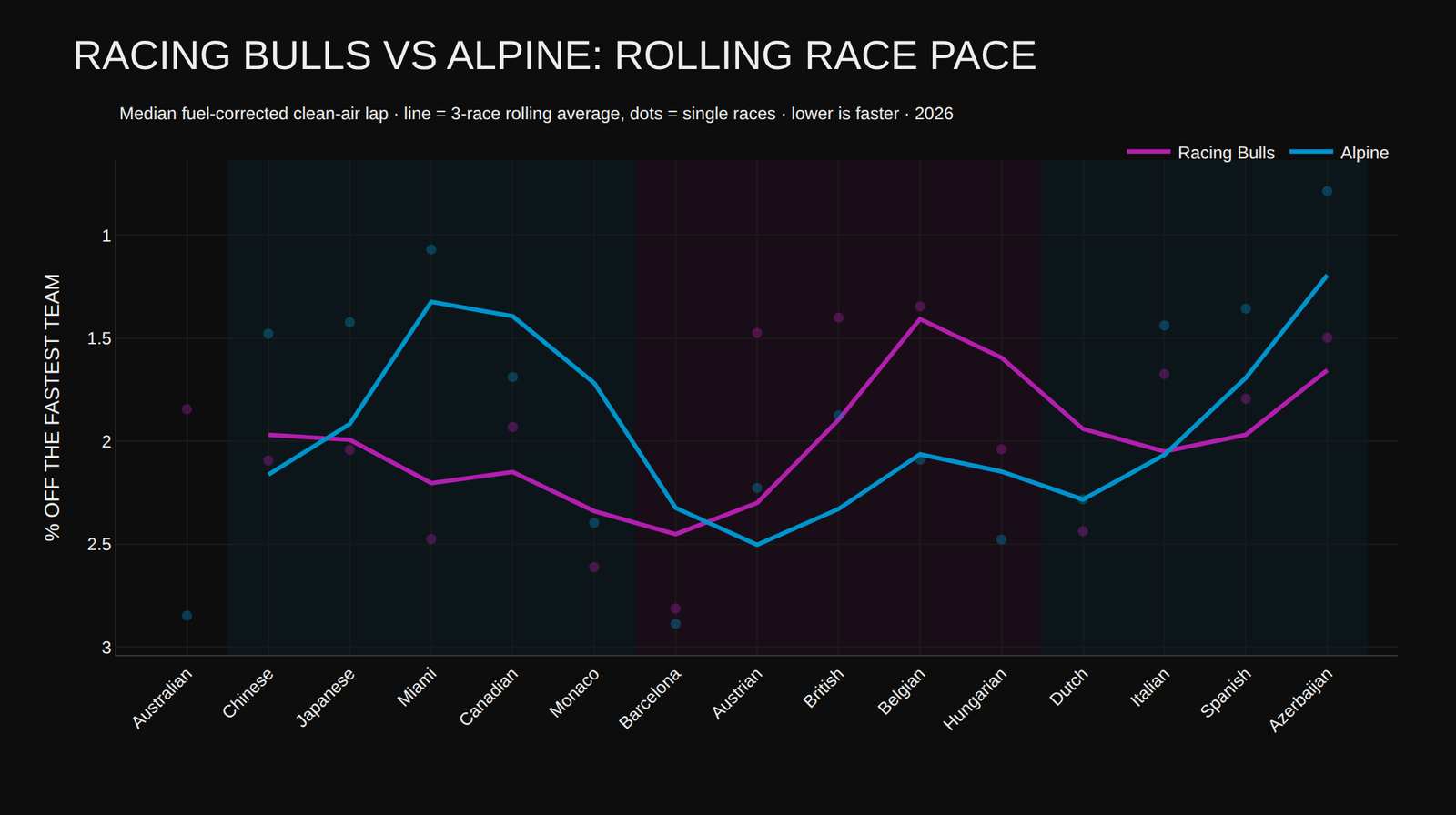
Race pace between the two has come in three clear phases:
- China → Monaco: Alpine quicker in five races in a row.
- Barcelona → Hungary: Racing Bulls quicker in five in a row.
- Zandvoort → Baku: Alpine quicker in all four, with the gap growing every race, to 0.7% in Baku.
The reason shows up when you split the lap into corners and straights. Racing Bulls’ mid-season run was built in the high-speed corners, where they were 3–5 km/h quicker from Barcelona to Spa. Alpine, powered by Mercedes, have reached the higher top speed for most of the season.
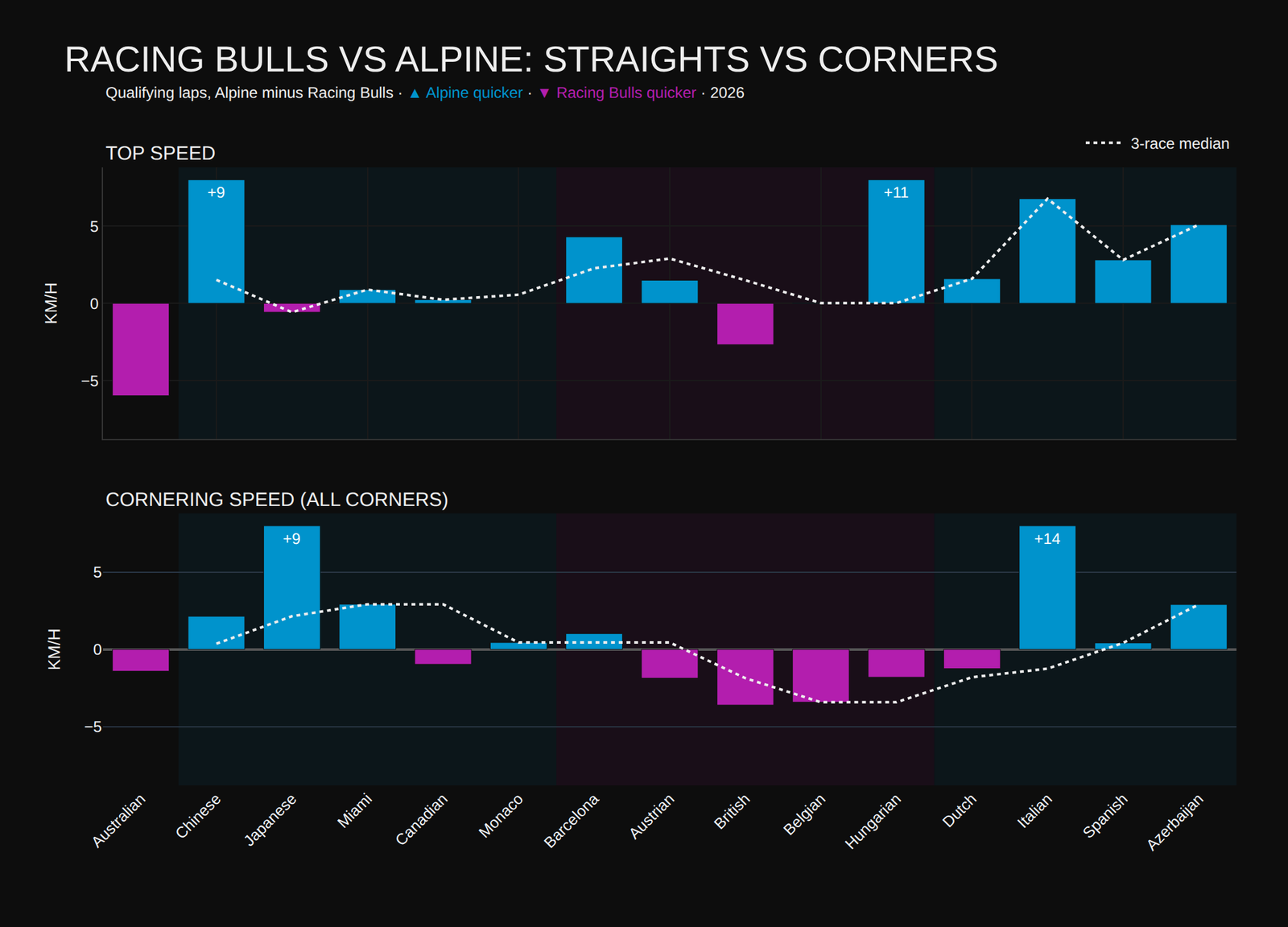
Then came two changes. At Zandvoort, Alpine introduced a bigger package aimed at downforce in the fast corners, first on Gasly’s car. Racing Bulls’ edge in the fast corners has been level since. At Monza, Alpine brought back the low-drag rear wing from winter testing, and Gasly took pole by 0.060s from Russell. The momentum carried through Spain and into Baku.
Baku, and where it stands
Baku should have been the race where Alpine cut the gap. It was their best race pace of the season, and they had the quickest car in this fight. Instead, Colapinto’s crash at the restart took out both Alpines while they were running 7th and 10th. That is roughly 7 points gone in one corner.
One nuance on Alpine’s straight-line speed: they usually reach a higher top speed than Racing Bulls, but give most of it back late on the straights as the battery runs out. At the braking point, the two cars have been almost equal on average. Monza and Baku were the exceptions. There, Alpine held their speed to the end of the straight, which points to the new rear wing.
Where it stands now:
- Racing Bulls: 15 points up, zero DNFs all season, and a small update in Baku (front wing, brake ducts, suspension fairings). With Red Bull switching most of its resources to 2027, more seems unlikely.
- Alpine: the faster car right now, with their upgrades already on it. A 15-point gap is catchable, but it needs clean weekends.
The remaining calendar
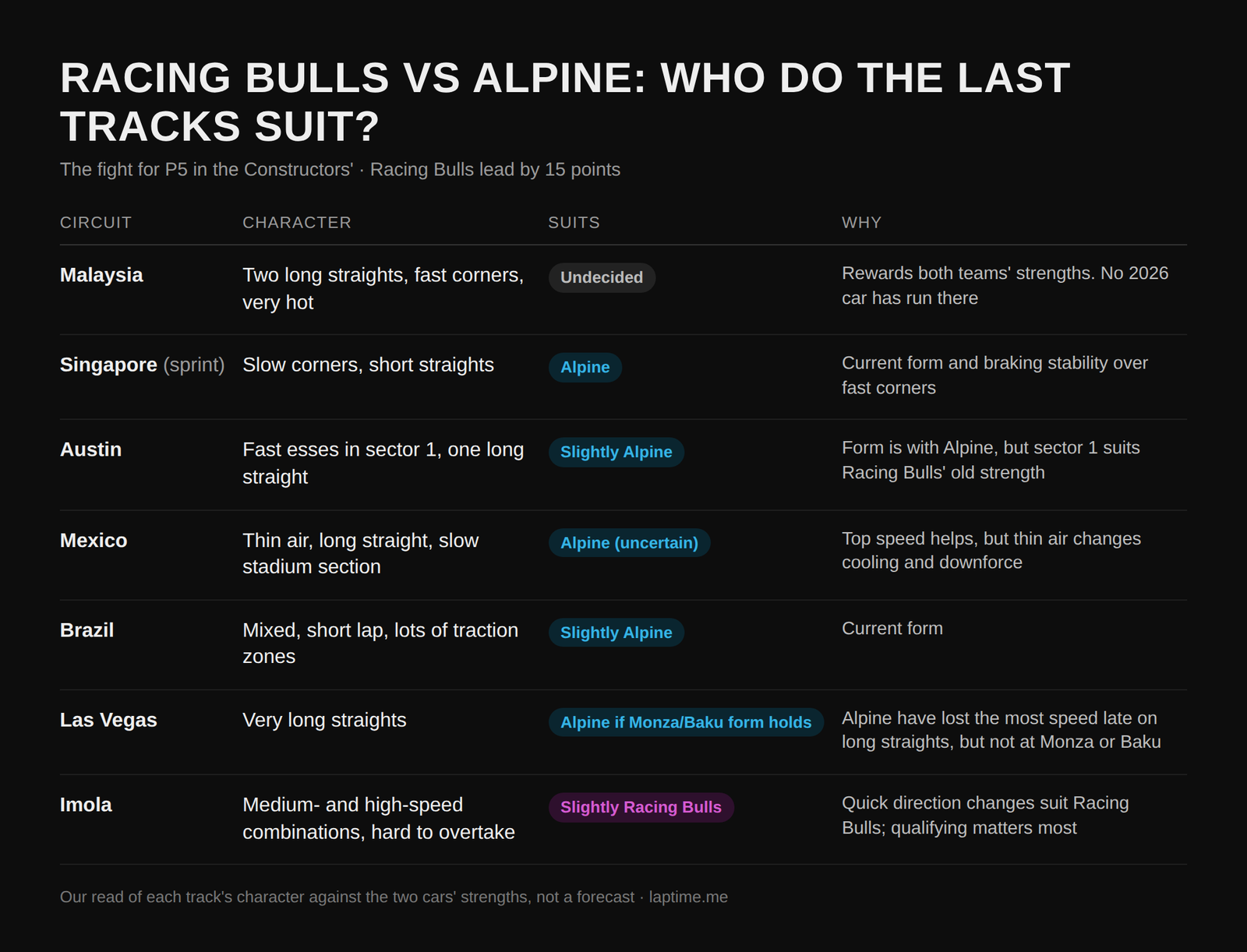
Most of the remaining tracks lean Alpine’s way. This is our read of each track’s character against the two cars’ strengths, not a forecast.
Verdict
Alpine have the pace, and their upgrades are already on the car. Racing Bulls have a 15-point lead, zero DNFs and a fresh Baku package, but probably nothing more in the pipeline. Their best hopes lie at Imola, and in Alpine either fading on the long straights in Las Vegas or retiring again.
What to watch
- Rain in Malaysia: a chance for Alpine to take a big swing.
- Las Vegas: can Alpine keep their straight-line speed to the end of the long straights?
- Singapore: does Racing Bulls’ Baku package show real pace, with sprint points on the table too?